
Buyers can finance off-plan property in the UAE through three main routes. Developer payment plans, post-handover payment plans and bank off-plan finance each cover a share of the purchase price. Bank products fund up to roughly half the assessed value during construction. Off-plan finance differs from a standard mortgage in its lower loan-to-value, its later repayment start and the construction risk it carries. Terms vary by lender and change often.
Can Buyers Get a Mortgage on Off-Plan Property in the UAE?
Yes. Buyers can now secure bank finance on off-plan property in the UAE.
For years, banks financed only ready property. For off-plan property purchase, buyers have no option for a mortgage. A buyer paid the developer in stages according to the payment plan.
Now, several UAE banks offer off-plan and handover-stage finance products. The list includes Dubai Islamic Bank, Mashreq, Emirates NBD, Arab Bank and Abu Dhabi Islamic Bank. Many products are pre-approved for large developers such as Emaar, Dubai Holding and Aldar.
But buyers should keep in mind three points:
- Bank off-plan finance is newer and stricter. Lenders cap the loan-to-value lower than they do for ready homes.
- Developer plans remain the default. Most buyers pay construction installments in cash and finance only the final handover payment.
- Previously, the mortgage was only available for UAE residents. Now the off-plan financing is extended to foreigners.
How Can Buyers Finance Off-Plan Property in the UAE?
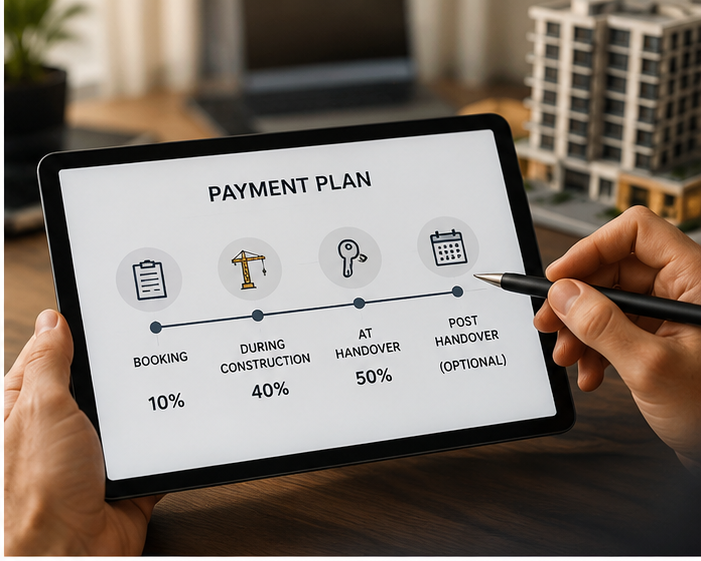
Off-plan property refers to a home purchased before construction is complete. The buyer purchase directly from the developer at a launch price and then pays on an agreed schedule. There are five ways to fund the purchase and the table below sets them side by side before each is explained in turn.
|
Route |
Who sets the terms |
Share financed |
Interest or profit |
|
Developer payment plan |
Developer |
Full price, staged |
None |
|
Bank off-plan finance |
UAE bank |
Up to around 50% of the value |
Yes |
|
Islamic off-plan finance |
Islamic bank |
Up to around 50% of the value |
Profit, not interest |
|
Cash-plus-mortgage mix |
Buyer and bank |
Handover payment financed |
On the financed part |
In practice, a buyer often blends these routes rather than relying on a single one.
Developer Payment Plan
A developer payment plan is the default route for off-plan property in the UAE. The developer sets the schedule and the buyer pays in stages with no bank involved. A typical plan opens with a booking deposit of 5% to 20% of the price, continues through construction installments that fall due as the building rises and ends with the largest payment on handover. Common structures include 40:60, 50:50 and 60:40, where the first figure covers payments made during construction and the second covers the amount due at or after handover.
UAE law protects these payments. Under Dubai's escrow regime, buyer funds sit in a regulated account and the developer draws money only at verified construction milestones. A worked example makes the pattern clear.
|
Stage |
Share of price |
Amount on a AED 1,000,000 unit |
|
Booking deposit |
20% |
AED 200,000 |
|
During construction |
30% |
AED 300,000 |
|
At handover |
50% |
AED 500,000 |
The total price stays the same in every plan. What changes is the timing of each payment, not the amount owed. Developer plans also carry no profit charge or interest in most cases, and they require no income proof or bank pre-approval, which makes them the easiest entry point for many buyers.
Post-Handover Payment Plan
A post-handover payment plan extends the schedule beyond completion. The buyer collects the keys while a portion of the price remains outstanding, then clears that balance in installments after moving in. The schedule usually runs in three phases.
- During construction, the buyer pays 50% to 80% of the price in stages.
- At handover, the buyer takes possession of the property.
- After handover, the buyer settles the remaining 20% to 50% over one to five years, and some developers stretch that window to seven or ten years.
Most developers post-handover plans charge no interest, though admin fees and late-payment penalties can still apply. The buyer should read the Sales and Purchase Agreement rather than the brochure to confirm the terms. The main appeal lies in cash flow, because a buyer can rent out the unit and direct the rental income toward the outstanding installments. On freehold projects, these plans also remain open to all nationalities, since eligibility flows from the contract rather than from a bank.
For example, the recently launched The Archives by Imitiaz offers a 60:40 post-handover payment plan where buyers have to pay 60% during construction, 40% paid over three years after handover.
|
Instalment |
Payment |
Due |
|
1st instalment |
20% + 4% DLD fee + admin fee |
On booking |
|
2nd instalment |
5% |
15/11/2026 |
|
3rd instalment |
10% |
01/04/2027 |
|
4th instalment |
5% |
15/08/2027 |
|
5th instalment |
10% |
01/11/2027 |
|
6th instalment |
5% |
15/02/2028 |
|
7th instalment |
5% |
01/07/2028 |
|
Post-handover |
40% (3.3% quarterly) |
Over 3 years |
Bank Off-Plan Finance
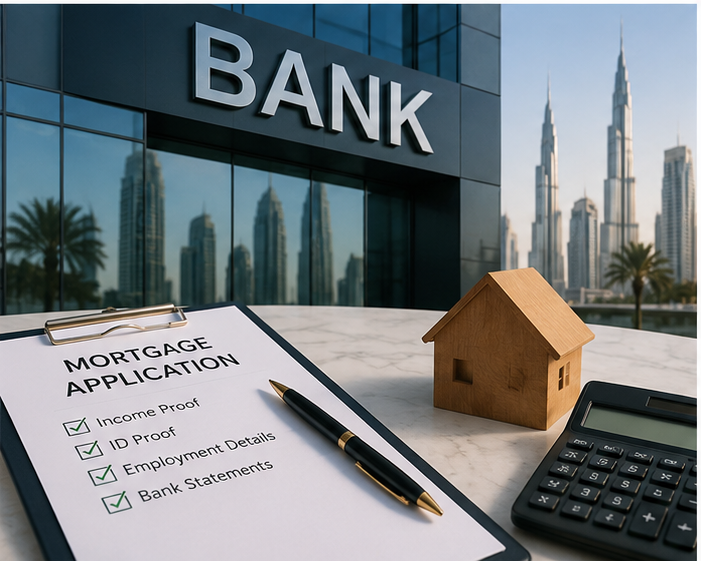
Bank off-plan finance is the newest route and it works differently from a standard mortgage. A UAE bank lends against a property that is still under construction, but it does not release the full loan at booking. The disbursement follows a set sequence.
- The buyer first pays a substantial share of the price to the developer.
- The project must reach a set stage of roughly 35% to 40% completion.
- The bank then releases funds in tranches that match the developer's milestones.
- During the build, the buyer usually pays only the profit or interest portion.
The loan-to-value here is well below the level offered on ready property. Current Central Bank rules cap off-plan finance at close to 50% of the assessed value for most buyer categories and the bank lends against the lower of the purchase price and its own valuation. The buyer funds the remaining balance. Rates and tenure track the wider mortgage market, with fixed rates that ran from roughly 4% to 5.5% a year in early 2026, variable rates linked to EIBOR plus a bank margin and terms that often extend up to 25 years.
Islamic (Shariah-Compliant) Off-Plan Finance
Islamic off-plan finance follows Shariah principles and charges profit rather than interest, which keeps the structure free of riba. For under-construction property, banks rely on a few recognized structures.
Murabaha
Works on a cost-plus basis. The bank purchases the property on the buyer's behalf and then sells it back at an agreed profit and the buyer repays that amount in fixed installments. No interest changes hands, so the arrangement stays within Islamic finance principles.
Ijarah
Works on a lease basis. The bank buys the property and leases it to the buyer, who makes rental payments until ownership transfers at the end of the lease term. This lets the buyer take possession without a conventional loan and the Forward Ijara variant extends the same idea to property that is still being built.
Istisna
Best for property under construction. The bank agrees to finance the build, the buyer pays in installments as work progresses and ownership transfers once the project is complete. That sequence makes it a natural fit for off-plan developments.
Islamic and conventional off-plan finance are often similar in cost. The difference lies in the legal structure, so a buyer who wants a Shariah-compliant route should shortlist Islamic lenders and compare their profit rates against conventional offers. In Aug 2026, Dubai Islamic Bank announced a new “Off-Plan Home Finance - The Smart Way to Buy Off-Plan” scheme to streamline the Shariah compliant mortgage to all buyers groups.
Cash-Plus-Mortgage Mix
Many buyers combine cash and finance and this remains the most common real-world approach. The buyer pays the developer's construction installments in cash, then applies for a mortgage on the final and largest payment at handover. Because the property is complete by that point, the bank often finances the handover payment at a higher loan-to-value than pure off-plan finance allows. This mix suits buyers who can fund the early stages themselves but want leverage at completion and it opens access to standard mortgage terms once the property is ready.
Off-Plan vs. Ready-Property Mortgages: Key Differences
Off-plan finance and a ready-property mortgage are distinct products. The table below sets out the main differences and the figures reflect current UAE market norms that should be confirmed with the lender.
|
Factor |
Off-Plan Finance |
Ready-Property Mortgage |
|
Loan-to-value |
Around 50% of the assessed value |
Up to 80% for an expat first home under AED 5 million |
|
When repayments start |
At handover or a set construction trigger |
Immediately after drawdown |
|
Main route |
Developer plan or bank off-plan product |
Standard bank mortgage |
|
Rental income |
After handover |
Immediate |
|
Risk profile |
Construction and handover risk |
Lower |
The contrast is straightforward. Off-plan finance demands more equity up front and begins later, while a ready-property mortgage offers higher leverage and immediate use of the home.
Who Can Finance Off-Plan Property in the UAE?
Eligibility depends on both the route and the buyer's status. Here is the eligibility for off-plan property finance in the UAE.
|
Buyer type |
Developer or post-handover plan |
Bank off-plan finance |
|
UAE nationals |
Full access |
Widest access, highest limits |
|
Residents |
Full access |
Available, subject to income and credit checks |
|
Non-residents |
Available in freehold areas |
Limited to select developer-linked schemes |
Developer and post-handover plans require no bank approval and no income proof and a non-resident needs neither a UAE visa nor an Emirates ID to buy off-plan through them.
Bank off-plan finance applies far tighter checks on income, credit history and the developer's standing and only approved projects qualify. Non-resident access to bank off-plan finance stays limited, even so, because most banks finance completed and titled property for this group.
One notable scheme pairs a major UAE bank with a large developer and welcomes both residents and non-residents, so buyers in this group should confirm the current terms directly with the lender.
For any bank off-plan facility, applicants should expect to provide proof of stable income above the minimum salary threshold, a clean credit record, several months of bank statements and evidence that the unit comes from an approved developer.
What Costs Should Buyers Budget For?
Off-plan property carries several costs beyond the price of the home. The breakdown below reflects current Dubai norms and can change, so each figure should be verified with the Dubai Land Department or the lender.
|
Cost |
Amount |
Notes |
|
DLD transfer fee |
4% of purchase price |
The buyer usually pays during booking time. |
|
Registration and trustee fee |
AED 4,200, or AED 2,100 below AED 500,000 |
Paid at registration |
|
Oqood registration |
Lower than a ready property title deed |
Off-plan units register through Oqood |
|
Developer and NOC fees |
Varies by developer |
On registration and resale |
|
Service charges |
Annual, by size and community |
Begin after handover |
These ancillary costs add roughly 6% to 8% on top of the purchase price. Some developers waive the DLD fee as a sales incentive, so buyers should confirm whether an advertised offer already includes it.
If the buyer opts for a mortgage, they should add these costs to the off-plan property purchase.
- Mortgage registration: 0.25% of the loan + AED 290, paid to the DLD.
- Property valuation: AED 2,500 – 3,500 + VAT. A CBUAE-required independent valuation; the amount is set by the bank/valuer.
- Bank arrangement fee: 0.5 – 1% of the loan + VAT.
Does Off-Plan Property Qualify for the Golden Visa?

Off-plan property can support a UAE residency route, which matters most for non-resident buyers. The property-investment Golden Visa is assessed on the property's value rather than on how much the buyer has already paid. The current public threshold for the ten-year residency visa starts at AED 2 million of purchase value on the contract. A buyer can meet that gate with an off-plan unit priced at or above the level, even while installments remain outstanding. Two conditions are there:
- Eligibility rests on the price recorded in the Sales and Purchase Agreement or Oqood, not on the cash cleared so far.
- Off-plan bank finance and foreign ownership apply only in designated freehold areas, which exclude some emirates and leasehold zones.
Visa rules shift over time, so buyers should verify the current threshold and conditions through official UAE guidance before relying on this route.
Conventional or Islamic Off-Plan Finance: Which Structure Applies?
Buyers can choose a conventional or an Islamic route and both fund off-plan property. The difference lies in how the finance is structured rather than in the final cost, which depends on the bank, the buyer's profile and the property.
|
Feature |
Conventional |
Islamic (Shariah-compliant) |
|
Charge |
Interest |
Profit |
|
Rate basis |
Fixed or EIBOR-linked |
Profit rate, often EIBOR-linked |
|
Structure |
Loan against the property |
Ijara, Istisna, or partnership |
|
Ownership |
Buyer owns, bank holds a lien |
Transfers to the buyer at the end of the term |
Neither route is automatically cheaper. A buyer set on a Shariah-compliant product should shortlist Islamic lenders and weigh their profit rates against conventional offers before deciding.
What Are the Pros, Cons and Risks of Off-Plan Finance?
Off-plan finance offers multiple advantages, yet it also carries risk and a balanced view matters because off-plan property is never risk-free. The table below sets the two sides against each other.
|
Advantages |
Drawbacks and risks |
|
Lower entry cost through staged payments |
Construction risk if the project is delayed |
|
Potential capital growth before handover |
The largest payment falls due at handover |
|
Flexible cash flow with post-handover plans |
Loan-to-value is near 50%, so more equity is needed |
|
Interest-free developer schedules |
Funds are released only at a set completion stage |
Capital growth is a possibility rather than a promise, since past gains never guarantee future results, and a valuation that comes in below the purchase price raises the buyer's cash requirement further. Before committing, buyers should keep four checks in mind.
- Read the Sales and Purchase Agreement very carefully.
- Confirm the developer's track record and DLD registration.
- Secure pre-approval before booking any unit if bank finance is the plan.
- Check whether the unit can be resold before handover, and at what transfer fee.
Off-plan finance is not guaranteed profit. It carries construction and handover risk and the buyers who understand that risk and budget for it are the ones who tend to come out ahead.
How Do Buyers Apply for Off-Plan Finance?
Bank off-plan finance follows a clear sequence from budget to drawdown.
- The buyer confirms income, credit standing and available deposit, since off-plan finance calls for substantial equity from the outset.
- The buyer needs to apply for pre-approval, which sets the borrowing limit before any unit is chosen.
- The buyer selects a unit from a developer that the bank has already approved.
- The buyer funds the booking deposit and early construction installments.
- The bank waits for the project to reach its required completion stage before it releases funds.
- The bank commissions a valuation and then disburses the loan in tranches tied to developer milestones.
- The buyer registers the mortgage with the Dubai Land Department and settles the related fee.
Throughout the process, the buyer should keep documents ready to submit at short notice. A clean credit record and steady income improve the odds of approval, and an experienced broker can match the project and its construction stage to the right lender.
Buying a house here is on every investor’s wish list in 2026. Thus, if you want to know which home is perfect for you, check out our website, topluxuryproperty, or get in touch with us today! We can guide you to the best properties for investment and living.