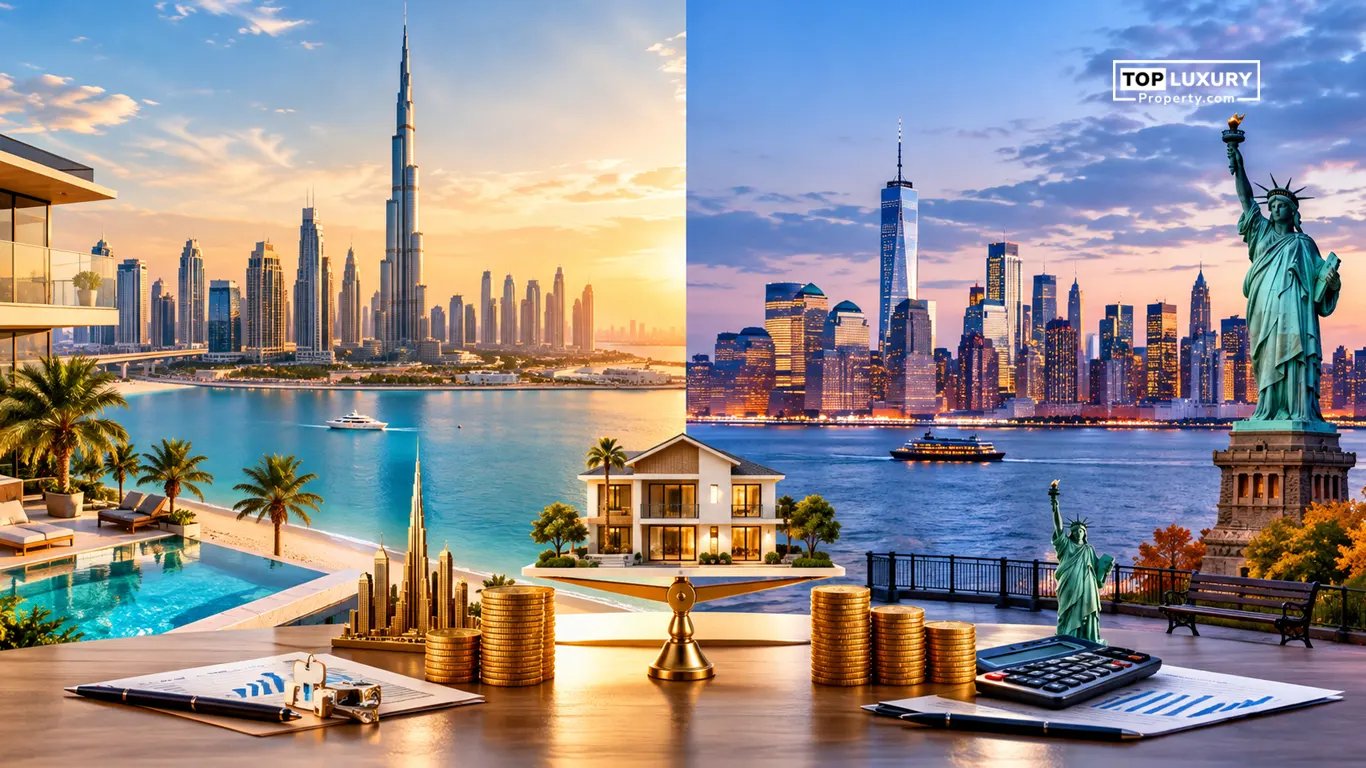
Two skylines. Two very different tax bills. Two very different rental cheques at month-end.
Buyers weighing Dubai against NYC usually start with price per square foot. Then they analyze the second line. Property tax. Mansion tax. Board approval. Service charges. Federal, state, and city withholding. Each affects your rental income and future property value.
Dubai offers 6-8% gross rental yields, zero income and capital gains tax, and a 10-year Golden Visa from AED 2M. New York gives you deeper capital markets and prewar heritage buildings, but stacks federal, state and city taxes plus a mansion tax that starts biting at $1M and climbs to 3.9%.
Let’s see the quick comparison between the Dubai vs NYC real estate markets.
Dubai vs. NYC: The Comparative Analysis for Investors and Expats
Both cities pull global capital. Both draw wealthy expats. But the financial mechanics under the hood look almost nothing alike.
Two Global Powerhouses, Two Radical Approaches to Wealth and Living
Dubai runs on a growth-and-yield model. Low friction to buy. No tax on the income. The population is growing fast, service charges are the main recurring cost, and the government keeps rolling out visa reforms that pull more capital in.
NYC runs on capital preservation. Prices are steep, appreciation is slow but steady, and the tax regime is designed to collect on every stage of ownership. Buy, hold, sell, inherit. Something is taxable at each step.
Quick summary of the split:
-
Dubai investors chase cash flow and appreciation without a tax drag.
-
NYC investors chase legacy value, deep liquidity, and the strongest legal frameworks in the world.
-
Dubai off-plan launches routinely appreciate 18-25% between launch and handover in prime corridors.
-
NYC new-development supply hit a 10-year Q1 low in 2026, tightening prices at the top end.
Neither is objectively better. It depends on whether you want to own the yield or own the address.
Real Estate Comparison: Dubai vs. NYC Property Markets
The pricing gap is what most buyers see first. What you actually buy for the same money varies wildly. Let us break it down room by room.
What $1 Million Gets You in Dubai vs. NYC
According to DLD data, the average price per square foot across Dubai in 2026 is arround AED 1,658, roughly $451. Downtown Dubai averages AED 3,011 per sqft ($820). Dubai Marina runs AED 2,058 per sqft ($560). Palm Jumeirah tops the chart above AED 4,000 per sqft ($1,089) for prime waterfront villas.
NYC condo pricing are very different story. Q1 2026 data from Miller Samuel highlights the average condo price at $1,972 per square foot, with luxury clearing $4,000 in Tribeca and SoHo, and ultra-luxury trophies above $7,000. Prime new-development pricing is currently listed between $2,500 and $5,000 per sqft.
So what does $1 million actually buy? The price per sq ft Dubai vs Manhattan ratio is roughly 1:4 in the mid-market and closer to 1:2 in the ultra-luxury tier.
|
Location |
$1M Buys You |
Property Type |
|
1,800-2,200 sqft, 2-3 bed apartment |
Modern high-rise, DIFC-adjacent |
|
|
1,600-1,800 sqft, 2 bed |
Waterfront lifestyle stock |
|
|
2,200-2,700 sqft, 3-4 bed |
Mid-market apartment, high yield |
|
|
1,200-1,400 sqft, 2 bed |
Burj Khalifa view condo |
|
|
Midtown Manhattan condo |
400-500 sqft studio |
Boutique high-rise |
|
Upper East Side co-op |
550-650 sqft 1-bed |
Prewar building, board approval |
|
Tribeca condo |
250-350 sqft studio |
Loft conversion, luxury tier |
Rental Yields & Cash Flow: Dubai High-Yield Market vs. NYC Capital Appreciation
The Dubai rental yields vs NYC comparison is where most cash-focused investors decide the debate.
Dubai gross yield averages:
-
Citywide apartment yield: 7.15%
-
Villa yield: 4.98%
-
Overall market: 6.68%
-
JVC and Dubai South: 7-9%
-
Palm Jumeirah premium tier: 4-6%
Net yields, after service charges, insurance, agency and vacancy, cumulate about 1.5-2%. Even on the net line, a well-picked apartment in Business Bay or JVC clears 5-6.5%.
IN NYC, the gross yields is arround at 3-5%. Net yields, after property tax, common charges, insurance, and management, typically add up to 2-3%. Hitting 4% net is a strong result. High-end condos on Central Park South often net less than 2%.
Add the tax layer. NYC rental income is federally taxed as ordinary income, plus state and city taxes. Even a 4% net NYC yield on paper delivers roughly 2% for high earners. Dubai's 6.5% gross yield stays at 6.5%. There is no income tax to subtract.
Foreign Ownership Rules: Freehold Zones vs. Co-op Restrictions
Buying property in Dubai as a foreigner is straightforward. In designated freehold areas (70+ communities, including Downtown Dubai, Dubai Marina, Palm Jumeirah, JVC, Business Bay, Dubai Hills), foreigners own outright. Same title deed as a UAE national. The Dubai Land Department registers you, and the ownership is direct, inheritable, and can be sold without government approval.
NYC is a much harder market for foreign buyers:
-
Condos: open to foreign buyers, with largely no restrictions
-
Co-ops: dominate roughly 70% of Manhattan stock, and most co-op boards reject foreign or non-US-tax-filing buyers outright
-
Cash reserves: Many co-ops require 1-3 years of maintenance in liquid reserves post-closing
-
FIRPTA withholding: 15% of gross sale price withheld from foreign sellers at closing
-
Financing: US banks rarely lend to non-resident foreign buyers without 40-50% down
Result: foreign buyers in NYC self-select into condo new-development, which trades at a premium to the broader market. In Dubai, no such filter exists. Every freehold area is open to all.
Off-plan Development vs Historic Real Estate
The Dubai market is largely off-plan project-heavy. Off-plan launches from Emaar, Damac, Aldar, Sobha, Danube, Binghatti and Ellington Properties drive most of the transaction volume. In off-plan development, the developer's payment plan is open to all, which means foregiers can benefit from their construction-linked payment options. Small down payment, construction phase-wise payment and a handover amount, that’s all, your payment is clear during project construction phases. No huge upfront, some developers also offer 1% payment plan along with post-handover payment options.
Manhattan's supply, by contrast, is mostly fixed. Zoning, land scarcity, and a slow approval process constrain new development, so most transaction volume moves through resale of existing prewar and postwar stock. That scarcity is exactly what underpins long-term price stability, but it also means buyers are dealing with older building systems, co-op board politics, and a much slower-moving inventory pipeline than Dubai's constantly refreshed off-plan supply.
A $1 Million Purchase in Both Cities
Now the receipts. Let us put $1M to work in each city and see what is left after year one.
Scenario A: Dubai, Business Bay 2-bed apartment (~1,600 sqft), held for rent.
|
Parameters |
Amount (USD) |
|
Purchase price |
$1,000,000 |
|
DLD transfer fee (4%) |
$40,000 |
|
Agent commission (2%) |
$20,000 |
|
Trustee & registration |
$1,200 |
|
Total entry cost |
$1,061,200 |
|
Annual service charges |
$6,500 |
|
Annual property tax |
$0 |
|
Gross annual rent (7%) |
$70,000 |
|
Net rental after costs |
$59,000 |
|
Tax on rental income |
$0 |
|
Take-home yield |
5.9% |
Scenario B: NYC, Midtown Manhattan studio condo (~500 sqft), held for rent.
|
Parameters |
Amount (USD) |
|
Purchase price |
$1,000,000 |
|
Mansion tax (1%) |
$10,000 |
|
Buyer closing costs (3%) |
$30,000 |
|
Mortgage recording tax (if financed) |
$15,000-$19,000 |
|
Total entry cost |
$1,055,000-$1,059,000 |
|
Annual property tax |
$12,000-$18,000 |
|
Common charges |
$18,000-$36,000 |
|
Gross annual rent (4.4%) |
$44,000 |
|
Net rental before tax |
$8,000-$15,000 |
|
Tax on net rental (40% combined) |
$3,200-$6,000 |
|
Take-home yield |
0.5%-1.5% |
Same million dollars. Roughly $59,000 clears in Dubai. Roughly $6,000-$9,000 clears in NYC after tax. On top of that, you keep six times the square footage in Dubai.
Tax Framework: Dubai Zero-Tax Model vs. NYC Tax Burden
The tax gap is the single biggest number in this comparison. Everything else flows from it. Keep more of what you earn, and you can afford a smaller yield.
Personal Income Tax: 0% Environment vs. Combined NYC Rate
Dubai: Dubai has zero income tax. Zero on rental income. Zero on capital gains from selling your apartment.
New York City: Layered. Federal income tax runs up to 37% on ordinary income. New York State piles on 3.9% to 10.9%. NYC adds another 3.078% to 3.876%. Combined state and city marginal rates can reach 14.776% before federal.
The Dubai zero tax vs NYC income tax gap is not marginal. On $500,000 of earned income, a Dubai resident keeps roughly $500,000. A comparable NYC resident keeps closer to $290,000 after federal, state, and city taxes.
For US citizens, the picture shifts. Americans face worldwide taxation regardless of residency, so a US passport holder moving to Dubai still files with the IRS. The Foreign Earned Income Exclusion covers roughly the first $130,000 of salary. Above that, federal tax still applies. State and city taxes do stop.
Non-US expats get the cleanest break. Move to Dubai, become a tax resident, and personal income tax drops to zero.
Real Estate & Property Taxes: DLD Transfer Fee vs. NYC Property & Mansion Taxes
Dubai charges a 4% Dubai Land Department transfer fee at purchase. One-time. Split by custom between buyer and seller, though the buyer usually absorbs the full amount. Add a 2% agent commission and small trustee fees. There is no annual property tax. You pay service charges to the building, typically AED 12-25 per sqft per year, and that is your recurring bill.
The NYC property tax rate landscape is very different. On a $2M Manhattan condo, annual property tax alone runs $16,000 to $38,000, depending on class and abatement status.
-
Buyer closing costs: 3-6% of purchase price, including mortgage recording tax, title insurance and attorney fees
-
Mansion tax: 1% on purchases from $1M to $2M, scaling to 3.9% on purchases above $25M
-
Annual property tax: roughly 0.8% to 1.9% of assessed value, depending on class
-
Common charges or maintenance: $2,000 to $5,000 per month on a Manhattan condo or co-op
-
Federal capital gains: 20% long-term for high earners plus 3.8% Net Investment Income Tax
-
State and city capital gains: taxed as ordinary income (no preferential rate)
On a $2M Manhattan condo, the annual carrying cost before the mortgage can top $60,000. On a AED 7.3M Dubai apartment at roughly the same dollar value, the carrying cost typically lands at AED 25,000 to 45,000 in service charges and DEWA utility bills. That is a 3-4x recurring cost difference every single year.
Corporate Tax & Capital Gains
The UAE introduced a 9% corporate tax in 2023 for business profits above AED 375,000 per year. That does not affect a personal rental portfolio. It does affect a company that runs a short-let business or a property fund.
The US federal corporate rate is 21%, plus New York State corporate tax at 6.5-7.25%, plus the NYC corporate income tax at 8.85%. Capital gains from selling a business or property compound on top.
The gap in capital gains tax between Dubai vs US is stark. Dubai charges nothing on gains for individuals. A US-resident seller pays up to 20% federal plus 3.8% NIIT plus state and city surcharges. Sell a $3M condo you bought for $2M, and roughly $250,000 to $310,000 exits to tax authorities in NYC. In Dubai, the same $1M gain stays with you.
Residency & Long-Term Visa Options for Investor-Expats
For many international buyers, the visa is the deal. Owning property that also unlocks residency changes the maths on the whole purchase. Here is how the Dubai Golden Visa vs US Green Card actually stacks up in 2026.
Dubai 10-Year Golden Visa via Property Investment
The Dubai Golden Visa property threshold is AED 2 million (~$545,000). One property, or a combined portfolio, that reaches the DLD-valued threshold qualifies for the 10-year residency visa.
Key 2026 rules after the February reform:
-
The old 50% equity requirement was removed. Mortgaged properties now qualify from day one.
-
Off-plan properties qualify for the Golden Visa. No wait for handover.
-
Multiple properties can be combined to reach AED 2M. No cap on the number.
-
Bank NOC required for mortgaged property, confirming DLD-valued threshold.
-
10-year renewable residency covers the investor, spouse, and unmarried children (any age).
Q1 2026 saw 4,218 Golden Visa property applications registered with the DLD. Up 34.7% year-on-year.
Costs on top of the property itself:
-
Government fees: AED 4,000-5,000
-
Medical, biometrics, Emirates ID: AED 1,500-2,000
-
Optional PRO service fees: AED 3,000-8,000
US Immigration Pathways: EB-5 Investor Visa
The US Green Card tax implications also needs address right next to the visa cost, because they compound the true price of moving.
EB-5 requires:
-
$800,000 in a Targeted Employment Area (TEA), or $1,050,000 elsewhere
-
Investment in a new commercial enterprise
-
Creation of 10 full-time US jobs within 2 years
-
USCIS filing fees: $10,000-$12,000 for the primary petition
-
Regional Center administrative fees: $50,000-$100,000
Processing needs 32-33 months for the initial petition. Full green card timeline: 5-8+ years. Investors from India and China face additional visa bulletin backlogs.
Once you have the green card, the US taxes your worldwide income for life. Which means an EB-5 investor moving to New York starts paying federal, state, and city tax on every dollar earned anywhere. Even from businesses in their home country. Even from rental properties in Dubai. Even if they leave the US, they must formally expatriate (and pay an exit tax) to break the tax link.
The Dubai Golden Visa does not do that. UAE residency does not trigger UAE tax on foreign income.
|
Feature |
Dubai Golden Visa |
US EB 5 Green Card |
|
Minimum investment |
AED 2M (~$545K) |
$800K (TEA) or $1.05M |
|
Recoverable? |
Yes, property retained |
Yes, must stay at risk |
|
Job creation required? |
No |
Yes, 10 US jobs |
|
Processing time |
30-90 days |
32-33 months |
|
Duration |
10 years, renewable vs |
Conditional 2 yrs then permanent |
|
Path to citizenship? |
No |
Yes, after 5 years |
|
Worldwide taxation? |
No |
Yes |
Cost of Living Breakdown: Dubai vs. New York City
Beyond the purchase, day-to-day living costs shape the actual quality of life. This is for end users who want to live in that property.
Numbeo's 2026 data on the cost of living Dubai vs New York puts NYC 40-44% more expensive than Dubai on average living costs excluding rent. Including rent, NYC runs 50%+ higher. A $12,000/month NYC lifestyle can be matched in Dubai at roughly $6,700.
|
Category |
Dubai vs NYC (USD) |
|
1-bed apartment rent (city centre) |
$2,200-$2,800 vs $4,500-$5,500 |
|
Meal, mid-range restaurant |
$18-$25 vs $30-$45 |
|
Monthly transport pass |
$80 vs $132 |
|
Gym membership (mid-range) |
$70 vs $95 |
|
Utilities (85m² apartment) |
$180 vs $220 |
|
Groceries (weekly basket) |
$95 vs $135 |
|
Petrol (per litre) |
$0.75 vs $1.05 |
Luxury Living Costs
Fine dining costs less in Dubai for equivalent quality. A tasting menu at Zuma, Nobu or COYA is between $180 to $ 250 per head. NYC equivalent at Le Bernardin, Per Se or Masa charges you $400 to $1000. Both cities have Michelin-starred restaurants, but Dubai costs roughly 60-70% of the Manhattan pricing for the same brand and format. Yachts, supercars and members' clubs cost the same everywhere. But the income to pay for them is very different.
Education & International Schools
International school fees in Dubai vs NYC are a large expense for living expat families. Dubai international schools (GEMS Wellington, Dubai College, Dwight School Dubai, Repton) have tuition fees of AED 70,00 - AED 120,000 per year, roughly $19,000 to $33000. Manhattan private schools ( Trinity, Dalton, Horace Mann) charge $65,000 to $72000 per year for K-12. Multiply across two or three children, and the annual gap can top $100,000.
Healthcare & Insurance
Dubai has a hybrid public-private healthcare infrastructure. Employer-sponsored health insurance is mandatory for residents. A comprehensive family plan through Bupa, Cigna or AXA costs AED 20,000 to AED 45000. Private hospitals like Mediclinic, King’s College Hospital, and American Hospital Dubai deliver first-world care with almost no wait times.
NYC private insurance for a family without employer coverage can hit $30,000 to $40,000. Out-of-pocket exposure stays high even with insurance because deductibles and coinsurance stack up fast. A single ER visit without full coverage can go up to $5,000 to $ 15,000.
Quality of Life & Culture: Middle Eastern Hub vs. Empire State
Money is not the only lens. What daily life feels like matters just as much for anyone actually moving. And the Dubai lifestyle vs New York comparison hinges on climate, safety, and how you like to spend a Sunday.
Safety, Crime Rates, and Public Order
Is Dubai safer than NYC? By the numbers, yes. And a wide margin.
Numbeo’s 2026 Safety Index gives Dubai 83.8 (5th globally). NYC scores 49.2 (212 globally). Crim rates are higher in NYC than in Dubai. Violent crime, pretty theft, and street incidents are rare in Dubai. Women report that they feel safe walking alone at night: Dubai 87%, NYC 44%.
Climate & Seasonality
Dubai weather vs New York seasons is night and day.
Dubai: sunshine 340+ days a year. Winters (Nov-Mar) are mild at 18-28℃, beach perfect. Summers (June -Oct) are dominating, hitting 42-48℃ with high humidity. Air conditioning is must have.
NYC: Four full seasons. Winter drops to -5℃ with snow. Summer climbs to 32℃ with humidity that feels tropical. Spring and autumn are the payoff. Central Park foliage in October is genuinely spectacular. Christmas in the city has no comparison.
If you like beach days, then choose Dubai. If you like snow and chill weather, then choose NYC.
Transportation & Mobility
NYC is a walking, subway and yellow-cab city. Owning a car is optional and usually more trouble than it is worth. The MTA runs 24*7 bus services and covers all boroughs with the OMNI system. NYC also offers the Staten Island Ferry, Airtrains and Roosevelt Island Tram.
Dubai is car-first, and highway dominates. Dubai Metro is the backbone of the city’s public transport, fully automated and driverless, with Red and Green lines connecting major areas like Downtown, Dubai Marina, JBR, and the airport. Fares range from AED 3 to AED 8.50 per trip using a Nol Card. Dubai trams, Palm monorail, Dubai Ferry, Marina Water Bus, and traditional Abras are other options of public transportation.
In transportation, both cities are top-notch.
Quick Reference: Dubai vs. NYC Head-to-Head
Let’s see a quick snapshot of Dubai vs New York. Use this as a checklist against your own priorities.
|
Metric |
Dubai (UAE) |
New York City (USA) |
|
Personal income tax |
0% |
Up to ~14.8% state + city + federal (up to 37%) |
|
Property transfer / mansion tax |
4% DLD one-time |
1-3.9% mansion tax + 2-6% closing |
|
Annual property tax |
$0 (service charges only) |
0.8-1.9% of assessed value |
|
Average gross rental yield |
6-9% |
2-4.5% |
|
Foreign ownership |
100% freehold in 60+ zones |
Condos open, co-ops largely restricted |
|
Primary economic driver |
Trade, tourism, tech, finance |
Wall Street, media, tech, commerce |
|
Safety ranking (Numbeo 2026) |
Top 6 globally (index 83.8) |
262nd globally (index 49.1) |
|
Residency |
10-yr Golden Visa (~$545k) |
EB-5 ($800k TEA) + worldwide tax |
|
Weather |
Sun 340+ days, hot summers |
Four full seasons |
|
Capital gains tax |
0% |
20% federal + 3.8% NIIT + state/city |
The Bottom Line: Which Global City Suits Your Goals?
Two paths. Both work. Not for the same investor.
Choose Dubai If
-
You want tax-free yield and full ownership of what you earn
-
You want a straightforward 10-year Golden Visa without job-creation rules
-
You value newer stock, larger square footage, and off-plan payment plans
-
You want direct freehold ownership without board approval
-
You will actually use the beach, the sunshine, and the winter climate
Choose New York City If
-
You want prewar architecture and legacy addresses
-
You want deep US capital markets on your doorstep
-
You already have US tax exposure and cannot reduce it
-
You want a 24-hour walking city with mass transit
-
Capital appreciation and prestige matter more than cash flow
For Dubai property vs NYC property as a pure cash-flow investment, Dubai wins by a wide margin. For legacy positioning and long-term US-based wealth, NYC still matters. Many high-net-worth families own both. That is often the smartest answer.