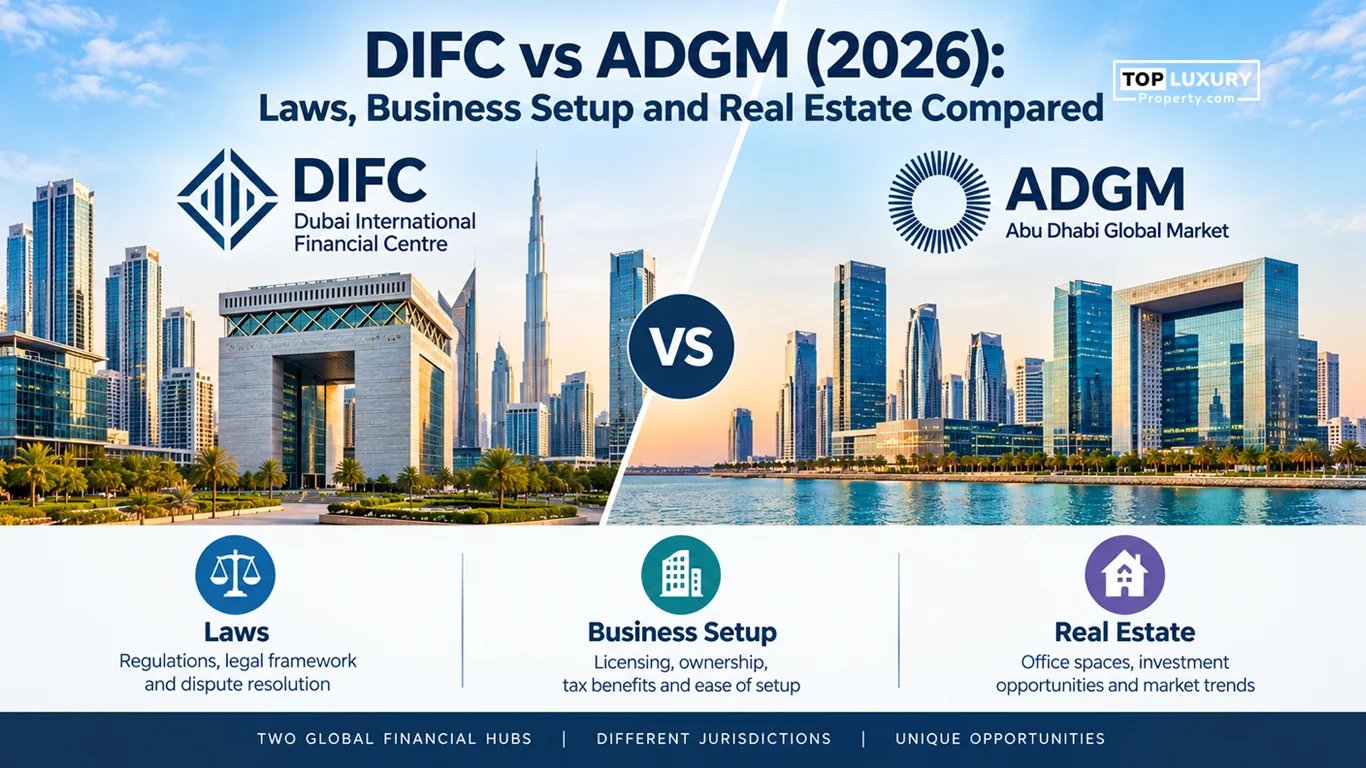
Quick answer: DIFC (Dubai International Financial Centre) and ADGM (Abu Dhabi Global Market) are the UAE's two international financial centres. Both run independent common law systems with their own courts and financial regulators. DIFC, founded in 2004, is older, larger by company count and located in central Dubai. ADGM, inaugurated in 2015, applies English common law directly and now covers Al Maryah and Al Reem Islands. For property buyers, DIFC offers ultra-prime Dubai apartments with a 5% transfer fee, while ADGM's Al Reem Island offers lower entry prices, higher gross yields and a 2% registration fee.
What Are DIFC and ADGM?
If you are weighing DIFC vs ADGM, you are really comparing two "jurisdictions within a country." Each operates inside the UAE but has its own civil and commercial law, its own courts, its own financial regulator and its own company and property registries. UAE federal criminal law and anti-money laundering rules still apply in both.
Dubai International Financial Centre (DIFC) opened in 2004 on Sheikh Zayed Road, between Downtown Dubai and Business Bay. It is the older and more established of the two, with a dense cluster of banks, law firms, hedge funds and family offices within walking distance of each other. DIFC describes itself as the leading financial centre for the Middle East, Africa and South Asia (MEASA) region, and Dubai's D33 economic agenda aims to place the city among the world's top four financial centres.
Abu Dhabi Global Market (ADGM) was inaugurated in late October 2015. It started on Al Maryah Island and, on 24 April 2023, expanded to include Al Reem Island. According to ADGM, the combined district covers 14.38 million square metres, which makes it one of the largest financial districts in the world. ADGM has positioned itself as the "Capital of Capital," leaning on Abu Dhabi's sovereign wealth funds and a fast-growing asset management base, and it has set a target of joining the world's top five financial centres.
Verdicts: DIFC wins on depth and history; ADGM on space, growth pace and closeness to Abu Dhabi's institutional capital.
DIFC vs ADGM at a Glance
|
Feature |
DIFC |
ADGM |
|
Emirate |
Dubai |
Abu Dhabi |
|
Established |
2004 |
2015 (operational late October 2015) |
|
Location |
Sheikh Zayed Road, between Downtown and Business Bay |
Al Maryah Island and Al Reem Island |
|
Size |
About 110 hectares today; DIFC Zabeel District adds a 7.1 million sq ft site |
14.38 million sqm across two islands |
|
Legal system |
Own codified civil and commercial laws, with English common law as the fallback |
Direct application of English common law, plus ADGM regulations |
|
Financial regulator |
Dubai Financial Services Authority (DFSA) |
Financial Services Regulatory Authority (FSRA) |
|
Courts |
DIFC Courts |
ADGM Courts (Court of First Instance and Court of Appeal) |
|
Company registry |
DIFC Registrar of Companies |
ADGM Registration Authority (RA) |
|
Property registry |
DIFC Registrar of Real Property (RoRP) |
ADGM Registration Authority via AccessRP |
|
Active companies / licences (H1 2026) |
10,018 active registered companies |
Almost 14,000 active licences |
|
Workforce |
50,200 at end of 2025 |
49,027 at H1 2026 |
|
Property transfer cost |
5% transfer fee |
2% registration fee (Al Reem Island) |
|
Residential price range (indicative) |
Around AED 2,900 to 3,000 per sq ft |
Around AED 1,000 to 1,600 per sq ft on Al Reem |
DIFC vs ADGM Legal Framework: Codified Common Law vs Direct English Law
Both centres were built so that an international bank or fund could operate under rules its lawyers already understand. The route each took is different, and that difference matters when you draft contracts or buy property.
DIFC's Legal System
DIFC has enacted its own body of statute law covering companies, contracts, employment, insolvency, data protection, trusts, foundations and real property. These laws are drafted in English, modelled on common law principles, and they are written alongside the DIFC Law on Application of Civil and Commercial Laws. That application law tells courts what to use when a DIFC statute is silent.
In November 2024, DIFC enacted amendments to this law so that English common law, along with developments in other established common law jurisdictions, stays central to how DIFC law is interpreted. The official DIFC Laws and Regulations portal publishes every law, regulation and consultation paper.
In practice, DIFC gives you a written code first and English case law second.
ADGM's Legal System
ADGM went a step further. Under its founding regulations, English common law, including the law of equity, applies directly within the jurisdiction. ADGM then layers its own regulations on top for companies, insolvency, employment, data protection, real property and financial services. ADGM says this makes it an independent jurisdiction operating in line with international best practice. For a UK-trained lawyer, the ADGM model can feel almost like working in London, which is part of its appeal to global asset managers.
Regulators: DFSA vs FSRA
The DFSA authorises and supervises banks, brokers, asset managers, insurers and crypto firms operating from DIFC. The FSRA does the same for ADGM, and ADGM describes its role as keeping the marketplace fair, efficient and transparent. Both regulators run innovation testing licences and sandboxes for fintech firms. Market advisers generally describe FSRA's published fees as somewhat lower than DFSA's for comparable categories, and ADGM is often seen as more mature for virtual asset regulation. DIFC, on the other hand, has the region's largest pool of regulated firms, which can make hiring, partnering and client acquisition easier.
Courts, Arbitration and Dispute Resolution
DIFC Courts hear commercial and civil disputes connected to DIFC, and parties anywhere can opt into their jurisdiction by contract. Judgments are enforceable in Dubai through established protocols and internationally through reciprocal arrangements.
ADGM Courts consist of a Court of First Instance and a Court of Appeal. ADGM also runs the Dispute Resolution Hearing Centre (DRHC), a digitised venue for arbitration hearings and mediations that offers physical, virtual and hybrid formats, and even a "Mediation in the Metaverse" service. ADGM's arbitration framework is based on the UNCITRAL Model Law, and the centre maintains panels of arbitrators, mediators and investor-state mediators. ADGM Courts also run a UAE National Judge Programme to train Emirati lawyers for senior judicial roles.
|
Dispute resolution |
DIFC |
ADGM |
|
Court structure |
DIFC Courts (First Instance, Appeal, Small Claims Tribunal) |
ADGM Courts (First Instance, Appeal) |
|
Opt-in for outside parties |
Yes, by contract |
Yes, by contract |
|
Arbitration venue |
Dubai-based institutional arbitration |
Dispute Resolution Hearing Centre (DRHC) |
|
Arbitration law basis |
DIFC Arbitration Law (UNCITRAL-based) |
ADGM Arbitration Regulations (UNCITRAL Model Law) |
|
Distinctive feature |
Longest track record among UAE common law courts |
Court-annexed mediation and metaverse hearings |
DIFC vs ADGM: Growth and Ecosystem in 2026
Numbers from the two centres are not measured the same way. DIFC reports "active registered companies," while ADGM reports "active licences," so we treat them side-by-side.
DIFC closed 2025 with 8,844 active registered companies, 1,052 regulated firms, more than 500 wealth and asset managers, including 102 hedge funds, and a workforce of 50,200. Combined revenues rose 20% to AED 2.13 billion. By the end of June 2026, DIFC crossed 10,000 active registered companies for the first time, reaching 10,018 after adding 2,318 companies in twelve months. Regulated firms rose to 1,134, AI and fintech firms to 1,933, and foundations jumped 67% to 1,409.
ADGM reported that assets under management rose 54% year on year in H1 2026, extending a growth run that began in 2022. Active licences climbed to almost 14,000, the workforce reached 49,027, fund and asset managers grew to 190, and funds managed from ADGM rose to 276.
|
Metric (latest available) |
DIFC |
ADGM |
|
Companies / licences |
10,018 active registered companies (H1 2026) |
Almost 14,000 active licences (H1 2026) |
|
Regulated financial firms |
1,134 (H1 2026) |
392 financial services entities (H1 2026, reported) |
|
Workforce |
50,200 (end-2025) |
49,027 (H1 2026) |
|
Asset / fund managers |
500+ wealth and asset managers (2025) |
190 fund and asset managers (H1 2026) |
|
Growth headline |
Companies up 30% year on year |
AUM up 54% year on year |
|
Strategic theme |
AI-native financial centre, family wealth |
"Capital of Capital," asset management, sustainable finance |
Business Setup in DIFC vs ADGM
Both centres allow 100% foreign ownership, no local sponsor and repatriation of capital and profits. Both are treated as free zones for UAE corporate tax purposes, meaning a company can access the 0% rate on qualifying income only if it meets the Qualifying Free Zone Person conditions. Otherwise, the standard 9% federal rate applies above the threshold.
Legal Structures
DIFC offers limited liability companies, branches of foreign companies, limited partnerships, Prescribed Companies (a low-cost holding and structuring vehicle), foundations and fund structures. The DIFC "Establish a Business" pathway guides applicants through name reservation, licensing and registration, and DIFC Services handles employment visas, Emirates IDs and other government services for staff.
ADGM offers private companies limited by shares, public companies, branches, limited liability partnerships, Special Purpose Vehicles (SPVs), foundations and restricted scope companies. Its SPVs and foundations can be administered through a registered corporate service provider without a physical office, which keeps costs down for holding structures.
Costs and Timelines
Before going to the costs and timeline section, we want to clarify one thing: Published fee schedules change often, so always check the official ADGM Registration Authority and DIFC fee pages before budgeting.
As a general pattern reported by advisers in 2026, ADGM's non-financial registration and renewal fees tend to be lower, and it offers heavily discounted packages for tech start-ups and venture capital fund managers.
DIFC's fees for non-regulated firms are typically higher, and DFSA authorisation for regulated activity adds significant application and annual costs. DIFC offers subsidised routes through its Innovation Hub and flexible desk licences.
For family wealth, the difference can be sharp. One 2026 comparison found ADGM's single-family office registration cost roughly a quarter of DIFC's in the first year, with a lower minimum net asset threshold. DIFC, however, hosts far more family-related entities and foundations, which brings advisers, trustees and peer networks with it.
|
Setup factor |
DIFC |
ADGM |
|
Foreign ownership |
100% |
100% |
|
Holding vehicle |
Prescribed Company |
Special Purpose Vehicle |
|
Office requirement |
Required for most; shared or flexi options available |
Required for most; not for SPVs and foundations using a service provider |
|
Indicative non-regulated fees |
Generally higher |
Generally lower, with start-up incentives |
|
Regulated activity |
DFSA authorisation |
FSRA authorisation |
|
Visa and government services |
DIFC Services |
ACCESSADGM portal |
|
Best for |
Client-facing finance, hedge funds, private wealth, law firms |
Asset managers, sovereign-linked mandates, SPVs, virtual assets |
Real Estate in DIFC vs ADGM: The Complete Property Comparison
Most DIFC vs ADGM comparisons stop at licensing, yet each centre runs its own property registry, real property laws and fee structure. Whether you buy an apartment, lease an office or invest off-plan, the jurisdiction shapes your costs, protections and returns.
Location of the Properties
DIFC real estate is compact and central. The existing district covers roughly 110 hectares along Sheikh Zayed Road, served by two Red Line metro stations. It mixes Grade A office towers, residential towers such as Index Tower, Liberty House and Central Park Towers, branded residences, hotels, and the Gate Village art and dining quarter. DIFC's locations span The Gate District, Gate Avenue, ICD Brookfield Place and the DIFC Innovation Hub.
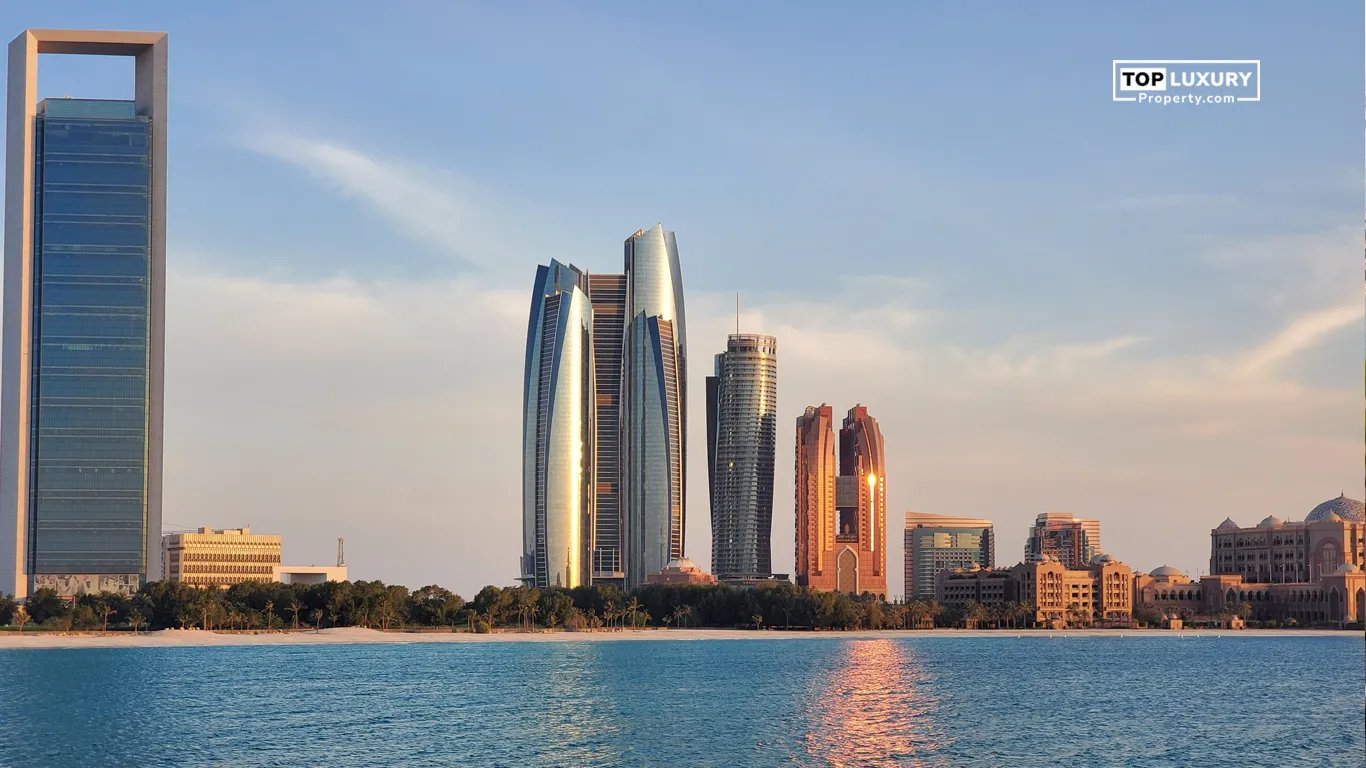
ADGM real estate is spread across two islands. Al Maryah Island is the commercial core, with ADGM Square's four office towers, the trapezoid-shaped ADGM Authorities Building, The Galleria mall, the Four Seasons and Rosewood hotels and Cleveland Clinic Abu Dhabi. Al Reem Island is the residential center. ADGM describes it as three districts, Tamouh, Najmat and Shams, with homes, offices, Reem Central Park and schools such as Sorbonne University Abu Dhabi, Repton Abu Dhabi and Nord Anglia International School. Reem Mall, which opened in 2024, anchors retail on the island.
In short, DIFC is a small, premium, work-centred neighbourhood, while ADGM's market is dominated by Al Reem's deep apartment stock, with Al Maryah adding a premium commercial layer.
The Legal Framework for Property
In DIFC, the Registrar of Real Property (RoRP) administers the DIFC Real Property Law, the DIFC Strata Title Law and the DIFC Leasing Law. DIFC Services handles the day-to-day work: freehold transfers, lease registration, mortgage registration and other lodgements. The Registrar stands behind the accuracy of a central register, so the registered title is protected by law and buyers need little due diligence beyond the register. Developers must also lodge a Strata Management Statement that binds all owners and occupiers.
In ADGM, the Registration Authority registers all real property interests across Al Maryah and Al Reem Islands under the ADGM Real Property Regulations. ADGM revamped these rules in 2024, blending English common law with onshore practice. Its Real Estate and Infrastructure division oversees sales, leases, off-plan registration and escrow accounts, all processed through the AccessRP digital platform.
The biggest recent change came on 1 January 2025, when the Al Reem Island property register moved from Abu Dhabi Municipality to the ADGM Registration Authority. All ownership interests registered before that date were migrated to the ADGM register. Jointly owned property defaults to tenants in common unless owners agree otherwise, and existing leases were migrated automatically.
Who Can Buy? Freehold Ownership Rules
Both DIFC and Al Reem Island offer freehold ownership to buyers of any nationality, with no UAE residency requirement. Al Reem is a designated investment zone in Abu Dhabi, and its move into ADGM changed the paperwork, not buyers' ownership rights. In both locations, a qualifying property purchase can support a UAE residence visa application, including the 10-year Golden Visa route for investments at or above the federal threshold (currently AED 2 million). Check current eligibility with the relevant immigration authority before you rely on it. In the wider DIFC area, confirm on the title documents which registry holds the unit, because fees and protections follow the registry.
Transaction Costs: Where the Gap Is Widest
DIFC charges a freehold transfer fee of 5%, calculated on the greater of the price paid or the property's market value. Transfers of shares in a company that owns DIFC property can also trigger the fee. In November 2024, DIFC added a mortgage registration fee of 0.25% of the loan amount, matching the onshore Dubai practice.
On Al Reem Island, market sources report a 2% registration fee on transfers processed through ADGM, the same headline rate as mainland Abu Dhabi. For leases, ADGM applies a 5% authority fee on registered residential rental contracts of up to 25 years, collected over the lease term through monthly utility bills.
|
Cost item |
DIFC |
ADGM (Al Reem Island) |
|
Transfer / registration fee |
5% of the greater of price or market value |
2% (as reported for Reem transfers) |
|
Share transfers in property-owning company |
Can trigger transfer fee |
Check with Registration Authority |
|
Mortgage registration |
0.25% of loan amount |
Charged per ADGM fee rules |
|
Off-plan registration window |
60 days |
Registered through AccessRP |
|
Residential lease fee |
Lease registration fees apply |
5% authority fee, paid through utility bills |
|
Late payment penalty |
USD 1,000 plus 5% annual interest |
Per ADGM fee rules |
|
Digital platform |
DIFC Services portal |
AccessRP |
On an AED 3 million purchase, the gap between a 5% and a 2% fee is AED 90,000, often more than a year of net rent.
Off-Plan Buyer Protections
DIFC requires off-plan sale agreements, including reservation agreements where a developer receives more than AED 5,000, to be registered with the RoRP's Off Plan Register. In 2024, DIFC extended the registration window from 30 to 60 days. Developers must also give buyers a Disclosure Statement before the off-plan sale agreement is signed. If a developer fails to serve it before handover, the buyer can terminate the agreement.
ADGM handles off-plan registration and escrow through AccessRP. This matters on Al Reem, where launches are frequent, and ValuStrat data showed Abu Dhabi off-plan units priced about 38% above ready units in Q1 2026. Confirm that payments go into a registered escrow account.
Property Prices, Rents and Rental Yields
DIFC property prices are among Dubai's highest. DXBInteract index highlights the average DIFC apartment asking price at about AED 2,830 per sq ft in September 2026, up around 11% over twelve months. That places DIFC just behind Palm Jumeirah and Jumeirah for price per sq ft. Gross yield estimates vary by source, from about 4.5% to 6.0% (Property Monitor) up to 6.8% for one-bedroom units in agency data. The draw is tenant quality, which lowers vacancy risk.
ADGM property prices on Al Reem Island start far lower. Indicative 2026 rates run from about AED 1,000 to 1,500 per sq ft, depending on tower quality and view, while recorded transaction data put the twelve-month median closer to AED 1,600 per sq ft after a sharp rise. Gross yields of 6.5% to 8% are among Abu Dhabi's strongest. According to ADREC data cited by agents, Reem recorded AED 10.5 billion in transactions in H1 2026, ranking second in the emirate. Service charges of roughly AED 25 to 45 per sq ft a year in full-amenity towers can take a real bite out of net returns.
|
Market indicator (2026, indicative) |
DIFC |
Al Reem Island (ADGM) |
|
Average apartment price |
About AED 2,900 to 3,000 per sq ft |
About AED 1,000 to 1,600 per sq ft |
|
Entry price, one-bedroom |
From about AED 2 million |
From about AED 750,000 |
|
One-bedroom annual rent |
About AED 138,000 average asking |
About AED 80,000 and up |
|
Gross rental yield |
About 4.5% to 6.8% |
About 6.5% to 8% |
|
Price momentum |
About 11% annual rise in asking prices |
Recorded median up sharply year on year |
|
Tenant profile |
Senior finance and legal professionals |
Broad mix of professionals and families |
|
Supply outlook |
Tight until DIFC Zabeel District delivers |
Deep, active pipeline |
Note: These figures are indicative; review building-level transaction records before making an offer.
Commercial Property and Offices
DIFC's office market is among the region's tightest. 2026 industry commentary put prime rents near AED 537 per sq ft with Grade A vacancy under 5%, which favours strata office owners but raises costs for growing firms. ADGM has more room: Al Maryah keeps absorbing asset managers, and Al Reem added commercial space, giving expanding tenants better availability and negotiating power.
The Development Pipeline
The most important real estate story in DIFC is the DIFC Zabeel District, launched by Sheikh Mohammed bin Rashid Al Maktoum on 27 January 2026. The masterplan covers a site of 7.1 million sq ft with 17.7 million sq ft of gross floor area and an estimated gross development value above AED 100 billion. It will be built in six phases, open to the public in 2030 and reach completion by 2040. A signature bridge will connect it to the existing Gate District. Once complete, DIFC expects to host more than 42,000 companies and over 125,000 workers, with more than one million sq ft dedicated to AI and future technologies. The plan includes The Residences at DIFC Zabeel, hospitality and an art pavilion. Phased delivery should add homes gradually while the current supply stays tight.
ADGM's pipeline centres on Al Reem Island, where developers such as Aldar keep launching towers and communities like Reem Hills, meaning more competing supply over time. ADGM is also consulting on Undeveloped Commercial Land Regulations.
Leasing Rules for Landlords and Tenants
DIFC leases follow the DIFC Leasing Law and are registered with the RoRP, with disputes handled within the DIFC legal system. ADGM residential leases must use prescribed forms; pre-2025 Al Reem leases only need updating at renewal, when they are registered through AccessRP.
Which Property Market Suits Which Buyer?
-
Choose DIFC real estate for a trophy Dubai address, executive tenants and Zabeel District upside, if you can absorb higher prices and a 5% fee.
-
Choose ADGM real estate (mainly Al Reem) for a lower entry ticket, higher yields and cheaper transfers, if you can manage more competing supply.
DIFC vs ADGM: Lifestyle, Community and Sustainability
DIFC's appeal goes well beyond the office. Its Gate Village and Gate Avenue host art galleries, restaurants and bars that make it one of Dubai's busiest dining districts after work, and DIFC promotes a year-round programme of cultural events, including its well-known art nights. DIFC also publishes sustainability commitments for its ecosystem and has built green finance into its strategy.
ADGM pairs a quieter waterfront with luxury hotels, The Galleria, parks and schools. Its initiatives include a sustainable finance agenda, ADGM Academy, a gender equality programme and a district job portal.
DIFC or ADGM: Which Should You Choose?
There is no universal winner. The right choice depends on who your clients, investors and staff are, and what you want to own.
|
If your priority is... |
Better fit |
Why |
|
Access to the largest regional client base |
DIFC |
10,000+ companies and deep private wealth networks |
|
Abu Dhabi sovereign and institutional capital |
ADGM |
Proximity to Abu Dhabi's investment institutions |
|
Lower setup and registration costs |
ADGM |
Lower published fees and start-up incentives |
|
Pure English common law |
ADGM |
Direct application of English law |
|
Codified, statute-first common law |
DIFC |
Own laws with English law as fallback |
|
Low-cost holding structures |
ADGM (SPV) or DIFC (Prescribed Company) |
Both suitable; costs and office rules differ |
|
Premium residential address |
DIFC |
Top-three Dubai price per sq ft, executive tenants |
|
Higher rental yield and lower entry price |
ADGM (Al Reem) |
6.5% to 8% gross yields, lower price per sq ft |
|
Lower property transaction costs |
ADGM |
2% vs 5% transfer fee |
|
Long-term expansion upside |
Both |
DIFC Zabeel District and Al Reem's pipeline |
Many groups end up using both: a DIFC entity for client-facing operations in Dubai and an ADGM vehicle for fund structuring or Abu Dhabi mandates. Speak with a licensed corporate service provider, tax adviser and conveyancer before you commit, because fees and rules in both centres are updated regularly.