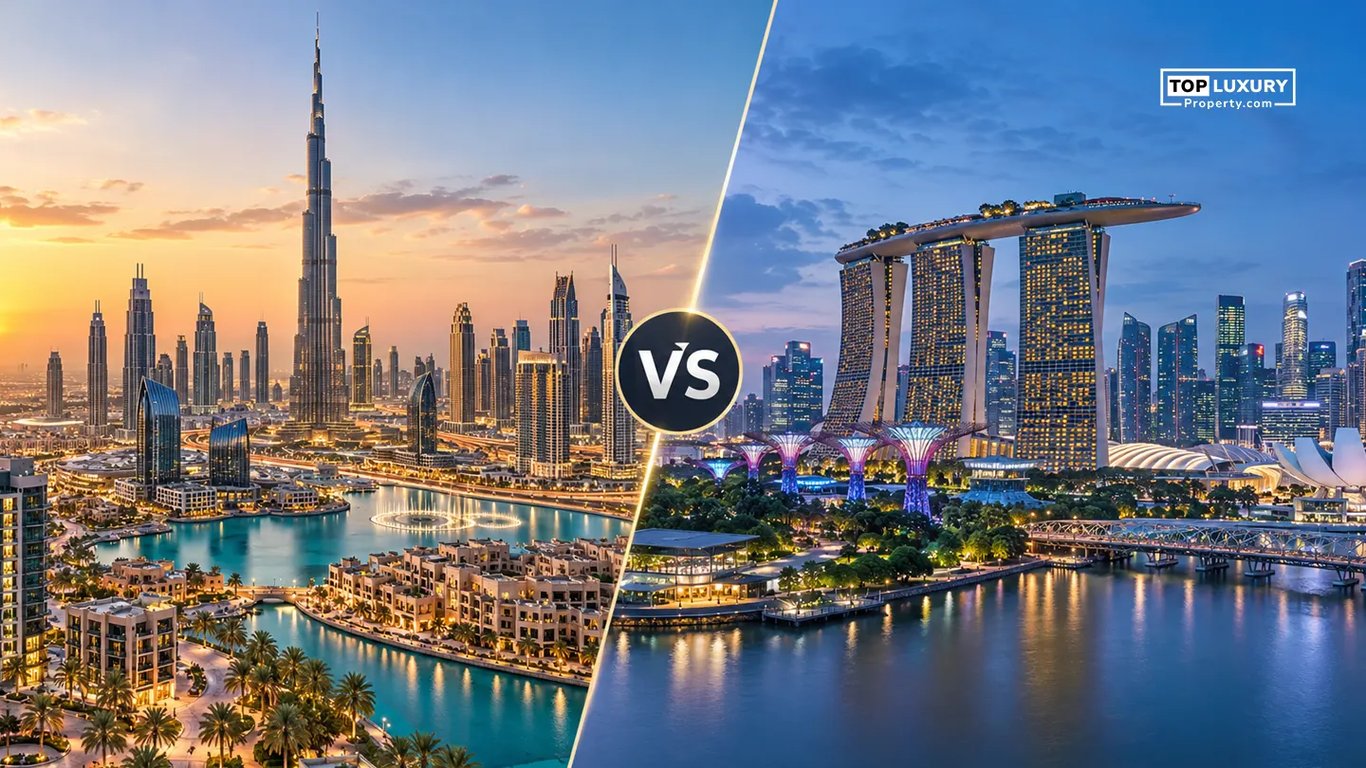
Dubai wins on income: gross rental yields of 5–12% against Singapore's 2–4%, plus zero property, capital gains and rental income tax. Singapore wins on stability, currency strength and regulatory maturity. Yield-driven investors lean toward Dubai. Capital-preservation investors with a decade-plus horizon often prefer Singapore, or a mix of both.
Key Highlights
-
Yield gap: Dubai's average gross yield is near 6.76% citywide and climbs past 8% in JVC and Dubai South, while Singapore's prime districts often settle under 3%.
-
Tax exposure: A foreign buyer pays roughly 4% total on a Dubai purchase versus a combined stamp duty and ABSD bill that can swallow 60%+ of a Singapore purchase price.
-
Residency route: AED 2 million in Dubai property buys a renewable 10-year Golden Visa with no minimum stay. Singapore has no property-linked residency pathway at all.
-
Entry cost: A one-bedroom in JVC starts around AED 700,000 (roughly USD 190,000). The Singapore equivalent, after ABSD, can run north of USD 950,000.
Ask 10 property investors why they’re choosing between Dubai vs Singapore, and you’ll get ten different answers. Still, they usually circle back to the same question: do you want income, or do you want certainty?
These are two global real estate markets that are coming up in every conversation. Both are small, both punch far above their geographics, and both have spent two decades building themselves into a magnet of foreign investment.
But that’s roughly where similarities end. Dubai is fast-moving, while Singapore is mature and tightly regulates its growth. They suit different investor bases. But as an investor, which one should you choose for property investment?
Let’s see the difference between Dubai vs Singapore real estate.
Market Overview: Dubai vs Singapore
Before starting the comparison, we need to understand the market overview to understand how each government underlies the philosophy toward its property market.
Dubai real estate saw AED 286 billion in property sales across 86,024 transactions in the first six months of 2026. The first quarter itself recorded AED 252 billion value, a 31% jump year-on-year, with close to AED 148 billion of that coming from foreign buyers. Although the nearby geopolitical tension reduced sales in Q2, the market is in an expansion phase, driven by population growth, Golden Visa, and a steady flow from Europe, Russia, India and East Africa.
In the same context, Singapore recorded $35 billion in transactions in H1 2026. The government treats its property market less like an asset class. Cooling measures, loan caps and stamp duty penalties are applied to keep prices stable. Singapore hasn’t had a property crash in decades.
In short, Dubai real estate is growing, and Singapore is stable.
Dubai vs Singapore: How Much Do You Have to Pay?
Price is a main factor when comparing Dubai vs Singapore real estate. And on this filter, Dubai opens the door to a much wider range of investors. Singapore is an incredibly dense premium market, and prices are stubbornly high. The Dubai market is balanced and stable, giving more sq. ft. in the same budget.
In 2026, the median price for a luxury apartment in Singapore's Core Central Region starts from $2.8 million. The average per square foot across the luxury private sector is $1,580. If you target ultra-prime neighborhoods like Orchard Road or Sentosa Cove, the costs scale significantly. Sentosa Cove averages $1,750 per square foot, while premium Central Business District (CBD) towers command upwards of $2,100 per square foot.
Dubai remains systematically underpriced compared to the global average. As of mid-2026, the average per square foot price in Dubai is AED 1,916 ($522). Premium waterfront districts offer incredible value. Dubai Marina ranges from $517 to $790 per square foot, and Downtown Dubai commands $760 to $1,500 per square foot. Even the world-famous Palm Jumeirah averages around $1,200 to $1,700 per square foot.
Which Gives Better Rental Yield, Dubai or Singapore?
If there’s one number that ends most Dubai vs Singapore debates, it's the rental yield. This is the annual rent as a percentage of the property value and it measures how your investment is giving returns month on month.
Singapore Net Yield Squeeze
Singapore private properties generate 3% to 4% gross yield. However, progressive property taxes and high maintenance costs gradually eat up the returns.
-
Property Tax: Singapore's IRAS charges a progressive annual property tax based on the Annual Value (AV) of the property. For non-owner-occupied properties, this rate ranges up to 36% for premium assets.
-
Maintenance Fees: High-end condos in Singapore charge significant monthly maintenance fees (sinking funds) to maintain manicured garden landscapes and security, consuming up to 0.7% of property value per year.
-
Management Costs: Standard property management costs 5% to 8% of the gross rents collected. After deducting these costs and factoring in the massive 60% upfront ABSD into your real capital outlay, your real net yield drops to 1.5% to 2.5%.
Dubai's Net Yield Superiority
Dubai gives 6% to 8% gross yields consistently. Dubai has no property tax, so net yields are very similar to gross yields. Like maintenance fees, Dubai has service charges that are heavily regulated by RERA and based on the actual square foot area. These charges generally lie between AED 3 and AED 30 per square foot.
ROI and Capital Appreciation: Real Property Returns
To understand how much returns you can get in Dubai and Singapore real estate, you must calculate both the cash flow and the tax treatment upon exit.
5-Year ROI Projection ($1.5M Cash Purchase)
Assumptions: 5 years of holding, flat 4% annual capital appreciation, sold in Year 5. Foreign buyer profile.
|
Investment Phase |
Singapore Private Condo ($1.5M) |
Dubai Apartment ($1.5M) |
|
Initial Upfront Foreign Tax / Fee |
60% ABSD = -$900,000 |
4% DLD Fee = -$60,000 |
|
Yearly Gross Rent |
$52,500 (3.5%) |
$105,000 (7%) |
|
Annual Property & Income Taxes |
-$12,000 |
$0 |
|
Annual HOA / Service Fees |
-$10,000 |
-$25,000 |
|
Annual Net Cash Flow |
$30,500 |
$80,000 |
|
5-Year Total Net Cash Flow |
$152,500 |
$400,000 |
|
Sale Price (Year 5 at 4% growth) |
$1,824,000 |
$1,824,000 |
|
Gross Profit on Sale |
$324,000 |
$324,000 |
|
Capital Gains / Exit Taxes |
$0 (After 3 years SSD drops to 0) |
$0 |
|
Net Profit / Loss (Cash Flow + Equity minus Upfront Tax) |
-$423,500 (Due to $900K upfront ABSD) |
+$664,000 |
Verdict: In identical growth environments, the Dubai property generates positive net wealth because Singapore's 60% upfront ABSD severely penalizes shorter 5-year holding periods for foreign individuals. Singapore requires a multi-generational holding timeline to absorb that tax hit.
Taxation: Dubai vs Singapore Real Estate
Tax structure is where the two markets diverge most sharply, and it's the factor that tends to make or break an investment case once you actually run the numbers on a specific property.
Dubai runs on a near-zero tax model for property. Singapore has high taxation for foreign buyers.
|
Tax Type |
Dubai |
Singapore |
|
Annual property tax |
0% |
Up to 36% of annual rental value (non-owner-occupied) |
|
Capital gains tax |
0% |
0% (Seller's Stamp Duty applies if sold within 4 years) |
|
Rental income tax |
0% |
0–24%, progressive |
|
Buyer stamp duty |
4% DLD transfer fee |
Up to 6% BSD, plus up to 60% ABSD for foreigners |
|
Inheritance tax |
0% |
0% |
|
VAT / GST on new property |
0% (residential exempt) |
9% GST |
The Additional Buyer's Stamp Duty, or ABSD, is the number that stops most foreign buyers. It was raised from 30% to 60% in April 2023 as a cooling measure aimed squarely at non-resident capital, and it hasn't come back down. On a SGD 2 million condo, that's an extra SGD 1.2 million due upfront, on top of the standard Buyer's Stamp Duty.
That isn't a rounding difference. It's the kind of number that changes what's even feasible for a mid-sized investor. Plenty of buyers with a genuine interest in Singapore simply get priced out at the stamp duty stage, long before they get to compare buildings or negotiate anything.
Ownership Rules and Foreign Access
Who can actually buy what, and how much paperwork stands between an offer and a signed title deed, matters just as much as the price on the listing. This is where the two cities' underlying philosophies really show themselves.
Dubai: Foreign nationals can buy freehold property outright in designated zones, and those zones cover most of the areas anyone actually wants: Downtown, Dubai Marina, Palm Jumeirah, Business Bay, JVC, Dubai Hills and dozens more. There's no cap on how many properties a foreigner can own, no requirement to live in the UAE, and the transaction itself, once agreed, typically closes within days rather than months. RERA oversight and mandatory escrow accounts for off-plan projects have tightened buyer protection considerably since the market's rougher early years.
Singapore: Foreigners can buy private condominiums without special approval. Landed property, meaning bungalows, terraced houses, semi-detached homes, is a different story entirely. It requires case-by-case approval from the Land Dealings Approval Unit, and approval is rare. HDB flats, which make up roughly 80% of Singapore's housing stock, are off-limits to foreign buyers entirely. So in practice, a non-resident's property buying options in Singapore is narrower than it first appears.
• Dubai: freehold ownership across designated zones, no residency requirement, unlimited property count.
• Singapore: condos generally open to foreigners; landed homes need LDAU approval; HDB flats excluded entirely.
Residency: Dubai's Golden Visa vs Singapore's Closed Door
For many buyers, especially those from countries with limited passport mobility, residency matters as much as the investment return itself.
-
Dubai: Buy AED 2 million or more in Dubai property and you qualify for a 10-year renewable Golden Visa, extendable to spouse, children and even domestic staff. There's no minimum stay requirement, which means you can hold the visa while living anywhere in the world. It also opens access to UAE banking, the ability to sponsor family, and a long runway in a jurisdiction with no personal income tax.
-
Singapore: Singapore offers nothing comparable through residential property. The Global Investor Programme requires a minimum SGD 10 million commitment into a Singapore-based business or fund, not real estate directly, and Permanent Residency applications are judged on employment history, education, family ties and economic contribution, with approval rates reportedly below 30%. Buying a condo in Singapore, however large or small, gives you a lease permit, not a foothold on residency.
Dubai vs Singapore Currency: Peg Versus Managed Float
Currency mechanisms rarely come into the glossy brochure, but they quietly shape long-term returns, particularly for anyone earning or spending in a third currency.
The UAE Dirham has been pegged to the US Dollar at AED 3.6725 since 1997. That peg removes currency risk entirely for dollar-based investors and gives predictable pricing for anyone earning or spending in USD. The flip side is that investors in GBP, EUR or other floating currencies still carry exchange rate exposure, especially at exit.
The Singapore Dollar operates under a managed float, steered by the Monetary Authority of Singapore against a trade-weighted basket of currencies. It has appreciated gradually against the US Dollar over the past two decades, which has quietly added to total returns for long-term holders. The cost is that entry prices for foreign buyers have crept upward in dollar terms over time, on top of the ABSD burden already discussed.
Market Maturity, Regulation and Volatility
Neither market is unregulated, but the style of regulation is where the real contrast began, and it's worth understanding before deciding which kind of risk you're comfortable carrying.
Singapore is arguably one of the most tightly regulated property markets anywhere. Loan-to-value caps, Total Debt Servicing Ratio limits (monthly debt obligations capped at 55% of gross income), and periodic ABSD adjustments are all designed to prevent the speculations that lead to crashes. It has worked. Singapore hasn't seen a property crash in decades, and that stability is precisely what attracts conservative, long-horizon capital.
Dubai's regulatory framework is younger and has matured quickly, but the market itself still moves in bigger cycles. The 2014–2019 correction, for context, saw prices fall 25–35% in many communities before the current boom began in late 2020. RERA's escrow requirements for off-plan sales have significantly reduced the risk of developer defaults that plagued the market in its early years, but cyclicality is still part of the deal here. Anyone buying in Dubai should go in expecting swings, not a straight line.
Dubai vs Singapore Lifestyle Factor: Spectacle Versus Curated Calm
Numbers aside, plenty of buyers are also weighing where they, or their tenants, actually want to live. The two cities offer genuinely different day-to-day experiences, and this shapes rental demand as much as any tax rule does.
• Visibility of wealth: Dubai's luxury market is outward-facing, with beach clubs, supercars and branded residences. Singapore's is understated, more about discretion than display.
• Climate and outdoor living: Singapore's tropical climate supports year-round outdoor activity. Dubai's summer heat pushes life indoors for roughly four to five months.
• Pace: Dubai moves fast and rewards opportunism. Singapore is structured, predictable, and rewards patience.
• Dining and culture: Both cities have world-class food scenes, but Singapore's hawker culture offers genuine everyday diversity that Dubai, still building its own food identity, hasn't quite matched at the mass-market level.
Neither is objectively better here. A tenant profile chasing beachfront glamour and a fast social calendar will gravitate to Dubai. A tenant profile prioritising schooling, governance and a slower pace will lean toward Singapore. This matters more for rental demand than most investors initially assume.
Which City Actually Fits Your Profile?
Enough theory. Here's how the decision tends to shake out in practice, based on the kind of investor sitting across the table and what they're actually trying to achieve.
|
Investor Profile |
Better Fit |
Reasoning |
|
Yield-focused, wants cash flow |
Dubai |
2–3x higher gross yields, zero tax drag on rental income |
|
Capital preservation, low risk appetite |
Singapore |
Mature regulation, low volatility, strong managed currency |
|
Budget under USD 500,000 |
Dubai |
Singapore's ABSD makes a comparable entry near-impossible |
|
Wants residency through property |
Dubai |
Golden Visa at AED 2M; Singapore has no equivalent route |
|
20-year-plus horizon, currency-conscious |
Singapore |
SGD appreciation history adds to long-run total return |
|
Diversified, seven-figure-plus portfolio |
Both |
Dubai for income and residency, Singapore for stability |
Final Verdict
If you want a well-capitalised portfolio, the smartest structure is usually not a binary choice at all. Hold Dubai property for income and residency, and hold Singapore property, or Singapore-linked assets, for long-term capital preservation and currency stability.
But if you're a single-property investor working with somewhere between USD 200,000 and USD 2 million, and cash flow is the priority, Dubai is, on the numbers, the clearer choice in 2026. The combination of zero taxation, higher yields, lower entry costs and a genuine residency pathway is difficult to replicate anywhere else at this scale. That said, Singapore isn't a bad market, far from it. It's simply built for a different kind of patience, and for investors who already hold PR status or citizenship there, but for foreign investors, the ABSD changes the calculation considerably.
Choose based on what you actually need. Income, residency and liquidity point toward Dubai. Stability, governance and a strong long-term currency point toward Singapore.