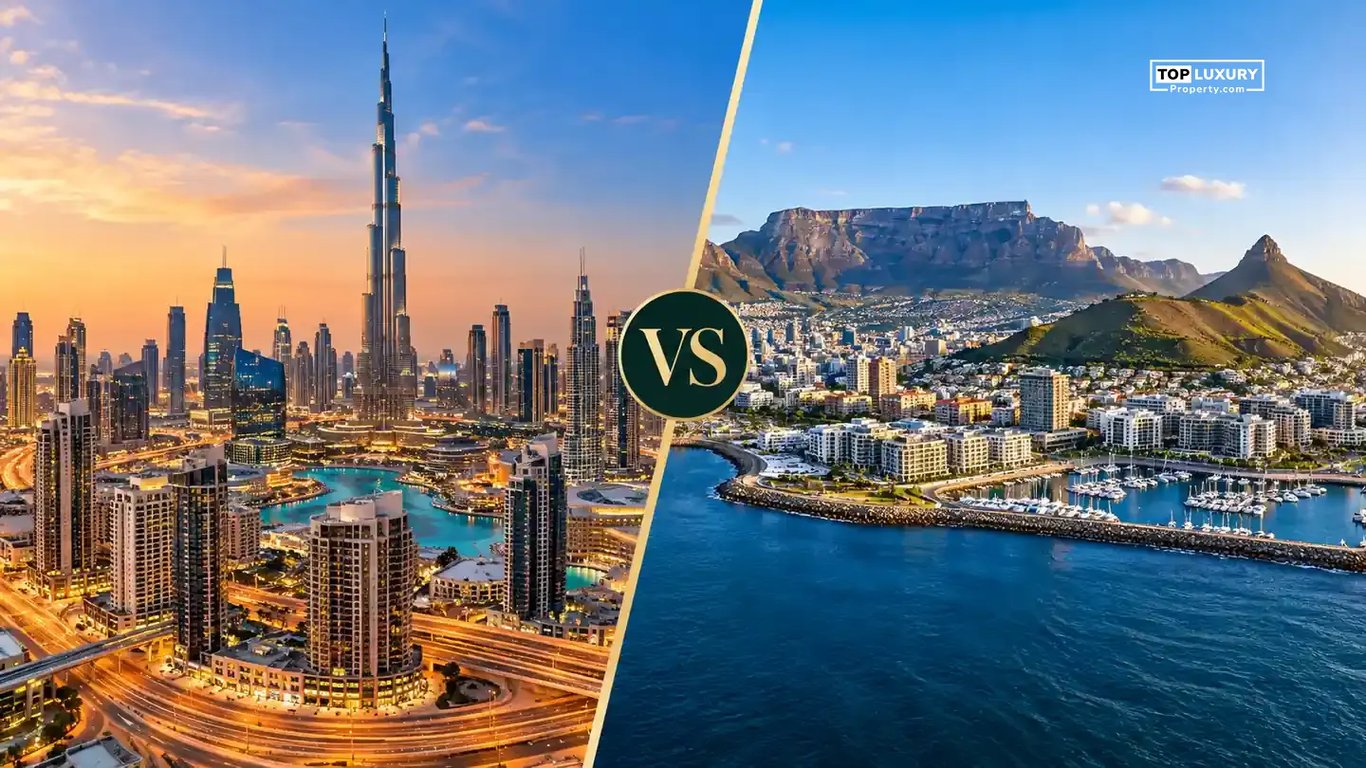
South African property investors face a major choice today. Do you buy another rental home in Cape Town, or do you move your capital offshore to the United Arab Emirates?
Cape Town remains one of the most beautiful cities in the world. It offers an unmatched lifestyle and a familiar property market. For lifestyle buyers, it is incredibly hard to beat.
But if you sideline the emotion and look at the numbers, the investment perspective is very different.
High-net-worth South Africans are now investing in Dubai real estate. This reason is not about wealth preservation; investors want to escape heavy local tax burdens, unpredictable municipal service charges, and the endless volatility of the Rand.
Now the question is, should you invest in Dubai?
Let’s compare Dubai vs Cape Town real estate across property prices, rental yields, capital appreciation, cost of living, visas, and expat lifestyle.
The Core Comparison: Dubai vs. Cape Town at a Glance
|
Feature / Metric |
Cape Town, South Africa |
Dubai, UAE |
|
Average Gross Rental Yields |
4% to 7% |
6.68% overall |
|
Annual Property Taxes |
Yes (Municipal rates) |
0% |
|
Capital Gains Tax (CGT) |
Yes (Up to 18% effective rate) |
0% |
|
Currency Stability |
South African Rand (Volatile) |
UAE Dirham (Pegged 3.67 to the US Dollar) |
|
Foreign Ownership Rights |
Full ownership allowed |
100% Freehold in designated zones |
|
Tenant Eviction Laws |
PIE Act (Heavily favors the tenant, slow) |
RERA Laws (Pro-landlord, swift resolution) |
|
Residency Perks |
N/A for local citizens |
10-Year Golden Visa |
The Macro-Economic Reality: Currency and Wealth Preservation
We cannot talk about investing in Dubai from South Africa without addressing the economic factor: the South African Rand vs UAE Dirham .
Currency volatility destroys long-term property value on a global scale. Imagine you buy a luxury apartment on the Atlantic Seaboard for R10 million. Over five years, the local property market performs well, and the home's value increases by 20% to R12 million. You think you made a solid profit.
However, if the Rand drops 25% against the US Dollar during that exact same five-year period, your global purchasing power actually shrank. You made money in Rands, but you lost money in real global terms. This is the major problem South African investors face constantly.
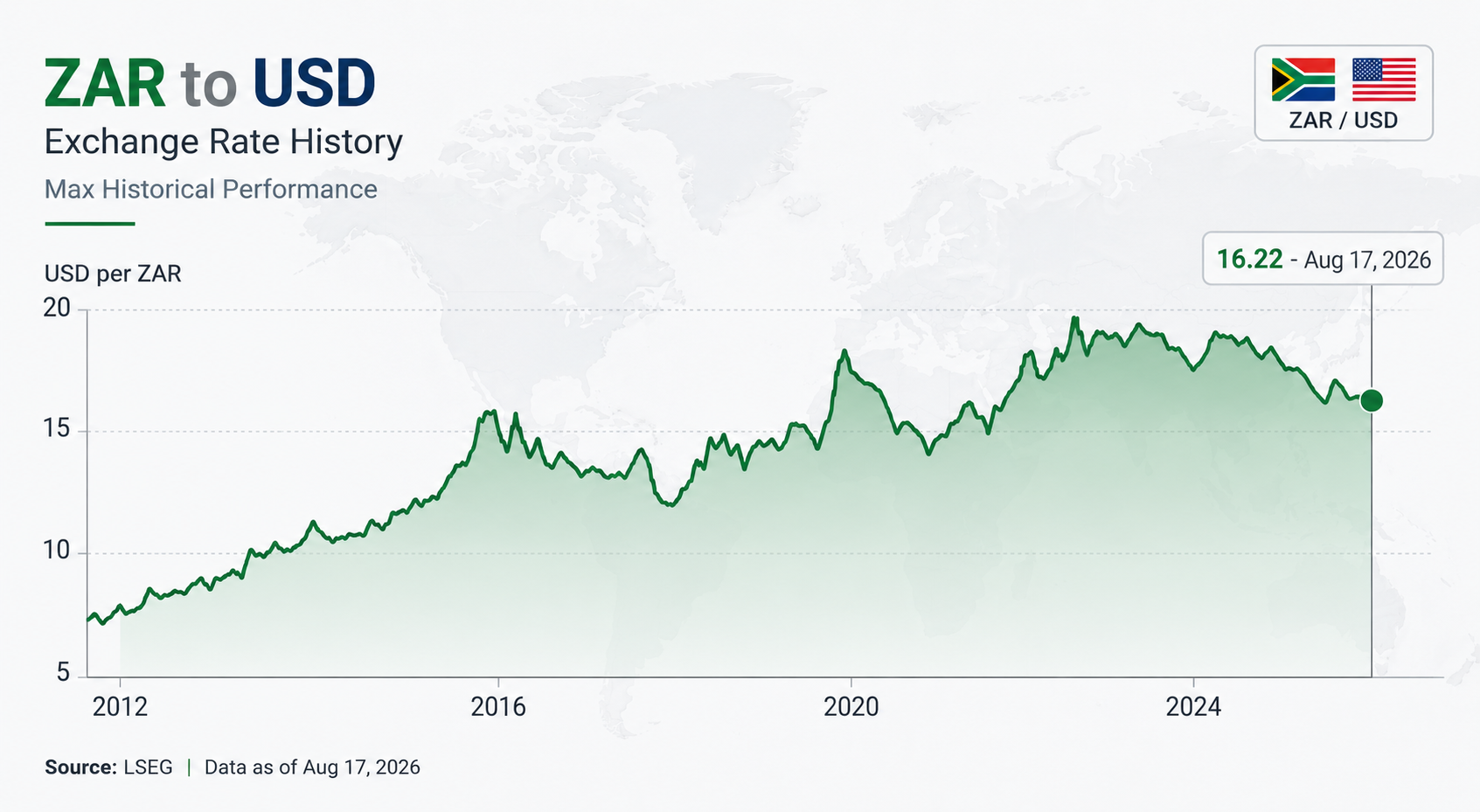
South Africans buy property offshore specifically to hedge against this exact currency risk.
The UAE Dirham (AED) is pegged directly to the US Dollar at a fixed rate of 3.67 AED to 1 USD. This peg has remained unchanged since 1997. When you buy an apartment or a townhouse in Dubai, you are essentially holding a dollar-backed asset. Your rental income is paid in a dollar-pegged currency. When you eventually sell the property, your capital gains are realized in a dollar-pegged currency. It completely insulates your wealth from emerging market volatility.
Beyond the currency, physical and economic safety drive capital out of South Africa. The UAE consistently ranks as one of the safest countries globally, featuring massive sovereign wealth reserves, zero tolerance for crime, and highly predictable government policy.
How are the Property Prices and Affordability between Dubai & Capetown?
Buying property in Dubai requires a higher initial capital outlay compared to Cape Town. However, Dubai properties offer higher net returns due to zero taxes and a stronger currency.
When you compare property prices, the differences reflect the economic strength of each city.
-
City Center Prices: In Cape Town, the average price to buy an apartment in the city center is roughly R3,636 per square foot. In Dubai, buying an apartment in a central hub like Downtown Dubai or Business Bay costs around R10,507 per square foot.
-
Suburban Prices: If you look outside the immediate city center, Cape Town property averages R2,424 per square foot. In Dubai's suburban communities, the price is approximately R6,031 per square foot.
While Dubai is more expensive per square foot, you must factor in the financing environment. The annual mortgage interest rate for a 20-year fixed loan in Cape Town is extremely high, averaging 11.16%. In Dubai, mortgage interest rates are much lower at an average of 4.50%. This lower cost of borrowing makes financing a Dubai property highly attractive for non-resident investors.
|
Dubai Area |
Avg (AED/sq ft) |
Cape Town |
Avg (ZAR/sq ft) |
|
15,028-23,868 ZAR (3,400-5,400 AED) |
Clifton / Bantry Bay |
7,432 to 11,798 |
|
|
Downtown Dubai |
11,492-16,796 ZAR (2,600-3,800 AED) |
Camps Bay / Fresnaye |
5,110 to 8,361 |
|
Business Bay |
8,398-11,492 ZAR (1,900-2,600 AED) |
Sea Point / Green Point |
3,716 to 5,574 |
|
8,840-11,934 ZAR (2,000-2,700 AED) |
City Bowl / Gardens |
3,252 to 4,645 |
|
|
4,420-6,188 ZAR (1,000-1,400 AED) |
Observatory / Woodstock |
1,672 to 2,601 |
|
|
3,757-5,304 ZAR (850-1,200 AED) |
Northern Suburbs |
1,579 to 1,951 |
Dubai vs Cape Town: Rental Yields and Cash Flow
Your return on investment (ROI) is the main highlight of your real estate portfolio. Cash flow pays the bills. Let's look at the numbers.
The Cape Town Yield Reality
In Cape Town, landlords generally see gross rental yields sitting between 4% and 7%. Prime areas like Clifton or Camps Bay offer fantastic capital growth over long periods. But the actual rental cash flow is quite low compared to the massive purchase prices. You also face high maintenance costs, rising municipal tariffs, and personal income tax on the rent you collect.
The Dubai Yield Reality
Dubai completely flips this script. As of 2026, the average overall rental yield in Dubai was 6.68%. If you invest specifically in apartments, the average rental yield goes to 7.15%.
Dubai operates a highly transparent market. They target specific master-planned communities designed to different expats. Here is how some of the top Dubai communities perform:
-
Dubai Investments Park: 8.53% average yield.
-
Dubai Sports City: 8.23% average yield.
-
Dubai Hills Estate: 6.35% average yield.
-
Jumeirah Village Circle (JVC): 7.43% average yield.
-
Business Bay: 6.77% average yield.
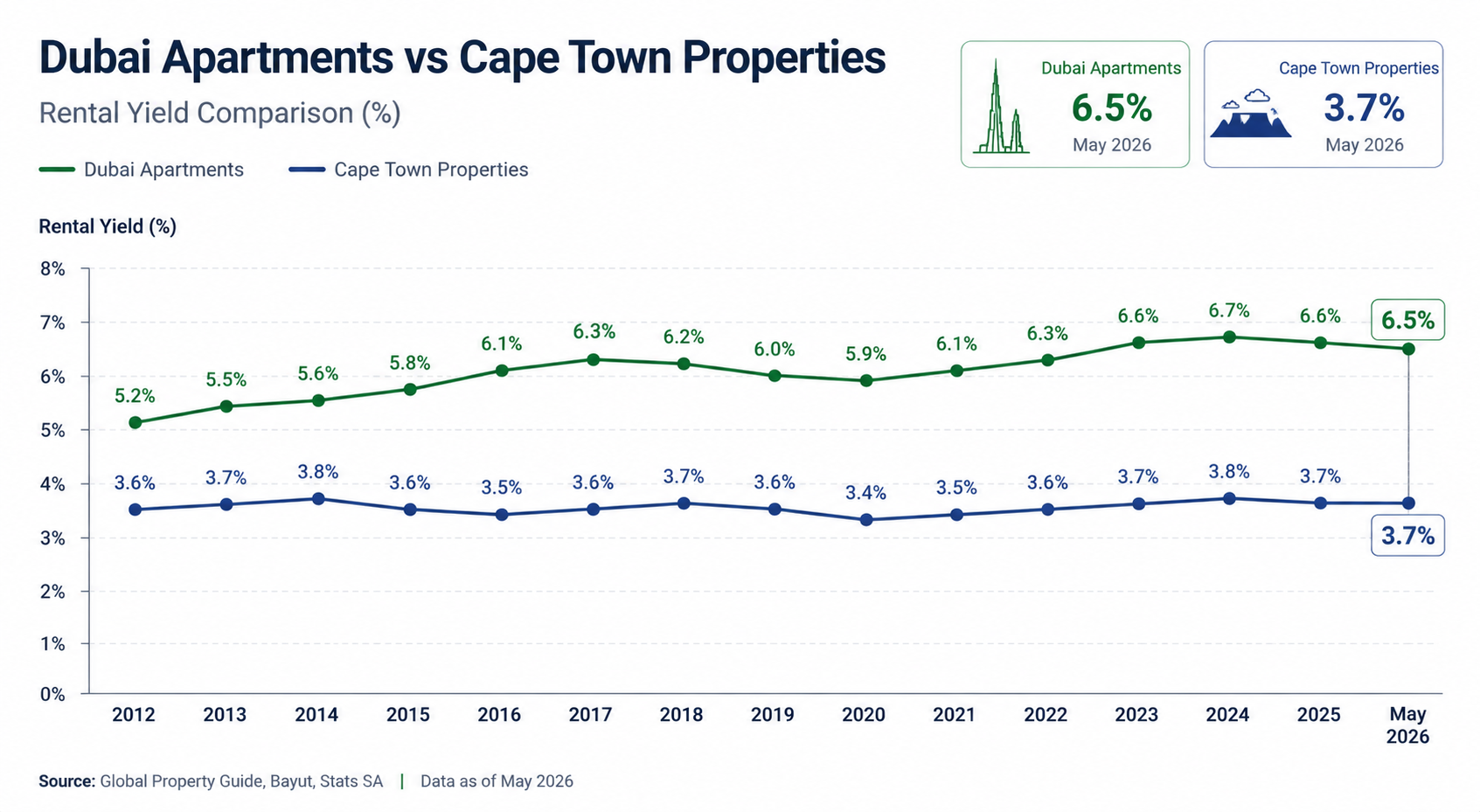 It is also vital to look at new leases. Rent increase controls restrict how much landlords can raise rent on existing tenants. Therefore, new contracts reflect the true current market rate. In 2026, the average rental yield for new contracts stood at a strong 6.98%.
Because Dubai charges zero tax on rental income, your gross yield is incredibly close to your net yield. The gap in net cash flow between Dubai and Cape Town is enormous.
Capital Appreciation Trends
Both cities offer capital appreciation. But Cape Town's growth is often erased by the depreciating Rand, while Dubai's growth is secured by a US Dollar-pegged currency.
Cape Town Market Growth
Cape Town properties, especially on the Atlantic Seaboard, have a long history of solid capital appreciation in local currency terms. Property values rise steadily. However, currency volatility destroys this value globally. If your property gains 20% in value over five years, but the Rand drops 25% against the US Dollar in that same time, your global purchasing power actually shrinks.
Dubai Market Growth
Dubai property prices increased significantly between 2022 and 2025, especially in prime and luxury locations. The market is maturing. While the explosive post-pandemic price jumps are stabilizing, steady, sustainable capital appreciation continues.
Because the UAE Dirham (AED) is pegged directly to the US Dollar, buying a townhouse in Dubai means holding a dollar-backed asset. When you eventually sell, your capital gains are realized in hard currency. You do not lose sleep over currency depreciation.
The Taxation Gap: Where Do You Pay More Taxes, Dubai vs Cape Town?
Taxes are the biggest reasons why South African investors are investing abroad.
When you invest in Cape Town, you deal with a heavy and layered tax burden.
-
Transfer Duties: If you buy a luxury property in Cape Town above R3.2 million, the transfer duty scales up aggressively, eventually 13% on the value above R12.1 million. This is a massive upfront cost just to acquire the asset.
-
Municipal Rates: You pay annual property rates to the City of Cape Town based on the municipal valuation of your home.
-
Income Tax: The rental income you generate is added to your personal income and taxed according to your personal income tax bracket, which can reach up to 45%.
-
Capital Gains Tax (CGT): When you eventually sell the home for a profit, the South African Revenue Service (SARS) apply capital gains tax. For individuals, the maximum effective CGT rate is 18%. For companies or trusts, it is even higher.
Dubai operates in a completely different.
-
You pay zero annual property taxes.
-
You pay zero capital gains tax when you sell.
-
You pay zero tax on your rental income.
Whatever rent your tenant pays you, you keep. You only pay a one-time 4% transfer fee to the Dubai Land Department (DLD) when you first buy the property. There are no other taxes. After you pay that initial 4%, you only have to pay the service charge.
Off-Plan Investment Strategies: How to Leverage Dubai's Market
One of the biggest differences between the two markets is how new properties are sold. In South Africa, most investors buy ready, existing homes. In Dubai, a massive portion of the market is driven by "off-plan" sales.
How Off-Plan Payment Plans Work

When you buy an off-plan property from a tier-one developer, you do not need a mortgage, and you do not need to pay the full price upfront. Developers offer structured payment plans tied to construction milestones.
For example, if you buy a townhouse in an upcoming development like Emaar Golf Trails, you might encounter an 80/20 payment plan.
-
You pay a 10% or 20% down payment to secure the unit.
-
You pay 60% in small, regular installments (like 5% every few months) during the 3-to-4-year construction phase.
-
You pay the final 20% only when the developer hands you the keys.
This allows South African investors to spread their capital outflow over several years. Furthermore, because you secure the property at today's launch price, you capture all the capital appreciation that occurs during the construction period. By the time the keys are handed over, the property is often worth significantly more than what you contracted it for.
Is Off-Plan Safe?
Yes. Dubai is one of the safest off-plan regulatory environments in the world.
Buyer funds do not go directly to the developer's corporate bank account. By law, your installment payments are deposited directly into a designated, RERA-approved project Escrow Account managed by a third-party bank.
The developer cannot freely withdraw this money. Funds are only released to the construction contractors in phases, and only after government-appointed engineers physically visit the site to audit the progress.
Furthermore, upon paying your initial deposit and the 4% DLD fee, the government issues you an Oqood, an official interim registration certificate. This legally binds the unit to your name and prevents the developer from selling it to anyone else.
Cost of Living Comparison: Dubai vs Cape Town
You cannot compare investment locations without looking at the daily cost of living. This is especially important if you plan to relocate or retire.
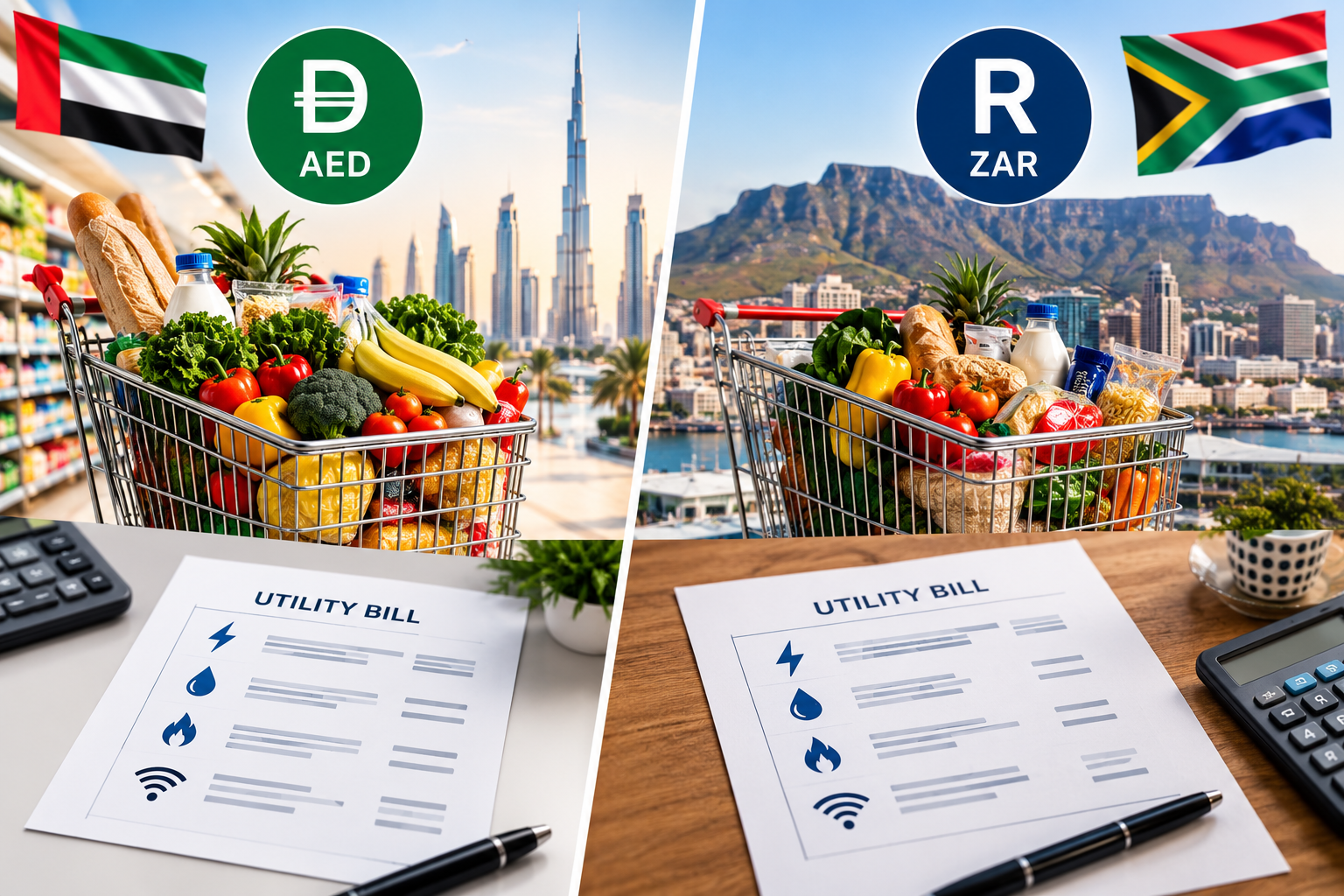 Dubai is undeniably more expensive than Cape Town.
-
Overall Costs: The cost of living in Dubai is roughly 31.2% higher than in Cape Town, excluding rent.
-
Rent: Rent prices in Dubai are drastically higher, sitting about 56% higher than in Cape Town. This is bad news for tenants, but incredible news for property investors looking high returns.
-
Dining and Groceries: Restaurant prices in Dubai are 41.4% higher, and grocery prices are 20.1% higher than in Cape Town.
However, you must balance these costs against earning potential. Salaries in Dubai are entirely tax-free. The average monthly net salary after tax in Dubai is approximately AED 12,278.31. In Cape Town, the average monthly net salary is only AED 6308.
Dubai’s local purchasing power is 11.5% higher than Cape Town's. You pay more to live in Dubai, but you also take home significantly more tax-free money.
Dubai vs Cape Town: Foreign Ownership Rules and Landlord Laws
Dubai makes it easy for foreigners to buy property and protects landlords with strict eviction laws. South Africa makes ownership easy but protects tenants with slow eviction laws.
Foreign Ownership Rules
In South Africa, foreigners can buy property with full ownership rights. The process is straightforward, but buying and selling is subject to strict South African Reserve Bank (SARB) exchange control regulations.
In Dubai, the government actively encourages foreign investment. You can buy property with 100% full freehold ownership in designated freehold areas. You do not need a local partner or a residency visa to buy real estate. You simply need an international passport.
Landlord Laws and Evictions
Dubai has vastly superior laws for property investors. The system is strictly pro-landlord. It allows rapid eviction of non-paying tenants within weeks. South Africa operates under the PIE Act, which heavily favors tenants and can drag eviction battles out for over a year.
South Africa: The PIE Act
In South Africa, landlord-tenant disputes are dictated by the Prevention of Illegal Eviction from and Unlawful Occupation of Land Act. While designed to protect vulnerable citizens, PIE Act evictions heavily favor the tenant.
If a tenant stops paying rent in Cape Town, evicting them is a nightmare. Landlords must go through a complex, highly bureaucratic court process. It can easily take six to twelve months. During this time, the landlord receives zero rental income, must pay expensive legal fees, and must continue paying the municipal rates and body corporate levies. In severe cases, the court may even refuse to grant an eviction order if the tenant claims they have nowhere else to go.
Dubai: A Pro-Landlord Environment
Dubai is built on commerce, and its legal system reflects that. Real Estate Regulatory Agency (RERA) handles rental disputes, rent increase and rental registration.
If a tenant in Dubai fails to pay rent, there is no year-long court battle.
-
The landlord issues a formal 30-day notarized legal notice.
-
If the tenant still does not pay, the landlord files a case with the Rental Dispute Settlement Centre (RDSC).
-
The RDSC typically reviews the case and issues an eviction judgment within a matter of weeks.
-
The police execute the eviction swiftly.
The system is highly digitized, completely unsentimental, and designed to protect the asset owner.
Furthermore, rent increases are tightly controlled to protect tenants from unfair gouging. RERA publishes an annual RERA Smart Rental Index calculator. If market rents in your building have increased, the calculator tells you exactly what percentage you are legally allowed to increase your tenant's rent upon renewal. Everything is transparent.
Visas and Residency Benefits Through Property Investment
Buying a house in Cape Town does not grant a South African citizen any new travel or residency privileges.
The UAE government offers residency visas through property investment to attract foreign investment. If you purchase property in Dubai, you unlock major residency benefits.
The 10-Year UAE Golden Visa
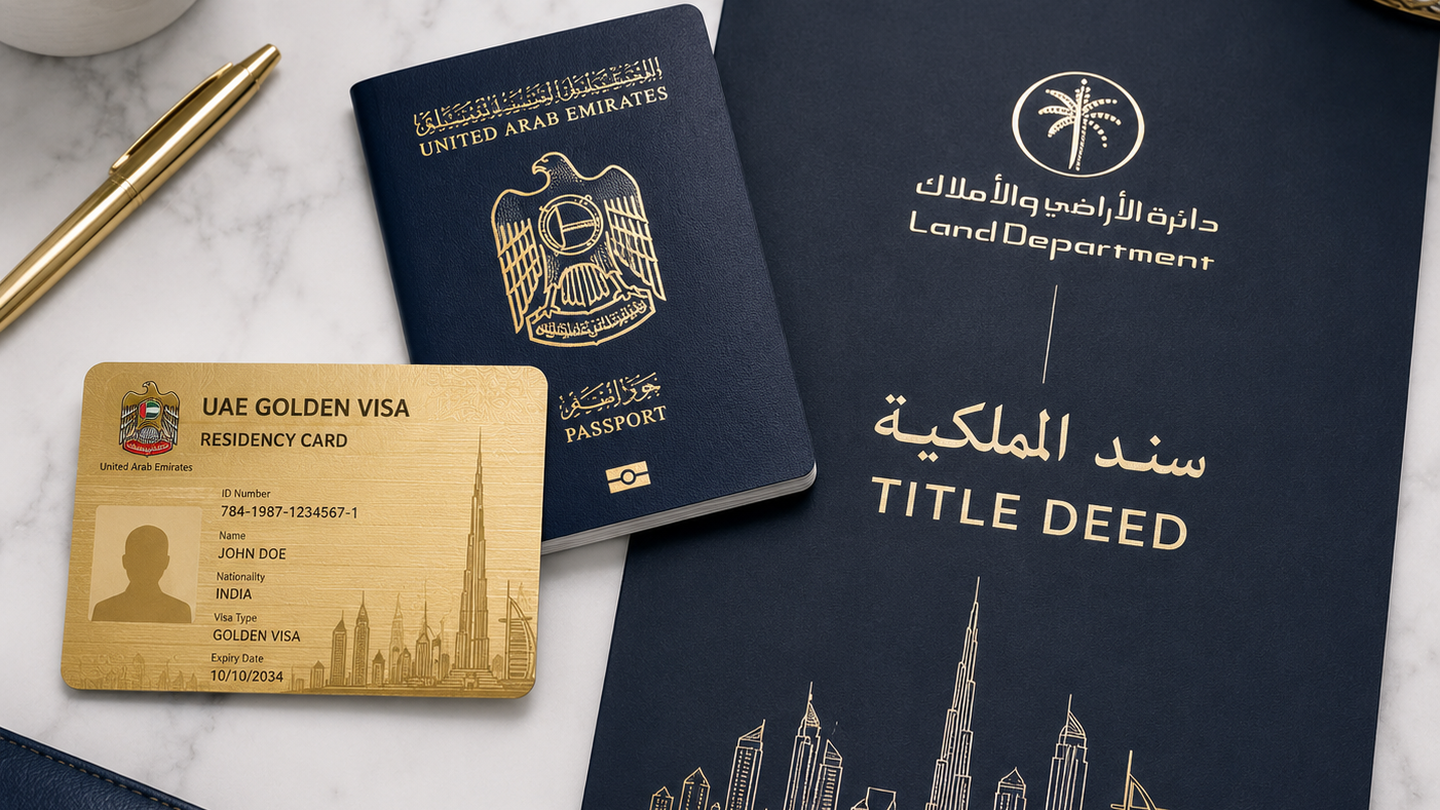
The 10-Year UAE Golden Visa is one of the key reasons why you should invest in Dubai.
-
The Investment Threshold: You must invest a minimum of AED 2 million in real estate.
-
The Rules: You can reach this amount by buying one luxury property or multiple smaller apartments. It applies to both ready properties and off-plan properties. If you use a mortgage, you can still qualify if the bank provides a No Objection Certificate.
-
The Benefits: The Golden Visa grants you long-term stability. You can live, work, and open personal and corporate bank accounts in the UAE. You can sponsor your spouse, your children of any age, and your domestic staff.
Unlike many other global residency programs, the UAE Golden Visa does not require you to relocate. You get 180 days absence rule, meaning you can stay outside the UAE for an unlimited period without your visa becoming invalid within the day limit. You can continue living in Cape Town and hold the Dubai visa as a "Plan B" security measure for your family.
What is the Difference Between Infrastructure and Urban Connectivity in Dubai & Cape Town?
Cape Town offers historic charm but struggles with power grids and public transit. Dubai offers world-class, futuristic infrastructure that operates flawlessly.
Cape Town Infrastructure
Cape Town is highly developed by African standards. The MyCiTi bus network provides decent public transport in certain areas. The roads are generally good. However, the broader South African infrastructure network faces severe challenges. Historic issues with national power grids (load shedding) and water restrictions have frustrated homeowners and businesses alike.
Dubai Infrastructure
Dubai is hyper-modern. The infrastructure is built to scale and operates with flawless efficiency.
-
Public Transit: The fully autonomous Dubai Metro connects the entire city. It is spotless, safe, and heavily used by residents.
-
Airports: Dubai International Airport is one of the busiest in the world. Furthermore, the city is currently executing a massive $35 billion expansion of Al Maktoum International Airport to make it the largest airport on world.
-
Utilities: Power outages simply do not happen. Water and electricity (managed by DEWA) are highly reliable. The city features smart grids and rapid emergency response times.
Dubai vs Capetown: Expat Lifestyle and Livability
If you are buying property with the intention of eventually living there, lifestyle is the ultimate deciding factor.
The Cape Town Lifestyle
Cape Town is globally renowned for its natural beauty. You have Table Mountain, world-class wine farms, pristine beaches, and incredible culinary experiences. The lifestyle is relaxed and outdoorsy. However, this beautiful lifestyle is heavily offset by severe concerns regarding violent crime and personal safety.
The Dubai Lifestyle

Dubai offers a completely different proposition. It is a man-made oasis of safety and luxury.
-
Safety: The crime rate is virtually zero. You can walk down the street at 2 AM safely. You can leave your doors unlocked. This peace of mind is the number one reason South Africans relocate to the UAE.
-
The South African Community: You will not feel alone. There is a massive, established community of South African expats in the UAE. There are approximately 60,000 South Africans living in Dubai alone (South African Embassy in Dubai). You can easily find biltong, watch the Springboks at local sports bars, and network with fellow South African business owners.
-
Entertainment: The city offers endless luxury shopping, massive indoor theme parks, beach clubs, and global dining. The only downside is the extreme summer heat sometimes.
Final Verdict: Where Should You Invest, Dubai vs Cape Town?
Cape Town will always hold incredible emotional value. Walking on the promenade in Sea Point provides a quality of life that is difficult to replicate anywhere else.
But a property investment portfolio must be driven by data, not emotion.
When you remove the emotion, the comparison is clear. Dubai provides South African investors with a tax-free environment, good rental yields, and Golden Visas for their family's future.
If you are tired of local taxes and currency dips, it is time to look offshore. Dubai offers safety, connectivity, and financial returns, which you need from an appreciated portfolio.
Ready to explore the market? Reach out to us today to start building your tax-free global portfolio.
Can a South African buy property in Dubai?
Yes. South Africans can buy freehold property in Dubai. You do not need to be a UAE resident; you only need a valid passport.
Is it better to invest in Dubai or South Africa?
For pure cash flow, capital preservation, and safety, Dubai is the best option. Dubai offers higher rental yields, zero property taxes, and a US Dollar-pegged currency. South Africa offers great natural beauty, but you may face high taxes and severe currency volatility.
Do I pay tax on Dubai rental income back in South Africa?
Dubai charges zero tax on rental income. However, as a South African tax resident, you must declare your global income to SARS. There is no double taxation agreement that exempts rental income entirely; you may be liable for tax in SA.
Can I get a mortgage in Dubai as a South African?
Yes, UAE banks offer mortgages to non-resident foreign investors to purchase ready properties. You typically need to pay a little more down payment compared to local residents. Along with that, you must submit your South African bank statements, proof of income, and a local credit bureau report as additional documents for mortgages.
Are there hidden costs when buying in Dubai?
Compared to South Africa, closing costs in Dubai are very transparent. You should budget approximately 6% to 7% on top of the purchase price. This covers the mandatory 4% DLD transfer fee, a 2% real estate agency fee, and minor administrative trustee charges.