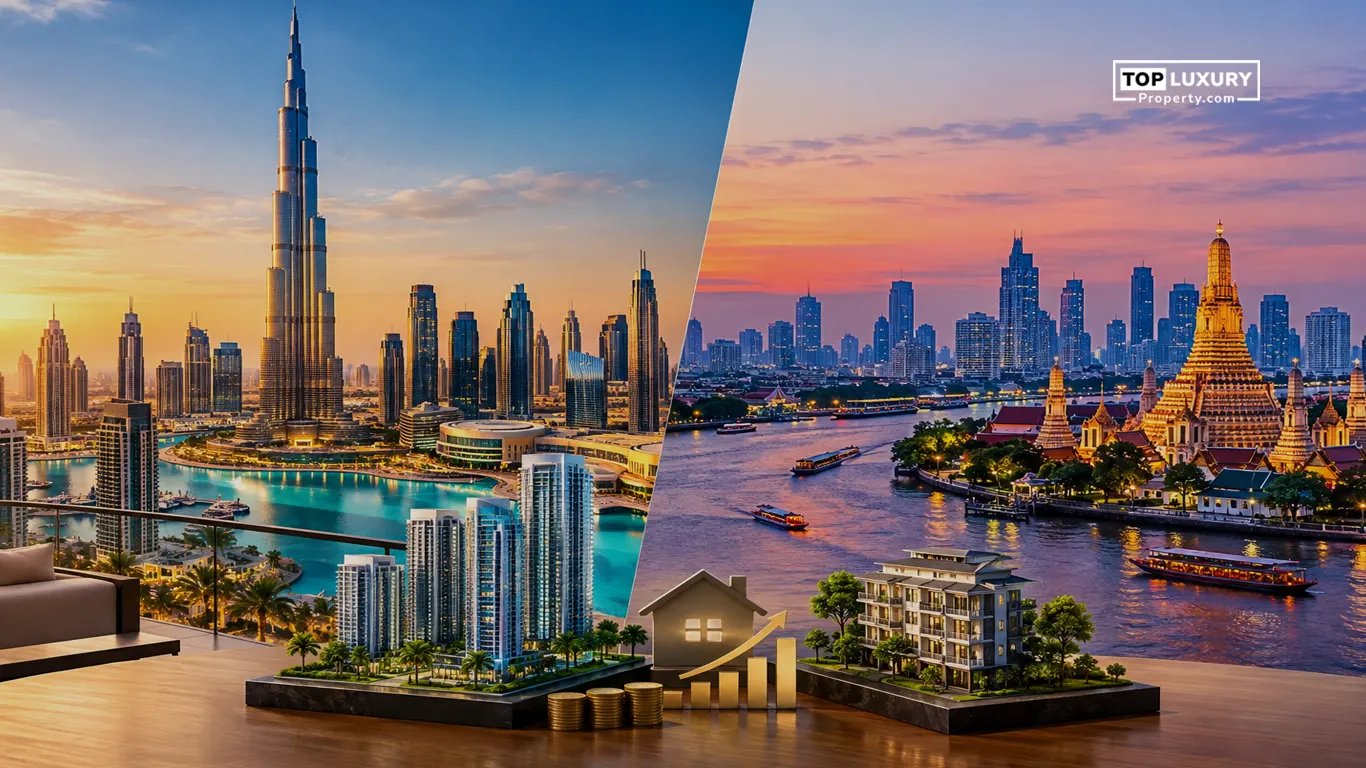
Dubai and Bangkok are two of Asia's most active property markets for foreign investors. Both allow freehold ownership in specific formats, both attract cross-border capital, and both have distinct regulatory and tax frameworks that shape investor returns.
Here, we compare the two markets across multiple variables: prices, yields, ownership rules, taxes, visas, currency behaviour, supply, cost of living, capital appreciation, infrastructure, buyer demographics, off-plan mechanics, livability, and risk.
The goal is to help you decide which market fits your capital, timeline, and objective, whether that is yield, appreciation, residency, or lifestyle.
Dubai vs. Bangkok Real Estate: 2026 Comparison Snapshot
The table below summarises the key differences between the two markets.
|
Factor |
Dubai |
Bangkok |
|
Prime price per sqm |
USD 5,800 to 8,000 |
USD 4,100 to 4,900 |
|
Ultra-luxury benchmark |
AED 5,400 per sq ft on waterfront |
THB 400,000+ per sqm in Ploenchit |
|
Gross rental yield |
6% to 11% |
4% to 7% |
|
Foreign ownership |
Full freehold in designated zones |
Freehold condo within 49% building quota |
|
Annual property tax |
None |
0.02% to 0.30% |
|
Capital gains tax |
None |
Progressive up to 35% |
|
Rental income tax |
None |
Progressive 5% to 35% |
|
Currency |
AED pegged to USD |
THB floats |
|
Residency by property |
Golden Visa from AED 2M |
No property-linked residency |
|
Off-plan availability |
Deep, 3 to 7 year post-handover plans |
Limited, mostly ready or near-ready |
|
Cost of living index |
25% to 30% higher than Bangkok |
Lower, affordable Asian capital |
|
2026 outlook |
5% to 9% growth expected |
Flat to 3% growth |
|
Ease of resale |
Strong secondary market |
Slower, quota dependent |
Dubai vs Bangkok: Market Size and Momentum in 2026
Dubai and Bangkok are two opposite directions. Dubai is in an expansion phase. Bangkok is absorbing prior oversupply. Both conditions create opportunities, but for different investor profiles.
Dubai: Record Transaction Volumes
Dubai closed 2025 with AED 917 billion in total transactions. H1 2026 crossed AED 286 billion. Sales above AED 10 million grew tenfold between 2020 and 2024, from 469 deals to over 4,670. Q1 2025 recorded 1,300+ luxury transactions, a 31% year-on-year increase, and Q1 2026 recorded 2148 transactions. Off-plan investment accumutes 68% of total sales of H1 2026.
ValuStrat's Prime VPI rose 27.5% year-on-year in early 2025. Forecasts point to another 5% to 9% growth through the end of 2026 in Downtown Dubai, Palm Jumeirah, Emirates Hills, and Dubai Hills Estate.
Bangkok: Buyer's Market
Bangkok is facing condominium oversupply from the past decade. The Bank of Thailand's residential price index showed condo prices broadly flat to slightly negative through 2025. Median housing prices dropped 0.4% year on year, or 1.3% in real terms after inflation.
Developers are absorbing transfer fees and offering 10% to 20% promotional discounts on completed inventory. The Bank of Thailand extended LTV relaxation through mid-2026. Prime addresses in Sukhumvit, Silom, and along the Chao Phraya continue to attract buyers. Thailand recorded 32.9 million foreign visitors in 2025, supporting short-let demand where building rules permit.
Momentum Summary
|
Factor |
Dubai |
Bangkok |
|
Investor Focus |
Capital growth and cash flow |
Discounted entry and lifestyle use |
|
Timing/Advantage |
Appreciation momentum |
Negotiation leverage |
|
Market Health |
No bubble indicators on current data |
|
Dubai vs Bangkok: Property Prices and What Your Budget Buys
Absolute prices differ significantly. USD 500,000 buys a different amount of space in each city, and the choice depends on whether you prioritise size or yield.
Entry-Level to Mid-Market
-
Dubai: A one-bedroom in Jumeirah Village Circle, Dubai South, or Al Furjan starts at AED 700,000 to AED 950,000 (USD 190,000 to USD 260,000). Business Bay and Marina one-bedrooms begin around AED 1.4 million.
-
Bangkok: A one-bedroom in Huai Khwang or Ratchada on the MRT line runs THB 3.5 million to THB 5.5 million (USD 100,000 to USD 165,000). Prime Sukhumvit units start at THB 8 million.
Prime and Ultra-Prime
USD 500,000 buys:
-
20 sqm in Singapore's Core Central Region
-
10 sqm at Hong Kong's Peak
-
55 to 70 sqm in prime Downtown Dubai or Business Bay
-
80 sqm freehold in prime Sukhumvit
Price Comparison by Neighbourhood
|
Dubai Area |
Avg (AED/sq ft) |
Bangkok Counterpart |
Avg (THB/sqm) |
|
3,400 to 5,400 |
Riverside Chao Phraya |
250,000 to 400,000 |
|
|
2,600 to 3,800 |
Ploenchit / Chidlom |
300,000 to 450,000 |
|
|
1,900 to 2,600 |
Asoke / Sukhumvit 21 |
220,000 to 300,000 |
|
|
2,000 to 2,700 |
Thonglor / Ekkamai |
200,000 to 280,000 |
|
|
1,000 to 1,400 |
Huai Khwang |
125,000 to 135,000 |
|
|
850 to 1,200 |
Lat Phrao |
70,000 to 95,000 |
Average Rental Yields and Cash Flow: Dubai vs. Bangkok Real Estate
Dubai leads on yield, particularly after tax. Bangkok yields have compressed as prices rose faster than rents.
Dubai Yields
Mainstream yields are 5% to 8% gross. Prime districts such as Dubai Marina, Business Bay, and JVC deliver 8% to 11%. Zero income tax on rentals means net yield stays within one percentage point of gross.
Example: An AED 2 million Business Bay apartment generates AED 140,000 to AED 200,000 per year. Service charges of AED 15,000 to AED 20,000 leave most of the rent as net income.
Bangkok Yields
Gross yields are 4% to 6% mainstream, 5% to 7% in Huai Khwang and MRT-adjacent areas. Short-let conversions can reach 8%, but face regulatory risk under the Hotel Act. Rental income is taxed progressively from 5% to 35%, reducing net yield materially.
Yield Comparison
|
Metric |
Dubai |
Bangkok |
|
Gross yield mainstream |
5% to 8% |
4% to 6% |
|
Gross yield prime |
8% to 11% |
5% to 7% |
|
Rental income tax |
None |
5% to 35% |
|
Typical net yield prime |
7% to 10% |
3.5% to 5% |
|
Short-let legality |
Permitted with licence |
Regulated, tightening |
Dubai and Bangkok Capital Appreciation Trends: Historical Performance
Dubai has posted stronger appreciation over the past four years. Bangkok has offered price stability rather than growth.
Dubai Track Record
Dubai's property market experienced a historic surge over the past 5 years (2021–2026), with prime real estate appreciating by an average of 147% to 150% overall, driven heavily by luxury villas, waterfront locations, and strong post-pandemic migration. Annual gains averaged 12% to 20% during peak recovery cycles, though the wider market has begun moderating toward a sustainable 5% to 7% annual growth.
|
Community |
Avg. Price 2020 (AED/sqft) |
Avg. Price 2025 (AED/sqft) |
5Y Growth |
Avg. Rental Yield 2025 |
|
2,400 |
6,800 |
+183% |
4.5% |
|
|
1,750 |
3,900 |
+123% |
5.6% |
|
|
1,850 |
3,250 |
+76% |
5.8% |
|
|
1,250 |
2,300 |
+84% |
6.5% |
|
|
1,400 |
3,400 |
+143% |
5.2% |
|
|
Dubai Hills Estate (apts) |
1,100 |
2,250 |
+104% |
6.4% |
|
1,500 |
2,750 |
+83% |
6.0% |
|
|
1,200 |
2,100 |
+75% |
6.8% |
|
|
750 |
1,400 |
+87% |
8.1% |
|
|
Emirates Hills |
2,800 |
6,200 |
+121% |
3.6% |
|
Tilal Al Ghaf |
1,150 |
2,650 |
+130% |
5.4% |
|
950 |
2,000 |
+110% |
5.6% |
Bangkok Track Record
-
Condos appreciated ~50% over the past decade, versus 22% for landed homes
-
Prices flat to slightly negative through 2025
-
Real terms decline of 1.3% year-on-year in 2025
-
Prime CBD and riverfront outperformed the broader market
-
Luxury held or edged up, while mid-market lagged
-
2026 forecasts point to 2% to 3.5% growth, uneven by area
|
Region |
YoY, % Q1 2026 |
2-year change, % Q1 2026 |
5-year change, % Q1 2026 |
|
Bangkok and vicinities |
-0.18% |
3.07% |
10.61% |
|
Central |
1.53% |
5.02% |
12.64% |
|
North |
2.33% |
5.52% |
15.91% |
|
Northeast |
2.61% |
9.04% |
17.58% |
|
South |
5.59% |
12.84% |
20.10% |
|
Nationwide |
1.26% |
4.79% |
13.53% |
Strategy Implications
-
Dubai suits investors targeting capital growth plus yield
-
Bangkok suits investors treating property as a store of value
-
Dubai's volatility includes drawdown history in 2008 and 2020
-
Bangkok's stability does not offset the low yield and progressive tax
-
Currency exposure shifts the picture for non-USD, non-THB buyers
Infrastructure and Urban Connectivity in Dubai and Bangkok
Infrastructure supports long-term property values. Both cities have invested heavily, but Dubai builds from scratch while Bangkok expands existing systems.
Dubai Infrastructure
-
Aviation: Dubai International handled 92M+ passengers in 2024. Al Maktoum International is being expanded into the world's largest airport
-
Metro: World's longest fully automated network. Blue Line extension to connect DXB airport to Silicon Oasis and Academic City by 2029
-
Roads: Well-maintained, with Sheikh Zayed Road and E611 as main arteries
-
Digital: Full 5G, gigabit fibre standard, top-tier internet speeds globally
-
Utilities: Reliable electricity and water via DEWA
-
Ports: Jebel Ali ranks among top 10 container ports globally
-
Future: Dubai 2040 Urban Master Plan, ongoing Dubai South build-out
Bangkok Infrastructure
-
Aviation: Suvarnabhumi handled 60M passengers in 2024, expanding to 120M. Don Mueang serves regional and budget carriers
-
Rail: The BTS Skytrain, MRT Blue Line, and MRT Purple Line network expanding. Orange Line under construction
-
Roads: Extensive but congested. Elevated expressways help, but ground traffic remains heavy
-
Digital: 5G active in central Bangkok, competitive fibre broadband pricing
-
Utilities: Generally reliable, occasional summer grid strain
-
Ports: Laem Chabang, 130 km southeast, is Thailand's main container port
-
Future: Eastern Economic Corridor, three-airport high-speed rail, further transit expansion
Infrastructure Comparison
|
Category |
Dubai |
Bangkok |
|
Airport capacity |
92M+, expanding to the world's largest |
60M, expanding to 120M |
|
Metro network |
Longest automated globally |
Extensive multi-line, growing |
|
Road quality |
Excellent, low congestion off-peak |
Extensive but heavily congested |
|
Public transport |
Integrated Nol card |
Multi-operator systems |
|
Internet speed |
Top 10 globally |
Top 30 globally |
|
Utility reliability |
Very high |
High, seasonal strain |
|
Future spend |
Dubai 2040 Master Plan |
Rail and EEC focused |
Property Value Implications
Dubai infrastructure gains often translate to price gains near new metro stations. We already seen huge price growth after Al Maktum Airport expansion; Dubai South, Expo city and Emaar South’s per/sq.ft price doubled. Hence the recent announcement of Gold and Blue line Metro will give same boost.
Bangkok MRT and BTS extensions have added 15% to 25% to nearby property values. Bangkok's Orange Line and high-speed rail favour Bang Sue and Huai Khwang
Buyers in both cities should track transport plans on a five-year horizon
What is Foreign Ownership Rules Differences between Dubai and Bangkok?
The legal frameworks differ significantly. Understanding them before purchase avoids structural problems on exit.
Dubai
-
100% freehold title in designated freehold zones
-
No cap on number of properties per foreign investor
-
No residency requirement to buy or hold
-
No local partner, sponsor, or proxy needed
-
Title deed registered with Dubai Land Department
-
Transactions typically close within days
Bangkok
Thailand does not allow foreigners to own land freehold. What you can own freehold is a condominium unit, but only within a strict framework:
-
Foreigners collectively cannot own more than 49% of a building's total floor area.
-
In older, well-located buildings, this 49% quota is often already filled.
-
If the foreign quota is exhausted, you either take the Thai quota via leasehold or via a Thai-registered company.
-
Villas and houses are typically held with structure owned freehold and land held on a 30-year lease, renewable twice on paper, though renewal is not guaranteed and depends on the goodwill of the counterparty three decades from now.
Most foreign buyers stay in condominiums for legal simplicity. If someone tries to sell you a Thai villa on a company structure, get independent legal advice before you sign anything.
Real Estate Taxes and Ongoing Maintenance Costs in Dubai and Bangkok
Tax treatment is the largest single variable in net returns. Dubai's position is materially more efficient than Bangkok's tax system.
Dubai
-
No annual property tax
-
No capital gains tax
-
No income tax on rentals
-
One-time DLD transfer fee of 4%, often absorbed by developers on off-plan
-
Service charges of AED 10 to AED 30 per sq ft annually
-
5% VAT on commercial only, not residential
Bangkok
-
Annual land and building tax of 0.02% to 0.30%
-
Transfer fee of 2%, typically split
-
Specific business tax of 3.3% if sold within five years
-
Stamp duty of 0.5% as SBT alternative
-
Withholding tax on sale, progressive on appraised value
-
Rental income taxed 5% to 35% progressively
-
Capital gains taxed as ordinary income at progressive rates
Net effect on a USD 500,000 apartment generating USD 30,000 gross annual rent:
-
Dubai: USD 27,000 to USD 28,000 retained after service charges
-
Bangkok: USD 18,000 to USD 22,000 retained after tax and fees
Residency and Golden Visa Pathways via Property Investment
Property that carries residency is a different asset from property that does not. This is a decisive factor for many buyers.
Dubai Golden Visa
Buying a qualifying property worth AED 2 million or more triggers a 10-year renewable Golden Visa for you and your dependents. This grants you unrestricted UAE residency, freedom of movement in and out of the country, access to schooling, banking, and driver's licences on resident terms, and the ability to sponsor domestic workers. Multiple properties can be combined to reach the AED 2 million threshold. Off-plan purchases qualify once payment milestones are met.
Thailand Elite Visa and LTR
Thailand offers no residency in return for property purchase. The Thailand Privilege Visa (formerly Elite) is a fee-based multi-year visa ranging from five to twenty years, with fees starting around THB 900,000. The Long-Term Resident (LTR) visa targets wealthy retirees, high-income professionals, and remote workers, with financial thresholds but no property linkage.
If residency is the reason you are buying, Bangkok does not currently offer a comparable pathway.
Currency Risks and Wealth Preservation in UAE and Thai Real Estate
Currency behaviour affects long-term returns for foreign buyers. The two markets present very different profiles.
The AED is pegged to the US dollar at 3.67 to 1 and has been for decades. Dubai property functions as a dollar-denominated asset, which benefits buyers from markets with weakening local currencies including India, Pakistan, Turkey, Nigeria, and Egypt.
The Thai baht floats. Over ten years it has ranged from 30 to 37 to the dollar. It is one of Southeast Asia's more stable currencies, but foreign buyers still carry meaningful currency risk that Dubai buyers do not.
Cost of Living Comparison: Why Bangkok is More Affordable than Dubai
Cost of living affects both end users and rental demand. Bangkok is one of Asia's more affordable major capitals. Dubai is in the upper tier globally.
Numbeo data shows that Bangkok's cost of living 25% to 30% below Dubai's. The gap is widest in groceries, transport, healthcare, and dining. Dubai's costs are comparable to Barcelona or Miami on most indices.
Monthly Cost Comparison for a Single Professional
|
Category |
Dubai (USD) |
Bangkok (USD) |
|
Rent, one-bedroom prime |
2,200 to 3,500 |
900 to 1,500 |
|
Utilities and internet |
200 to 300 |
90 to 140 |
|
Groceries |
400 to 600 |
200 to 350 |
|
Public transport pass |
90 to 120 |
30 to 50 |
|
Dining out, mid-range |
700 to 1,000 |
300 to 500 |
|
Gym membership |
90 to 180 |
40 to 80 |
|
Private health insurance |
200 to 400 |
80 to 200 |
|
Total monthly estimate |
3,880 to 6,100 |
1,640 to 2,820 |
Implications for Investors
-
End users and retirees stretch capital further in Bangkok
-
Lower housing burden in Bangkok supports rental occupancy stability
-
Dubai's higher cost base is offset by tax-free income and higher salaries
-
Bangkok suits buyers whose income is earned abroad and spent locally
-
Affordability enhances Bangkok's utility for lifestyle-plus-yield strategies
International Buyer Demographics in Dubai and Bangkok Property Markets
Buyer demographics indicate market maturity and future demand.
Dubai's Top Foreign Buyers
-
Indian nationals lead at 22% of foreign purchases
-
British buyers at 17%
-
Chinese buyers at 14%
-
Russian, Pakistani, French, German, and Egyptian buyers make up further shares
-
Emiratis and Indians are near parity in total investment volume
Bangkok's Top Foreign Buyers
-
Chinese buyers historically dominated, share moderated after 2020
-
Hong Kong, Taiwanese, Singaporean, and Japanese make up steady demand
-
Indian and Middle Eastern demand growing from small base
-
Medical and lifestyle tourism adds a long-tail buyer pool
Expat Lifestyle and Livability: Is Dubai or Bangkok Better for Foreigners?
Lifestyle factors matter for buyers who plan to live in the property or use it seasonally.
Dubai offers year-round dry weather (though summers are extreme), world-class infrastructure, high safety metrics, English as the business language, direct flights to most major hubs, and systems built around a permanent international resident base. Cost of living is high by regional standards.
Bangkok offers a lower cost of living for comparable amenities, strong dining and cultural depth, warm weather with a rainy season, a chaotic urban fabric, English use concentrated in tourism and business districts, world-class private healthcare at lower cost than Dubai, and easier informal long-term integration.
Key Real Estate Investment Risks in Dubai and Bangkok
Both markets carry specific risks that should be weighed against expected returns.
Dubai Risks
-
Historical volatility, including the severe 2008 to 2009 correction
-
Large supply pipeline of ~100,000 units through 2026
-
Possible yield compression if supply outpaces population growth
-
Regional geopolitical exposure
-
Some newer developers with limited track records
Bangkok Risks
-
Foreign quota limits resale liquidity in older buildings
-
Baht currency risk for foreign owners
-
Progressive tax structure reduces net returns
-
Short-let regulation tightening
-
Periodic political and policy uncertainty
-
Mid-market condo oversupply may persist several years
Dubai vs. Bangkok: Which Property Market Should You Choose?
The decision depends on your primary objective: yield, appreciation, residency, or lifestyle.
Choose Dubai if you want
-
Higher rental yield with zero tax
-
Dollar-pegged asset for wealth preservation
-
Residency for you and your family
-
Off-plan payment flexibility and pre-handover appreciation
-
Strong institutional oversight and transparency
Choose Bangkok if you want
-
Lower entry price for a global city lifestyle asset
-
A second home in a tourism and cultural capital
-
Diversification away from Middle East exposure
-
Lower yield in exchange for lifestyle value
-
Cash-heavy buyer status (foreign mortgage options are limited)
Consider both if you want
-
Geographic diversification across two watched markets
-
A yield engine in Dubai plus a lifestyle asset in Bangkok
-
Exposure to both dollar-linked and float-currency assets
For most globally mobile investors, Dubai suits as the core allocation for yield, tax efficiency, and residency. Bangkok fits as a secondary lifestyle allocation once the core is in place.