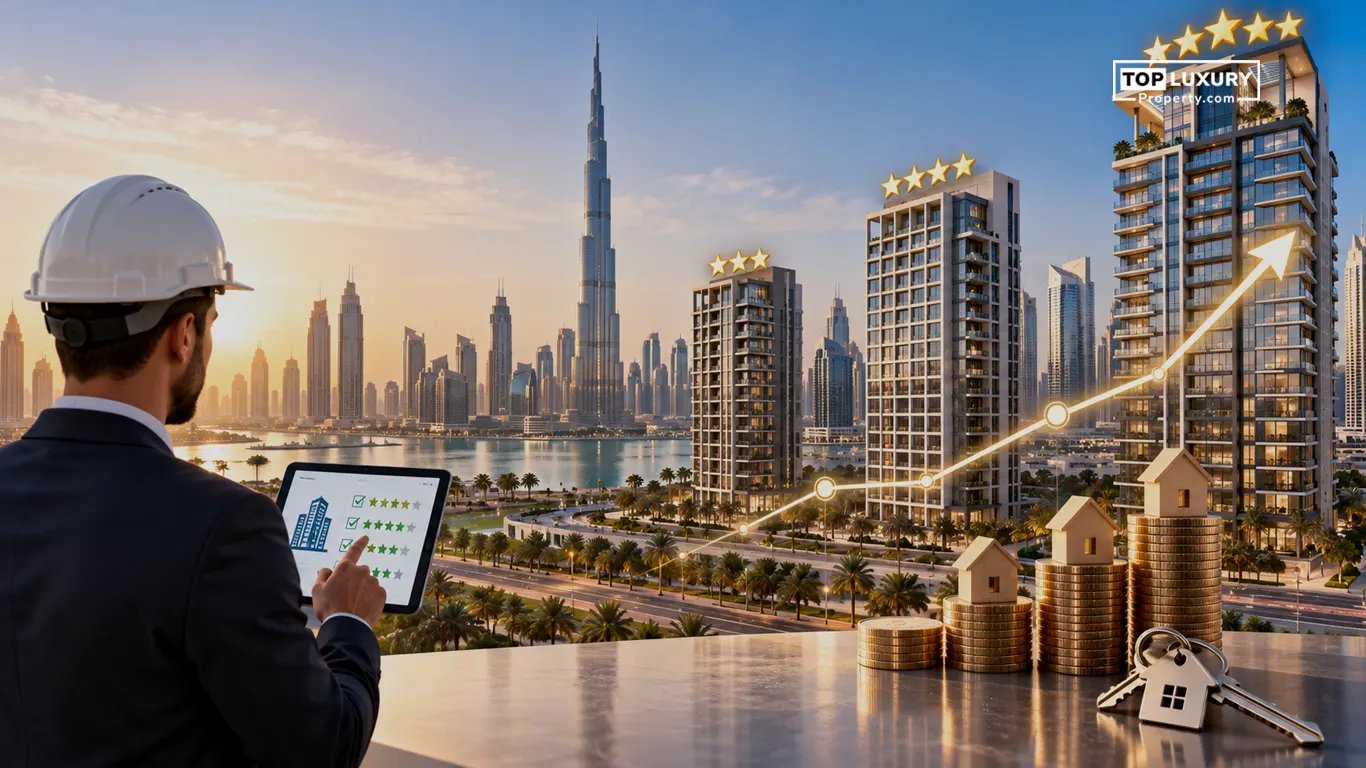
The Dubai Building Rating System is a government classification, run by the Dubai Land Department, that scores every residential building on a 1 to 5 star scale using more than 60 quality criteria. It is part of the Smart Rental Index and remains active in 2026.
What Is the Dubai Building Rating System?
The Dubai Building Rating System is an AI-powered classification, launched by the Dubai Land Department. It assigns every residential building in Dubai a star rating from 1 (basic) to 5 (premium), based on more than 60 measurable quality criteria.
Before this system, rental benchmarks in Dubai were purely dominated by zone. Like a lower average apartment in Palm Jumeriah commands premium rents than a luxury unit in JVC. The star rating fixed that by judging each building on its own merits instead of leaning on broad area averages.
For luxury property specifically, this matters because it gives buyers and tenants a government-verified way to compare towers. It takes the guesswork out of what developers or agents call "premium."
When Was the Building Rating System Launched?
The Dubai Land Department launched the Smart Rental Index, along with its building rating system, in January 2025. It has stayed active through 2026 and replaced the older, area-only rental calculator.
Key milestones:
-
January 2025: DLD officially launches the Smart Rental Index with the star rating system built in.
-
Through 2025: Buildings across Dubai are gradually evaluated and assigned ratings.
-
2026: The index now applies AI-driven evaluation across every residential area in Dubai, including free zones and special development zones, weighing structural condition, finish quality, maintenance, location, and available services.
-
Ongoing: Ratings are reviewed periodically, typically every 6 to 12 months, and can shift if a building's condition changes materially.
What Criteria Determine a Building's Star Rating?
A building's star rating comes from more than 60 individual factors, grouped loosely into four areas: structural condition, finish and maintenance quality, location and spatial value, and available amenities or services.
The Dubai Land Department evaluates each building using artificial intelligence across these criteria, covering everything from physical condition to how well the property is managed day to day.
Core Evaluation Categories
-
Structural and technical condition. Building age, construction quality, and general upkeep.
-
Finishes and maintenance. Quality of interior and exterior finishes and how consistently the building is maintained.
-
Security and safety. Building security is one of the named factors, alongside broader sustainability measures.
-
Amenities. Swimming pools, gyms, children's play areas, and parking all feed into the classification.
-
Property management quality. Cleanliness, security staffing, and how quickly maintenance requests get handled.
-
Location and spatial value. Where the building sits within its immediate community, not just its wider district.
How Location Factors into the Score
Ratings are relative to a building's own market area rather than compared citywide. A 3-star building in JVC and a 3-star building in Dubai Marina are each judged against their own neighborhood, not against each other. The system normalizes buildings within their local context instead of ranking the whole city on one scale.
Does the Star Rating Apply to Buildings or Individual Units?
The star rating covers the whole building. It does not apply to individual apartments or units inside it. Officials have confirmed that a poorly maintained building in a high-demand area will not automatically command high rents just because of its address.
This difference matters for luxury buyers. Renovating one unit inside a low-rated building does not raise that unit's classification. The building's overall condition and management set the ceiling for everyone in it.
How Does the Rating Affect Rent and Property Value?
A building's star rating sets the benchmark rent used to work out the maximum legal rent increase a landlord can apply. Higher-rated buildings can justify rents above the area average. Lower-rated buildings stay capped closer to, or below, that average.
Five-star buildings are allowed to charge a premium above the area average, which rewards landlords who invest in good mangement. The underlying legal caps on rent increases themselves have not changed.
Current Rent Increase Caps under Decree No. 43 of 2013
These caps apply based on how far the current rent sits below the benchmark rate for the building's rating.
|
Gap below market rate |
Maximum permitted increase |
|
Within 10% of the market rate |
0% (no increase permitted) |
|
11% to 20% below market rate |
Up to 5% |
|
21% to 30% below market rate |
Up to 10% |
|
31% to 40% below market rate |
Up to 15% |
|
More than 40% below market rate |
Up to 20% |
These figures apply once a unit becomes eligible for an increase under the building classification system, in line with Decree No. 43 as applied under current DLD regulations.
For luxury landlords, a verified 5-star rating is the legal basis for charging above-average rent.
Can a Building's Rating Change Over Time?
Yes. A star rating is not fixed. It can rise or fall depending on renovation, upgrades, or general decline, and the DLD reassesses ratings on a regular cycle.
DLD officials have explained that the building classification carries real weight, and owners who want to move a building from three stars to four, or four to five, need to carry out renovation work to justify the higher score.
That creates a direct financial incentive for owners of older luxury towers. Renovation and better facility management can push a building into a higher rent bracket.
What can Raise a Rating:
-
Structural or facade renovation
-
Upgraded finishes in common areas
-
Improved security and safety compliance
-
Faster, more reliable facility management
-
New or upgraded amenities such as pools, gyms, parking, or play areas
What can Lower a Rating:
-
Deferred maintenance
-
Declining management standards
-
Aging infrastructure left without renovation
How Do I Check a Building's Star Rating in Dubai?
You can check any residential building's official star rating for free through the Dubai REST app or the DLD website. It takes about two minutes and needs no appointment.
Steps to check a rating:
-
Open the Dubai REST app, the DLD's official platform.
-
Search for the building or community by name.
-
View the assigned star rating alongside the benchmark rent range for that classification.
-
Compare it against your current or proposed rent to see whether an increase is actually justified.
Most tenants never check this before signing a lease, even though it takes minutes. For luxury buyers and investors, checking a rating before signing is an easy way to confirm whether it is a "premium" listing or not.
Does the Rating System Apply Citywide, Including Free Zones?
Yes. As of 2026, the system covers every residential area in Dubai.
The Smart Rental Index and its building classification now apply across all residential areas, including free zones and special development zones. This means luxury developments in DIFC, Dubai Marina, Palm Jumeirah, Downtown Dubai, and newer master planned communities all fall under the same evaluation framework.
Is the Building Rating System Part of a New Law?
No. The rating system is a classification layer on top of Dubai's existing tenancy law. It does not replace or amend the legal framework that governs landlords and tenants.
The foundational laws, including Law No. 26 of 2007 and its amendment, Law No. 33 of 2008, remain unchanged. The star rating simply feeds a more precise, building-specific input into the rent calculation that Decree No. 43 of 2013 already governs.
Is There a Separate Rating System for Developers?
No, and this is a common confusion. RERA does not publish tiered ratings such as "AAA" or "A grade" for developers. The Dubai Land Department maintains a binary system for developers: they are either approved and registered, or they are not. There is no ranking or grading beyond that.
The star rating system classifies buildings, not the companies that built them, and it assesses each property after construction. A single developer can have buildings across several different star ratings, depending on build quality, age, and how well each property has been maintained since handover.
This is worth remembering as a luxury buyer. A well-known developer's name does not guarantee a 5-star building. Always check the specific building's rating on its own.
Why Does This Matter for Luxury Property Buyers Specifically?
For luxury property, the building rating system turns vague claims of "premium quality" into a verifiable, government-issued number. This gives buyers a factual basis for comparing towers before committing capital.
Practical implications for luxury buyers and investors:
-
Rental yield forecasting. A 5-star rating supports above-average rent, which directly affects projected yield.
-
Resale positioning. Buildings that hold a high rating are better placed to sustain rental premiums over time and support resale value.
-
Renovation ROI. For older luxury stock, moving a building from 3 stars to 5 can be a measurable, financially justified investment.
-
Due diligence. Checking a building's official rating before purchase adds one more objective data point alongside price per square foot and location.