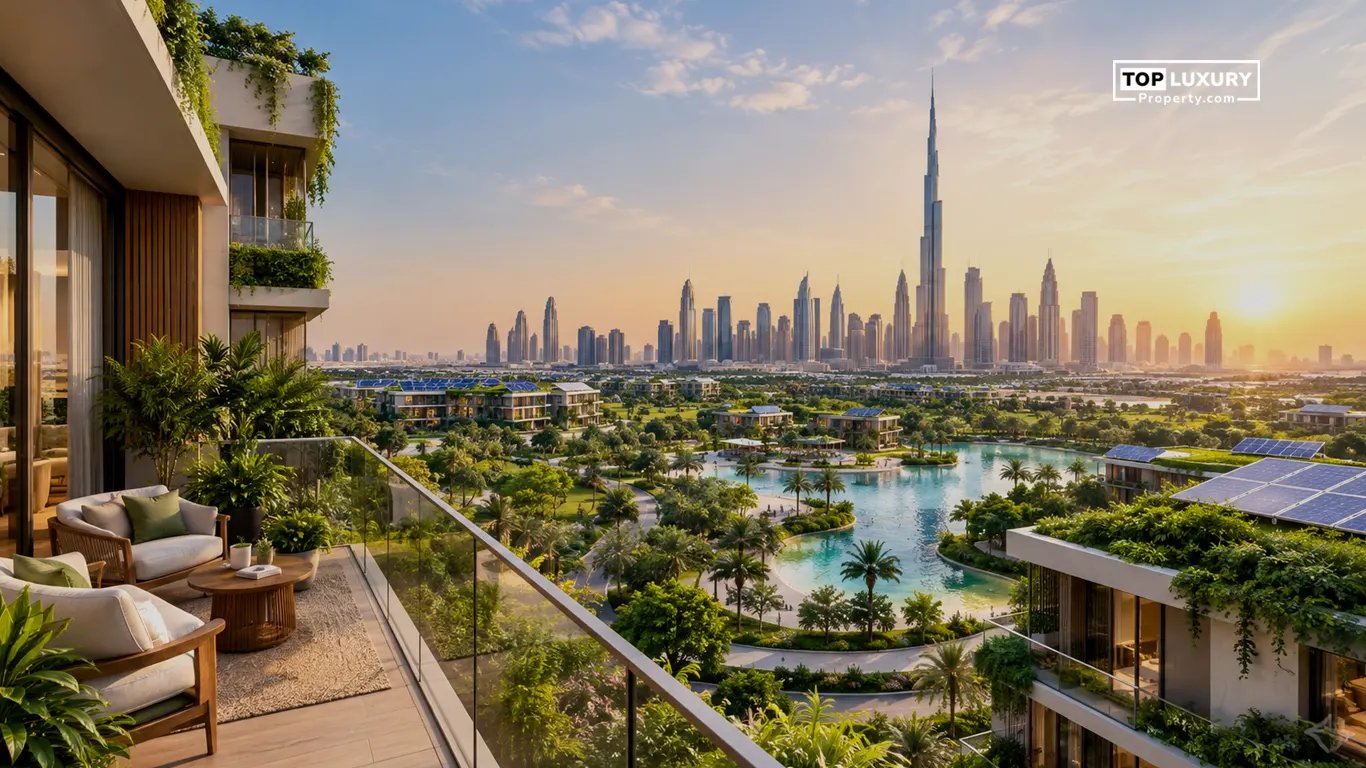
Sustainability has moved from a marketing add-on to a core driver of value in Dubai real estate. For investors and residents that shows up in two connected ways: green communities built around energy, water & open space and eco-friendly smart homes that pair sustainable design with automation. This blog covers both - the policy behind the shift, what actually makes a home "green and smart," the leading communities and the investor case.
Quick answer: Dubai is pushing green real estate through the Dubai Clean Energy Strategy 2050 (targeting 75% clean energy by 2050) and the UAE Net Zero by 2050 initiative. For buyers, eco-friendly smart homes can lower utility bills and tend to hold value well; for investors, sustainable communities offer strong rental demand and resilience — provided you check each development's actual green credentials rather than the marketing label.
Key Takeaways
-
The rules already push it: Dubai requires new buildings to meet green standards and the city's clean-energy goals are pushing developers to do even more.
-
"Green" and "smart" are not the same thing: solar panels, water recycling and eco-friendly materials make a home green. Automation and AI controls make it smart. The best homes have both.
-
The real green benchmark is The Sustainable City (by Diamond Developers) — it's built to make more energy than it uses. Golf communities call themselves "green" mostly because of their gardens and open space but golf courses use a lot of water, so it's not quite the same.
-
For investors: green homes usually cost less to run and can sell or rent for a bit more. Just check the real numbers and green certificates (like LEED or Estidama) for each project before counting on them.
Why Dubai Is Going Green: Vision and Policy
Dubai has consistently built ahead of the curve and sustainability is now central to that ambition. Two policy pillars matter most for real estate:
-
Dubai Clean Energy Strategy 2050 — aims to generate 75% of Dubai's energy from clean sources by 2050.
-
UAE Net Zero by 2050 - a national commitment which is officially announced by H.H. Sheikh Mohammed bin Rashid Al Maktoum, Vice President & Prime Minister of the UAE and backed by the fund of AED 600 billion in clean-energy investment.
On the development side, Dubai Municipality's Green Building Regulations & Specifications, under the mandate by Dubai Municipality (2020), require 100% of new developments to meet mandatory sustainability criteria which oblige developers toward energy-efficient design as a regulatory default rather than an optional upgrade
This aligns with the broader We the UAE 2031 national vision toward a sustainable, diversified economy.
What Makes a Home "Eco-Friendly and Smart"?
A sustainable smart home is designed to minimise its environmental footprint while adding automation and comfort. The core features:
|
Feature |
What it does |
|
Solar panels |
Generate on-site power and reduce reliance on the grid |
|
Smart thermostats |
Automate temperature control to cut energy use |
|
Greywater / recycling systems |
Reuse sink and shower water for irrigation |
|
Motion-sensing lighting |
Turn off lights in empty rooms automatically |
|
Eco-friendly insulation |
Reduce cooling load in Dubai's climate |
|
Voice / app automation |
Hands-free control of home systems |
|
Green building materials |
Low-VOC paint, recycled metal, sustainable finishes |
|
Air-quality monitoring |
Ventilation and filtration for healthier interiors |
Together, these reduce carbon footprint and running costs, the combination that has moved eco-smart homes from niche to mainstream buyer expectation.
Benefits for Investors and Residents
Lower Running Costs: Energy and water-efficient design materially cuts monthly utility bills. According to Dubai Municipality's Al Sa'fat green building metrics, Platinum-rated developments deliver energy efficiency gains exceeding 35% to 40% compared to baseline code. Fully integrated eco-communities (such as The Sustainable City) report up to 50% overall savings on DEWA electricity and water bills due to rooftop solar generation and thermal insulation.
Value Retention & Premium: Sustainable, certified properties consistently command sale and rental premiums ranging from 5% to 15% over non-certified inventory.
-
Sales Capital Value: JLL reports that green-certified properties in Dubai hold a 5% to 10% value premium over uncertified inventory due to future-proofing against building obsolescence.
-
Rental Premium: Market analysis highlights that green-certified residential units command rental premiums of up to 9% with commercial green spaces reaching up to 25% - 30% higher rental rates.
Rental Demand: Eco-luxury rentals experience higher occupancy rates and shorter vacancy periods. Demand is primarily driven by corporate occupiers, international expats and younger tenants prioritizing measurable ESG alignment and predictable monthly running costs.
Long-Term Resilience: Sustainable developments experience lower physical depreciation, age better and incur reduced lifecycle operating and maintenance (O&M) expenses over 10 to 25-year horizons. Conventional, uncertified ("brown") assets face growing risks of accelerated devaluation as tenant standards and regulatory benchmarks tighten.
Compliance Upside & Financial Incentives (Verified per Authority/Developer)
-
Regulatory Fast-Tracking: Dubai Municipality provides administrative incentives for developers meeting Gold or Platinum Al Sa'fat tiers, including expedited permitting and planning allowances.
-
Service Charge Reductions: Lower common-area energy consumption directly reduces building operational expenses (OPEX), leading to lower per-square-foot service charges and reduced district cooling charges for property owners.
-
Green Financing: Certified developments qualify for preferential lending rates and sustainability-linked loans from major UAE banks.
Certification as a Trust Signal: Third-party rating frameworks, specifically Al Sa'fat (Dubai Municipality), Estidama / Pearl Rating System (Abu Dhabi) and LEED (International) act as standardized trust signals that verify building performance and protect buyers against greenwashing.
Top Sustainable Communities in Dubai
Each community below is included for specific green features — not the label alone.
The Sustainable City (Dubailand)
Developed by Diamond Developers as Dubai’s flagship net-zero energy community, The Sustainable City sets the benchmark for other communities in Dubai for eco-friendly living. Spread over 5 million square feet, this fully integrated community generates its own clean energy, recycles 100% of its water, supports electric mobility and shaded pedestrian-friendly pathways. Built with urban farming bio-domes and solar-paneled rooftops, this community combines environmental stewardship with lower living expenses, offering residents up to 50% savings on DEWA utility bills without compromising modern suburban comfort.
-
Key Features:
-
Solar-powered rooftop providing clean energy to all residences.
-
100% greywater recycling systems dedicated to community irrigation.
-
11 urban farming bio-domes producing organic crops for residents.
-
Pedestrian-friendly residential zones allow only electric buggies, bicycles and pedestrian paths.
Al Barari
Al Barari stands out as Dubai’s premier eco-luxury community, dedicated more than 60% from its total 18.4 million square foot master plan for lush botanic gardens, natural lakes and freshwater streams. This community creates its own microclimate in the desert, which is approximately 5 degree celsius cooler than surroundings. This low-dense community applies organic landscaping practices, energy-efficient building materials and automated solar-powered irrigation systems. The development features high-end architectural villas with active biodiversity conservation, only for the affluent residents who demand high privacy, wellness-focused amenities and a well-maintained natural environment.
-
Key Features:
-
Over 60% green space with 500+ plant species and natural waterbodies.
-
Low dense development utilizing eco-friendly, thermally insulated construction materials.
-
On-site plant nursery and farm-to-table organic dining (The Farm).
-
Advanced greywater recycling systems for irrigation and green preservation.
Expo Valley (Expo City Dubai)
Expo Valley is the name which everyone knows, built on the legacy of COP28 & Expo 2020 and designed to meet the WELL Community Standards and LEED certifications guidelines. This community represents the next generation of climate-resilient urban design in Dubai, features villas and townhouses integrated directly into a native nature reserve and rolling hills landscape. Expo Valley prioritizes microclimate cooling, low-carbon construction materials and pedestrian-only green corridors, making it a benchmark for sustainable urban living in South Dubai near Al Maktoum International Airport.
-
Key Features:
-
Master-planned to meet international LEED Gold and WELL Community standards.
-
Pedestrianized green corridors with subterranean or perimeter-only car access.
-
Passive microclimate design strategies to reduce ambient temperatures naturally.
-
Integrated solar paneling and smart waste segregation infrastructure.
The Smart-Home Market and What's Next
Demand for eco-smart homes is being driven by UAE government incentives, smart-city infrastructure, and rising ESG expectations among buyers and developers. According to Data Bridge Market Research, the UAE Smart Home Market reached $4.97 billion in 2024 and is projected to expand to $17.58 billion by 2032 at a 27.91% CAGR.
Trends shaping the next few years:
-
AI-driven automation — predictive systems that adapt to how residents actually live.
-
Smart-grid integration — homes connected to Dubai's grid to optimise energy use.
-
Net-zero neighbourhoods — carbon-neutral development at community scale (e.g., The Sustainable City – Phase 2).
-
Blockchain sustainability tracking — emerging pilots to record energy use and carbon savings transparently.
-
Falling cost curve — incentives and scale are expected to make eco-smart features more affordable over time.
Challenges to Be Aware Of
-
Balancing luxury and sustainability. Buyer awareness of "sustainable luxury" is still maturing; clear education on running-cost savings and certifications closes the gap.
-
Retrofitting the existing city. Integrating green infrastructure into Dubai's built environment needs coordinated public–private planning, not project-by-project fixes.
Conclusion
Sustainability is now a core value driver in Dubai real estate, not a niche. Backed by clear government targets and green-building rules, the market is moving toward homes that are both eco-friendly and smart — lower to run, healthier to live in and more resilient to hold. For investors, the opportunity is real, but the discipline is simple: buy on verified features and certifications, not the "green" label.
Looking for a sustainable home or a green addition to your portfolio? Contact Top Luxury Property to explore Dubai's eco-friendly communities.