

Selling a property in Dubai sounds simple until someone mentions the NOC. Then the paperwork starts, and most owners realize they've never dealt with this document before.
A No Objection Certificate (NOC) is the one paper that can stop a property sale in the UAE. No transfer happens at the Dubai Land Department without it. Not for a studio in JVC, not for a villa in Arabian Ranches, not for a resale unit in Business Bay.
Here we are going to explain what an NOC is, who issues it, what it costs, and how to get an NOC for real estate in the UAE.
What Is an NOC in UAE Real Estate?
An NOC is a written statement from your property's developer (or, in some cases, the owners' association) saying they have no objection to you selling, transferring, or leasing the property.
In a more detailed way, the developer confirms that you don't have pending payments and your unit has no open disputes. Service charges paid. Maintenance fees settled. No legal red flags. Once they confirm that, the Dubai Land Department (DLD) will let the sale go through.
Without it, the deal stops. The trustee's office won't register a new owner on a property that still shows unresolved dues.
What is the Importance of the NOC?
-
It protects the buyer. Nobody wants to inherit someone else's unpaid service charges. The NOC confirms the slate is clean.
-
It protects the seller. It's proof, on paper, that all obligations were met before handover.
-
It keeps the DLD's records. Every transfer that goes through Dubai's system carries this checkpoint, which is part of why the market has a reputation for being relatively transparent compared to other regions.
-
It stops fraud. A fake listing or a unit tangled in a dispute won't clear NOC verification, so buyers get an extra layer of protection before investment.
-
It applies to leasing, too. If you're registering a tenancy contract on Ejari, some communities ask for an NOC confirming the change in occupancy.
Types of NOC You'll Come Across
|
NOC Type |
Issued By |
When You Need It |
|
Developer NOC |
Master developer (Emaar, Nakheel, DAMAC, Sobha, etc.) |
Selling a completed property |
|
DLD / Transfer NOC |
Dubai Land Department |
Older properties without a clear master developer |
|
Mortgage NOC (Liability Letter) |
Your bank |
Selling a mortgaged property, or after paying off a loan |
|
Off-plan Assignment NOC |
Developer |
Transferring an off-plan unit before handover |
Required Documents to Apply for the NOC
Gather these before you contact the developer. Missing paperwork is the single biggest reason applications bounce back:
-
Original title deed (or a copy, if the bank is holding the original)
-
Passport copies for both seller and buyer
-
Emirates ID copies, if either party is a UAE resident
-
Signed Form F (the Memorandum of Understanding between buyer and seller)
-
Original Sale and Purchase Agreement, if the developer asks for it
-
Bank liability letter, if there's an active mortgage on the unit
-
Statement of account showing service charges are fully paid
Step-by-Step: How to Get an NOC
Here is a step-by-step process to get a NOC in Dubai.
Step 1: Clear Every Outstanding Due
Call the developer or check their portal for a statement of account. Pay off anything owed, like service charges, maintenance and community fees. Developers reject applications over balances as small as a few hundred dirhams, so don't guess. Confirm the number in writing.
Step 2: Prepare Your Documents
Use the list above. Double-check passport and Emirates ID expiry dates. An expired ID is an easy, avoidable rejection.
Step 3: Submit the Application
Two routes exist:
In person: Visit the developer's sales or customer service center. Emaar, Nakheel, and DAMAC each have dedicated NOC counters. Both buyer and seller typically need to attend, or send a representative with power of attorney.
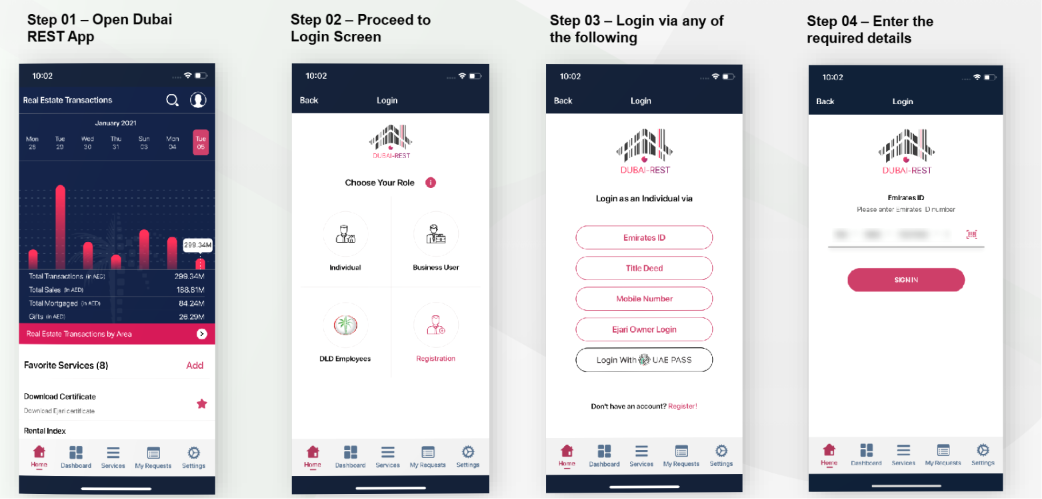
Online, through Dubai REST: This option is available only for ready properties managed by Owner association management companies, and the owner receives service charge invoices from the Mollak system.
-
Download the Dubai Rest App from Playstore & Apple App Store. Open the Rest App
-
Go to the Login page and log in via any one of the following documents: Emirates ID, Title Deed number, or UAE Pass.
-
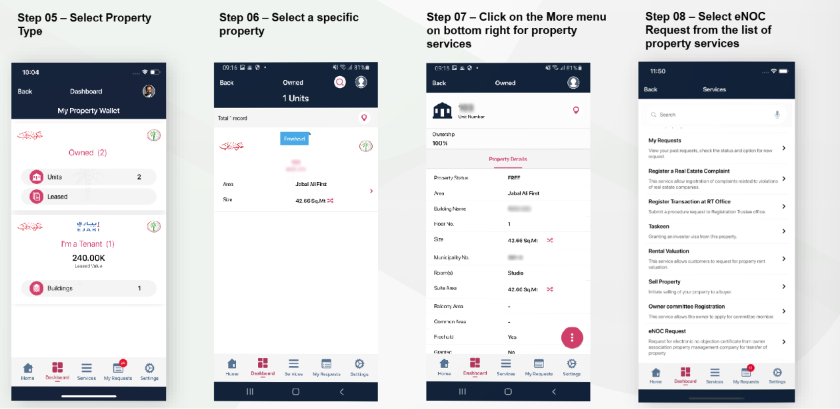
Next, select the property types and select your property
-
Click on the services option on the bottom bar.
-
Select the eNOC request from the list of property services.
-
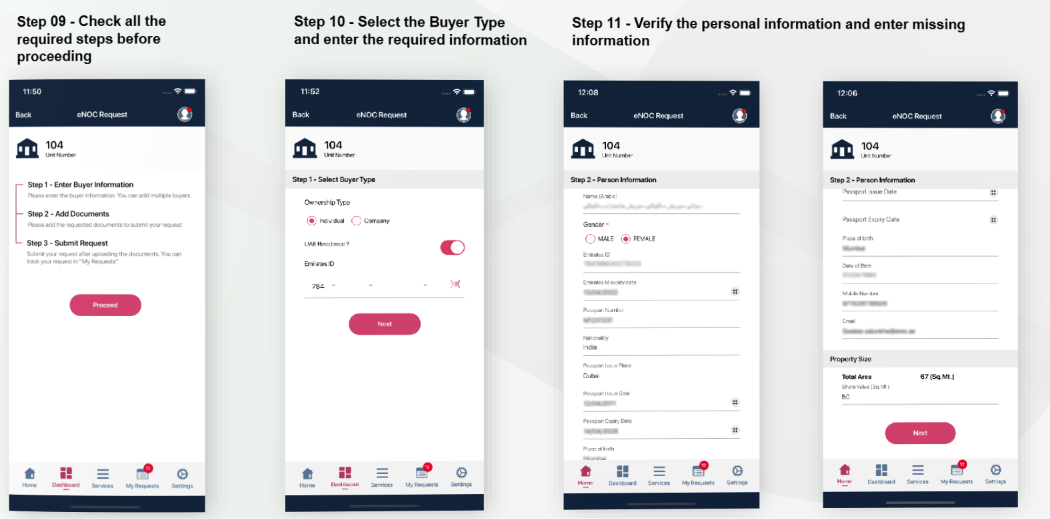
Collect all the mentioned documents and then select the buyer type and fill in the asking information.
-
Verify the personal information and click next.
-
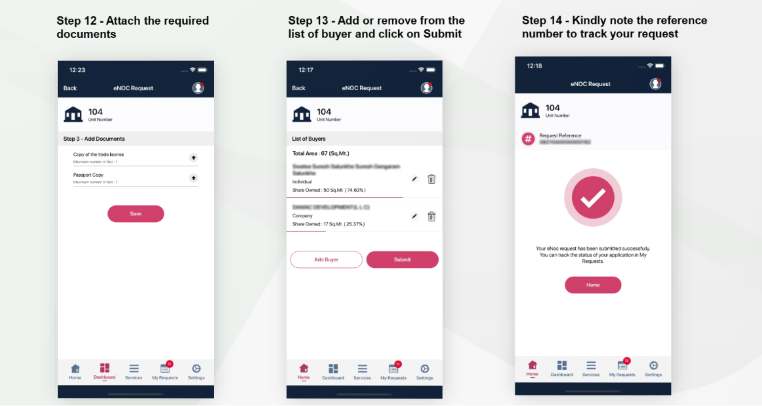
Upload a scan copy of the passport & trade licenses
-
If applicable, you can add or remove buyers from the list. Then submit the application. Note the reference number for tracking.
The request takes 3-5 business days. After that timeline, you can download the eNOC digitally.
Step 4: Pay the NOC Fee
This is a flat, non-refundable administrative charge. Fees vary by developer; see the table below.
Step 5: Collect and Verify
Check every detail on the certificate: owner name, buyer name, property details, validity period, before you leave the counter or download the digital copy.
Step 6: Complete the Transfer
Take the NOC and remaining documents to a DLD-approved trustee office. Both parties (or their legal representatives) attend, the transfer is registered, and a new title deed is issued in the buyer's name.
NOC Fees by Developer
|
Developer |
NOC Fee (AED) |
Processing Time |
|
Emaar |
AED 1,000 + 5% VAT |
2–5 business days |
|
Nakheel |
AED 1,000 + 5% VAT |
3–5 business days |
|
DAMAC |
AED 1,000 + 5% VAT |
3–5 business days |
|
Dubai Properties |
AED 500 + 5% VAT |
2–3 business days |
|
Meraas / Dubai Holding |
AED 1,000 + 5% VAT |
2–5 business days |
|
Sobha |
AED 1,000 + 5% VAT |
3–5 business days |
|
Azizi |
AED 1,000 + 5% VAT |
3–7 business days |
|
Danube |
AED 1,000 + 5% VAT |
3–5 business days |
Fees are set individually by each developer. There's no fixed government rate. This has drawn criticism over the years, including from owners who've questioned being charged the full fee even when they had zero outstanding dues. The DLD's own eNOC service, by contrast, doesn't add a developer markup on top of its processing fee.
Common Mistakes That Delay an NOC
- Unpaid service charges: The top reason for rejection. Verify your account is fully clear before applying, not after.
- Applying too late: Sellers often wait until a buyer is found and the MOU is signed. By then, the time on the deal is already running.
- Incomplete documents: Missing a passport copy or an unsigned Form F sends the application back to the start.
- Ignoring the validity window: Most NOCs expire in 30 to 60 days. Miss that window, and you're paying for a new one.
- Mortgage delays: The bank's liability letter often takes longer than the developer's NOC. Start both processes at the same time, not one after the other.
- Power of attorney gap: If you're selling from abroad, make sure your POA specifically covers NOC applications. A generic POA sometimes isn't accepted.
- NOC for Off-Plan Properties
Off-plan NOC in Dubai is different. Since there's no title deed yet, you're not transferring ownership at the DLD; you're assigning the Sale and Purchase Agreement to a new buyer, with the developer's consent.
A few things differ here:
-
Developers can charge a fee of 2–5% of the property value, well above a standard NOC fee.
-
Approval isn't automatic. Developers can restrict assignments until a set percentage of the purchase price is paid.
-
The change is recorded through Oqood, Dubai's interim registration system for off-plan units, not the standard title deed process.
Quick Comparison: Developer NOC vs eNOC via Dubai REST
|
Factor |
Developer NOC (In Person) |
eNOC (Dubai REST App) |
|
Where |
Developer's sales center |
Mobile app |
|
Speed |
2–10 business days |
Often faster, some same-day |
|
Fee |
Set by developer, AED 500–5,000 |
DLD processing fee, no developer markup |
|
Best for |
Complex cases, older properties |
Straightforward resale transfers |
Final Thoughts
The NOC isn't complicated once you know the sequence: clear your dues, gather your documents, apply early, and track the validity window. Most delays trace back to one of two things: an unpaid balance nobody checked, or an application submitted too close to the deadline. Handle both early, and the rest of the process moves the way it's supposed to.