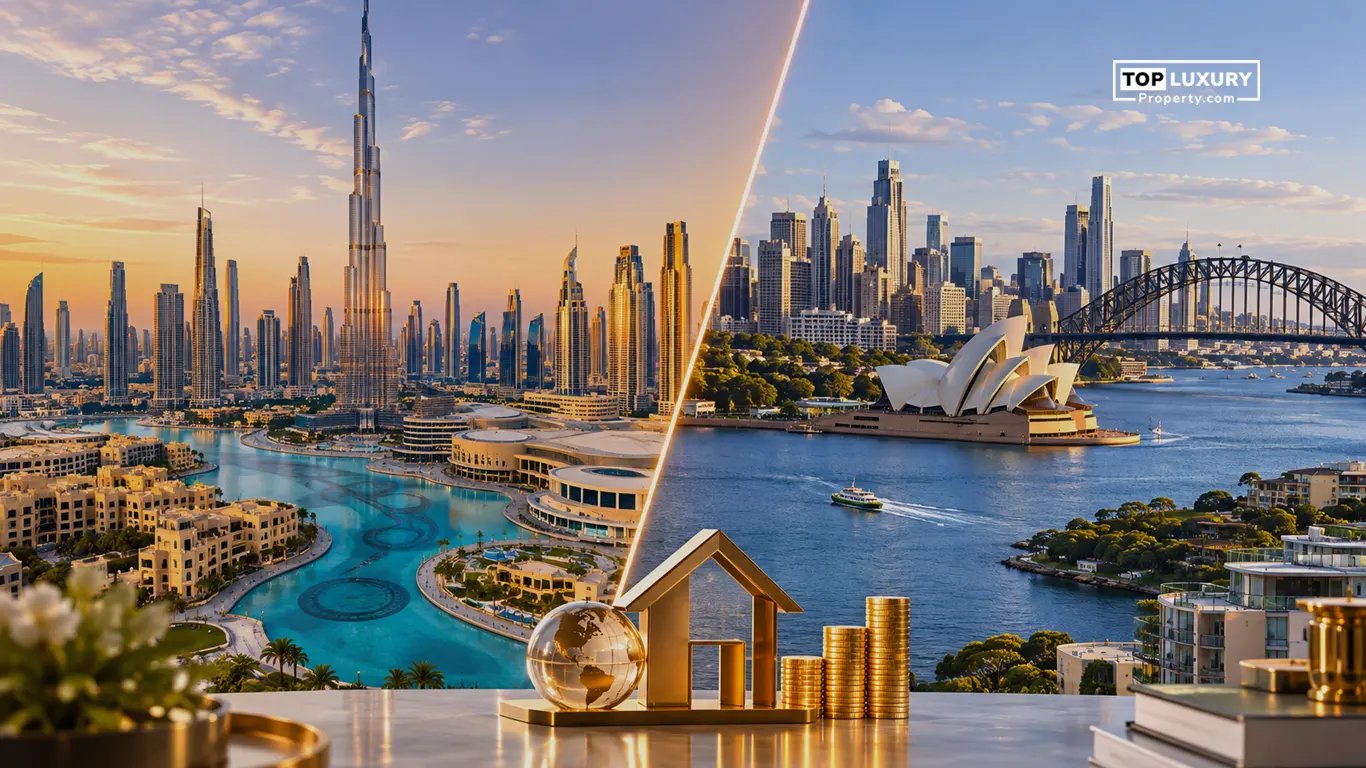
Dubai and Sydney represent two very different investment strategies. Dubai offers higher rental income, lower taxes, lower entry costs, and residency benefits. Sydney provides stronger long-term price stability and mature market fundamentals. The better choice depends solely on the inverters, what they want: cash flow, appreciation, tax efficiency, or lifestyle objectives.
Key Highlights
-
Dubai rental yields typically range from 6% to 8%, compared with Sydney's 3% to 4.5%.
-
Sydney remains one of the world's least affordable housing markets, while Dubai offers significantly better affordability ratios.
-
Dubai has no annual property tax or capital gains tax for individuals, whereas Sydney investors face upfront stamp duty, foreign buyer surcharges, land tax, and capital gains tax obligations.
-
Sydney favors long-term capital appreciation and generational wealth preservation, while Dubai strongly appeals to investors seeking immediate, tax-free cash flow returns.
Introduction to Global Real Estate Investing: Dubai vs Sydney
Dubai and Sydney are popular names in global real estate. Known for their real estate offerings, growth and taxes, these markets often create questions in the minds of investors: where should I invest in Dubai or Sydney? For real estate investment in 2026 is not simply choosing the "better" city; it is about aligning your capital with your exact financial strategy. Both cities are global magnets for wealth migration, but they operate on fundamentally opposed economic structures.
Sydney is a highly regulated, mature market. Tight land supply, strict zoning laws, and consistent historical capital growth characterize it. It requires a massive initial capital outlay and subjects foreign buyers to some of the more taxation than any developed market in the world. Conversely, Dubai is a high-growth, pro-business tax haven and attractive to global capital. It offers high rental yields, investor visas, and minimal transaction friction.
Because property investment requires more than just price, it requires an understanding of all cross-border investment risks. Currency fluctuations, shifting interest rates, and local regulatory changes can drastically alter your net returns.
If you are an investor or an end user looking to invest in the foreign real estate market, then today’s discussion is very helpful.
Dubai vs Sydney Real Estate at a Glance: Key Investment Metrics
Before the details of each market, let’s see key info about two cities:
|
Metric |
Dubai |
Sydney |
|
Rental Yield (Gross) |
6.5% to 8.5% (Varies by community) |
3% to 4.5% (Tighter for houses) |
|
Taxes |
No income tax, no capital gains tax |
High stamp duty, CGT, and land tax |
|
Foreign Ownership |
Freehold available in designated zones |
Strict Foreign Investment Review Board (FIRB) rules |
|
Entry Cost |
Accessible (1-bed from USD 200,000) |
Extremely High (Median unit USD 570,000) |
|
Capital Growth |
Moderate (More cyclical, maturing rapidly) |
High (Consistent, compounding growth) |
|
Residency Incentives |
10-Year Golden Visa for property buyers |
None linked directly to passive property buying |
|
Market Maturity |
Rapidly expanding and evolving |
Highly mature, tightly regulated |
Understanding the Fundamentals: Dubai vs Sydney Property Markets
Start with the basics. As a first-time investment in any foreign real estate, you should know the market. Here, we also start from those fundamentals:
Dubai Real Estate Market Overview
Dubai is a growth-oriented market. The city's real estate sector is supported massive expatriate influx, tourism, corporate relocations, pro-business facilities and high-net-worth wealth migration. The Dubai Land Department (DLD) manages a highly transparent, digitized transaction system that encourages foreign capital.
Off-plan property sales dominate the market, where developers sell unbuilt units on flexible payment plans. As per H1, 2026 data, value perspective off-plan market share is 48.8% and volume perspective the share is 68%. The market is stable but has huge potential, and it is not locked geographically. That’s why new master-planned communities like Damac Islands, Sobha Sanctuary, Emaar Grand Polo Club, etc., consistently fulfill new supply that keeps prices relatively affordable, but investing in them can also give huge capital appreciation.
Sydney Property Market Overview
Sydney is structurally defined by scarcity. Constrained by the Pacific Ocean to the east, national parks to the north and south, and the Blue Mountains to the west, Sydney has almost no room to sprawl. Furthermore, strict local council zoning regulations severely limit high-density development in established suburbs.
This chronic, structural supply deficit is met with relentless demand driven by high overseas migration into New South Wales. According to 2026 data, Sydney simply does not have enough dwellings to house its growing population. This scarcity ensures that demand consistently outstrips supply, making Sydney a fortress for capital preservation and long-term equity growth, but a difficult environment for generating positive cash flow.
Comparing Property Types and Asset Classes in Dubai vs Sydney
Now see what types of property you can get by investing across these two markets:
Branded and Off-Plan High-Rises (Dubai Dominant)
Dubai leads the world in luxury branded residences (e.g., partnerships with Armani, Dorchester, Bentley Home, de Grisogono, Aeternitas, Bugatti, Ritz-Carlton). These architectural landmarks offer resort-style amenities, private pools, and fully managed holiday rental programs. They are built specifically for remote investors looking for hands-off management.
Medium-Density Apartments and Strata Units (Sydney Dominant)
Sydney's unit market consists primarily of low-to-medium-rise brick flats and newer high-rises in suburban commuter hubs (e.g., Parramatta, Chatswood). Strict New South Wales strata schemes tightly bind these properties and focus heavily on long-term corporate governance, structural safety, and high-quality construction standards.
Freehold Villas and Townhouses (Dubai) vs. Torrens Title Houses (Sydney)
Dubai’s suburban master communities (like Dubai Hills Estate or Arabian Ranches) offer expansive freehold ownership villas within private, gated communities. Sydney’s low-density market centers on Torrens Title detached houses in prestigious school zones or coastal pockets. Due to extreme land scarcity, these detached Sydney houses command the highest pricing premiums in the southern hemisphere.
Comparing Property Prices: Affordability in Dubai and Sydney
Prices define who can invest and where to invest. In 2026, the gap in affordability between the two cities is stark.
Average Apartment Prices
Sydney remains prohibitively expensive for many international investors. In early 2026, the median unit price in Sydney is around AUD 890,000 (roughly USD 585,000), while the median house price is approaching a staggering AUD 1.9 million.
In contrast, Dubai offers multiple entry points. A well-located 1-bedroom apartment in a mid-market community like Jumeirah Village Circle (JVC) or Dubai Silicon Oasis can be purchased for AED 750,000 to AED 950,000 (roughly USD 205,000 to USD 260,000). Even premium waterfront apartments in Dubai Marina are frequently less than a standard suburban house in Sydney.
Price Per Square Foot
When breaking down costs by size, Dubai vs Sydney property prices per square foot lean heavily toward Dubai. Prime central Sydney real estate can easily exceed USD 1,500 to USD 2,200 per square foot. In Dubai, outside of ultra-luxury enclaves like Palm Jumeirah or specific branded residences, high-quality, newly built apartments often trade between USD 350 and USD 600 per square foot. You simply get more physical space and better building amenities for your capital in the UAE.
Affordability Analysis
According to Forbes, Sydney ranks 2nd position for expensive housing markets globally. The median house-price-to-income ratio in Sydney hovers around 13.8x, creating a high barrier to entry for end-users and pushing them permanently into the rental pool.
Dubai offers a much healthier affordability ratio. Middle-income expatriates can realistically transition from renting to owning within a few years of saving. It creates a deep pool of secondary market buyers when an investor eventually decides to sell.
Rental Yield Comparison: Maximizing Passive Income in Dubai vs Sydney
For investors looking to balance off the inflation, rental yield is the most critical metric. Here, the two markets diverge completely.
Gross Rental Yield
As of mid-2026, Dubai remains one of the highest-yielding property markets globally. The average gross rental yield for apartments citywide lies at roughly 6.6%, with high-demand, mid-market areas like JVC, Dubai South and Arjan pushing gross yields between 7.5% and 9%.
Sydney is a low-yield environment. Sydney apartments typically yield between 4% and 4.8%, while detached houses often yield a mere 2.5% to 3.2%. A Sydney property will rarely cover its own holding and mortgage costs in the early years of ownership.
Net Rental Yield
Gross yield is only the starting point; net yield is what you get in your bank account.
-
Dubai: In Dubai vs Sydney rental yield comparison, Dubai wins. The net rate 1 to 2% lower than gross. The primary deduction is the building's service charge, based on actual property per sq.ft ranges between AED 12 to AED 22 per square foot annually. A property generating an 8% gross yield might net out to 6%.
-
Sydney: Net yields are compressed heavily by strata levies, local council rates, water rates, property management fees, and land taxes.
-
Council Rates: Average AUD $1,200 to $2,000 annually.
-
Strata Levies: For buildings with amenities like elevators and gyms, levies routinely range from AUD $4,000 to $10,000+ per year.
-
Land Tax Surcharges: Foreign owners face an aggressive 4% annual land tax surcharge on the land value component of their residential holdings.
Net Result: A 3.5% gross yield in Sydney quickly drops down to a 1.0% to 2.0% net rental yield before accounting for any personal income tax liabilities.
Vacancy Rates
Both cities currently operate with incredibly tight rental markets, favoring landlords. Sydney's rental vacancy rate hovers around 1.2% to 1.5% due to a massive shortfall in new housing construction and returning international student migration. Dubai has similarly absorbed its new supply rapidly, driven by record population growth; vacancy rates in well-connected communities remain structurally low.
Capital Appreciation Potential: Long-Term Growth in Dubai vs Sydney
If Dubai wins on cash flow, Sydney is the historical champion of capital growth.
Historical Performance
Sydney real estate is deeply entrenched in the Australian psyche as a wealth-generation vehicle. Historically, Sydney property has demonstrated an ability to double in value roughly every 10 to 14 years. It is a slow, steady, compounding asset class.
Dubai's market history is much shorter as freehold ownership only began in 2002 and has historically been volatile, marked by intense boom-and-bust cycles. However, post-2021 regulatory reforms, the introduction of long-term visas, and the shift from a speculative market to an end-user market have stabilized Dubai's growth trajectory.
Growth Drivers
-
Sydney: The fundamental driver is land scarcity combined with relentless population growth. Even during periods of high interest rates, the absolute lack of available homes puts a hard floor under Sydney property prices.
-
Dubai: Growth is actively engineered by the state. The expansion of the Al Maktoum International Airport, proactive government visa policies, and the rapid influx of global millionaires are the primary reasons to push the prices upward.
Future Outlook
Moving through 2026, Sydney's prices are expected to maintain steady upward side. Dubai's market has got a post-pandemic hyper-growth phase and is entering a more mature, stabilized period.
Property Taxes and Transaction Costs: Hidden Costs of Investing in Dubai and Sydney
Taxes dramatically alter the actual return on investment. Dubai is designed to minimize friction; Sydney taxes foreign capital heavily.
Dubai Taxes
Dubai is famously a tax haven. There is no annual property tax, no capital gains tax when you sell, and no income tax on your rental earnings.
The primary transaction cost is the one-time Dubai Land Department (DLD) transfer fee of 4% of the property value, plus roughly USD 1,500 in administrative and registration fees. There are no ongoing land taxes or council rates; you simply pay the building's service charges to maintain the facilities.
Sydney Taxes
Investing in Sydney involves multiple tax frictions, explicitly designed to penalize foreign buyers and protect local housing affordability.
-
Standard Transfer (Stamp) Duty: Up to 5.5% on a sliding scale based on the property's purchase price.
-
NSW Surcharge Purchaser Duty: An aggressive 9.0% additional penalty surcharge levied directly onto foreign purchasers buying residential real estate in New South Wales.
-
Foreign Investment Review Board (FIRB) Fee: Starts at roughly AUD $14,100 for properties valued under $1M and scales up aggressively as the purchase price climbs.
-
Annual Land Tax Surcharge: Foreign owners face a 4.0% annual land tax surcharge on the taxable value of the land they hold, creating a permanent drag on long-term yields.
-
Capital Gains Tax (CGT): When a foreign national exits the market, they face up to a 45% non-resident marginal tax rate on all realized profits, without accessing the 50% CGT discount available to regular Australian residents.
Let us calculate with a standard USD $1,000,000 residential property in both cities:
|
Cost Component |
Dubai Purchase (USD) |
Sydney Purchase (USD) |
|
Property Purchase Price |
$1,000,000 |
$1,000,000 |
|
Government Transfer / Stamp Duty |
$40,000 (4% DLD Fee) |
$40,000 (Standard NSW Duty) |
|
Foreign Surcharge Penalty |
$0 |
$90,000 (9% NSW Surcharge) |
|
FIRB Application Fee |
$0 |
$9,500 (Base foreign fee) |
|
Broker / Agency Commissions |
$20,000 (2% Fee) |
$0 (Typically paid by seller in AU) |
|
Legal / Trustee / Conveyancing |
$1,090 |
$2,000 |
|
Total Cash Needed at Closing |
$1,061,090 |
$1,141,500 |
Can Foreigners Buy Real Estate in Dubai and Sydney?
Both cities allow foreign ownership, but the regulations are entirely different.
Dubai Foreign Ownership Rules
Dubai is a hub of foreign capital. Non-residents of any nationality can purchase freehold property in designated freehold areas, which cover almost all major investment and expatriate zones (e.g., Dubai Marina, Downtown Dubai, JVC, Business Bay). The process is streamlined, requires minimal paperwork, and can often be completed remotely. Most importantly, purchasing property above AED 2,000,000 (approx. USD 545,000) qualifies the buyer for a 10-year UAE Golden Visa.
Sydney Foreign Investment Rules
Australia heavily restricts foreign buyers to prevent offshore capital from inflating local housing prices. Non-residents must apply for and pay a fee to the Foreign Investment Review Board (FIRB) before purchasing:
-
Foreign non-residents are generally prohibited from buying established, second-hand residential dwellings as pure investments.
-
Foreigners are strictly limited to buying new residential builds or off-plan developments. This policy ensures foreign capital explicitly adds to Australia's housing supply rather than crowding out domestic buyers.
-
If a foreigner secures temporary residency (e.g., a student or working visa), they can buy one established dwelling to live in, but they must legally sell it within 3 months of their visa expiring.