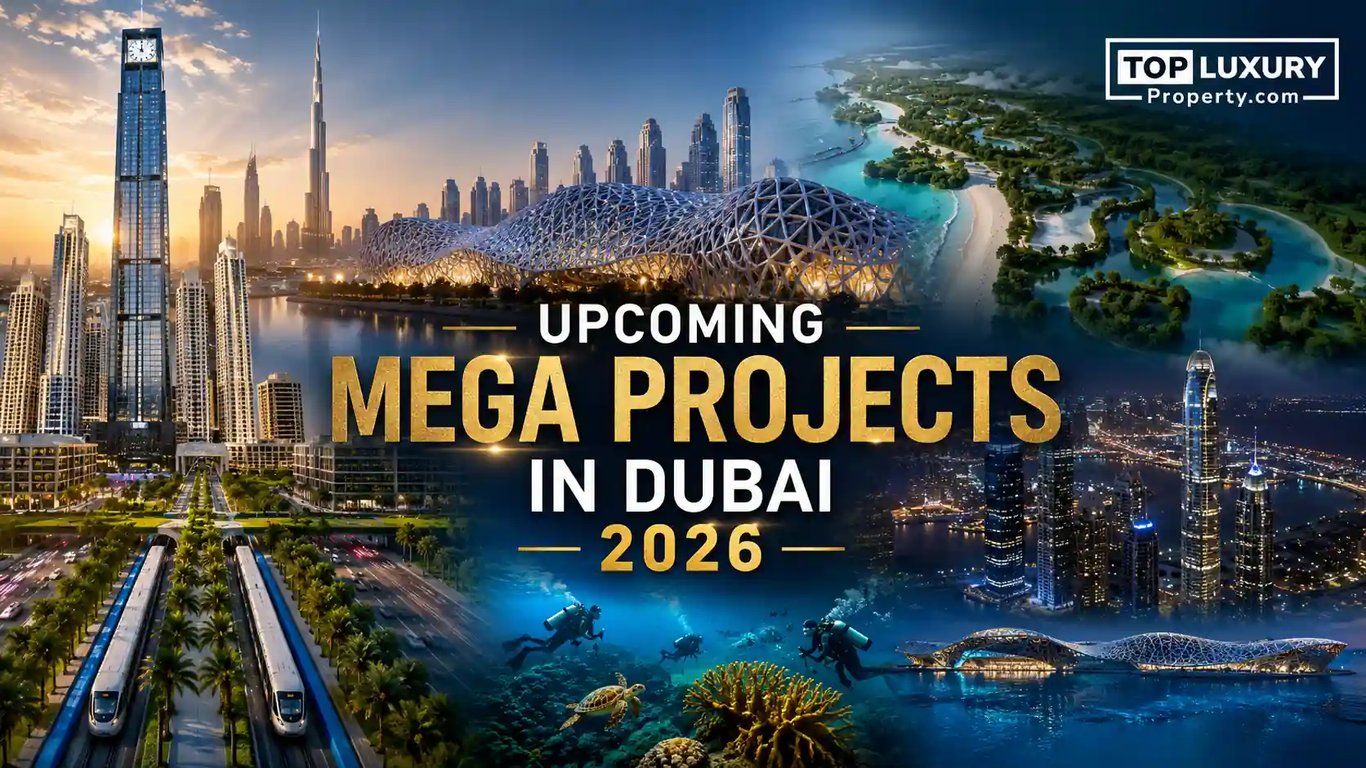
Dubai is advancing aviation, transport, waterfront and high-rise developments across the emirate at the same time.
Projects range from Al Maktoum International Airport and two new Metro lines to Palm Jebel Ali and more than a dozen supertall towers. Delivery schedules extend from 2026 residential handovers to transport infrastructure opening after 2030.
Such initiatives aim at breaking records but most importantly demonstrating how committed Dubai has been towards embracing science and technology, sustainability and luxury. Therefore, let us examine some of these phenomenal changes which are going to be found within this 21st century city.
Quick Answer: Dubai's Mega Projects in 2026
- Al Maktoum International Airport — AED 128 billion terminal, 260 million passengers a year
- Dubai Metro Gold Line — AED 34 billion, 42 kilometers, opens September 9, 2032
- Mohammed bin Rashid Solar Park — $13.6 billion, power for around 320,000 homes
- Dubai Metro Blue Line — AED 20.5 billion, 30 kilometers, 14 stations, opens 2029
- Palm Jebel Ali — AED 13 billion in awarded contracts, first villas from late 2026
- Burj Azizi — 725 meters, 131 floors, completion targeted for 2030
Part 1: Transport and Aviation Projects
Al Maktoum International Airport
Al Maktoum International Airport is progressing through major terminal, airfield and passenger transport construction packages. Sheikh Mohammed bin Rashid Al Maktoum approved the new passenger terminal design in April 2024. The construction cost for that terminal stands at AED 128 billion. Final capacity will exceed 260 million passengers annually and 12 million tonnes of cargo. All operations at Dubai International Airport will transfer to the new facility over the coming years.
Dubai Aviation Engineering Projects reported progress during June 2026 across terminal structures, baggage systems and the Automated People Mover. Power generation and district cooling infrastructure also form part of the current construction programme.
- Master plan area: 70 square kilometers, five times the size of Dubai International
- Airfield: five parallel runways with quadruple independent operation
- Terminals: two passenger processing terminals and seven concourses
- Aircraft stands: more than 430
- Phase one: 150 million passengers annually, due within ten years of start
- Wider plan: a city in Dubai South with housing for one million people
Dubai Metro Blue Line
Dubai Metro Blue Line entered its main tunnelling phase in May 2026. Sheikh Mohammed approved the project in 2023 under the Dubai 2040 Urban Master Plan. RTA is investing about AED 20.5 billion in the 30 kilometre route. Blue Line will contain 14 stations across underground and elevated sections. It will become the first Metro route to cross Dubai Creek, using a viaduct of 1,300 metres.
RTA expects construction to reach 30 per cent by the end of 2026. Completion is set for 2029. Forecast demand reaches 200,000 passengers daily in 2030 and 320,000 during 2040.
- Split: 15.5 kilometers underground and 14.5 kilometers above ground
- Stations: nine elevated and five underground
- Busiest station: Dubai Creek Harbour, designed for 160,000 passengers daily
- Areas served: Dubai International Airport, Mirdif, Al Warqa, Dubai Silicon Oasis, Academic City, International City, Dubai Creek Harbour
- Network effect: the Metro grows to 131 kilometers across 78 stations
- Traffic impact: around 20 per cent reduction in congestion, with land values rising near stations
Dubai Metro Gold Line
Dubai Metro Gold Line adds another 42 kilometres to the rail expansion programme. Dubai approved an investment of about AED 34 billion in April 2026. Gold Line will operate through 18 stations and become the first fully underground Metro line in the emirate. Connections will integrate the route with the Red Line, Green Line and Etihad Rail.
RTA has scheduled the inauguration for September 9, 2032. Gold Line will expand the Dubai Metro network by 35 per cent. Confirmed station sites usually lift land and rental values well before opening, which gives buyers a fixed date to plan around.
- Investment: AED 34 billion
- Length: 42 kilometers
- Stations: 18
- Format: the first fully underground Metro line in Dubai
- Inauguration: September 9, 2032
Dubai Loop
Dubai Loop introduces a separate underground passenger transport network beneath high-density districts. Omar Sultan Al Olama and Elon Musk announced the system at the World Government Summit. Musk described the ride as moving through a wormhole between two points, and argued that tunnels beat flying cars on safety, efficiency and protection from weather and noise.
RTA and The Boring Company signed an implementation agreement in February 2026. Phase one covers 6.4 kilometres and four stations between Dubai International Financial Centre and Dubai Mall. Full deployment expands the system to 22.2 kilometres and 19 stations.
- Phase one investment: about AED 565 million
- Total investment: about AED 2 billion
- Phase one route: Dubai International Financial Centre to Dubai Mall
- Full network: 19 stations
RAILBUS
RAILBUS is a solar-powered mass transit system with autonomous driving capability. Sheikh Mohammed reviewed the system during the World Governments Summit 2025. The carriages use recyclable carbon fibre and 3D printing, which cuts weight and lowers energy and maintenance costs. Infrastructure costs also sit below conventional rail.
The system is built to integrate with existing Metro and bus networks and close first and last mile gaps. RAILBUS supports the UAE Net Zero Strategy 2050 and the Dubai Autonomous Transport Strategy 2030, which targets 25 per cent of trips in Dubai as autonomous by 2030. Technical studies are selecting pilot locations.
- Capacity: 40 passengers per carriage
- Top speed: 100 km/h
- Build method: 3D printing with recyclable carbon fibre
- Status: technical studies underway
THE LOOP
THE LOOP is a 93 kilometre climate controlled route for walking and cycling, developed by URB. The corridor connects more than 3 million residents to key services and locations. It supports the 20-minute city target in Dubai, where more than 80 per cent of residents are expected to walk or cycle for daily trips by 2040. Estimated cost sits near $10 billion.
The route addresses the gap between cycling infrastructure and public transport stations, which currently limits year-round use. THE LOOP runs on 100 per cent renewable energy and uses recycled water for irrigation.
- Length: 93 kilometers
- Transport: zero emissions system, usable all year
- Food security: vertical farms built into the corridor
- Shift: from car-centric roads to people-centric mobility
Dubai Cycle City 2040
Dubai Cycle City 2040 aims to make the emirate the most bike friendly city in the world by 2040, ahead of Amsterdam and Copenhagen. URB leads the masterplan, which remains in planning and research stages. The network will pass 1,000 kilometres of cycling infrastructure, including cycling highways such as THE LOOP. The plan serves a population expected to reach 8 million by 2040.
Cycling and walking become the primary modes of daily transport under the plan, allowing residents to reach key services within minutes. The masterplan also adds urban agriculture, social spaces and sports facilities across neighbourhoods.
- Infrastructure: more than 1,000 kilometers of cycling routes
- Target population: 8 million residents by 2040
- Lead developer: URB
- Alignment: Dubai 2040 Urban Master Plan and the 20-minute city goal
Etihad Rail
Etihad Rail links Abu Dhabi and Dubai through a high-speed service running at up to 350 km/h. The high-speed train cuts travel between the two cities to 30 minutes. A separate passenger fleet running at up to 200 km/h will cover urban and regional routes across the country. Etihad Rail unveiled a prototype passenger train during the 51st National Day celebrations in 2022.
The first four passenger stations sit in Abu Dhabi, Dubai, Sharjah and Fujairah. Each station integrates with Metro and bus lines. Station designs draw on Emirati heritage.
- GDP contribution: AED 145 billion over 50 years
- Passengers: more than 36.5 million annually by 2030
- Station facilities: business class lounges, retail outlets and family amenities
- Alignment: UAE Net Zero 2050 Strategy
Part 2: Waterfront and Island Developments
Palm Jebel Ali
Palm Jebel Ali has moved deeper into physical construction across its residential fronds. Nakheel is developing the island at twice the size of Palm Jumeirah, under the Dubai 2040 Urban Master Plan. Developer contracts awarded across construction and infrastructure exceed AED 13 billion. Villa construction covers all 12 residential fronds. Nakheel scheduled phased delivery of its first villas from late 2026 through 2027.
Palm Jebel Ali spans seven islands, 16 fronds and 120 kilometres of coastline. An earlier award of AED 5 billion covered 723 ultra-luxury villas across the first six fronds, split between Ginco General Contracting, Shapoorji Pallonji Mideast and UNEC.
- Confirmed villas: 544 homes across Fronds A to Frond F, 728 villas across Fronds K to P
- Villa sizes: five to seven bedrooms, 8,000 to 15,000 square feet
- Full masterplan: more than 80 hotels and resorts, and 35,000 beachfront homes
- Energy: 30 per cent of power from sustainable sources
- Handover: phased from late 2026 through 2027
Dubai Islands
Dubai Islands is a waterfront destination built across five interconnected islands off Deira. The development carries more than 60 kilometres of waterfront and over 20 kilometres of beaches, including a Blue Flag certified stretch. Parks, open spaces and premium golf courses face the Arabian Gulf. The Infinity Bridge links the islands to the mainland, and interconnected bridges allow cruise and water transport access.
Bay Grove Residences, Bay Villas and Rixos Hotels & Resorts sit among the projects already announced. The islands keep an island atmosphere while remaining close to the city centre.
- The five islands: Central Island, Marina Island, Shore Island, Golf Island, Elite Island
- Travel times: 10 minutes to Gold Souq Metro Station, 20 minutes to Dubai International Airport, 24 minutes to Downtown Dubai
- Mix: residential, resort, retail, cultural, leisure and wellness
- Alignment: Dubai 2040 Vision
The Island
The Island is a hospitality and leisure development on a man-made island covering 26 acres. wasl Hospitality & Leisure is developing the project. It introduces the MGM, Bellagio and Aria hotel brands to the Middle East for the first time. UNStudio designed the scheme, with BSBG serving as lead consultant, executive architect and structural engineer.
The development holds more than 1,400 hotel rooms, suites and apartments alongside retail, dining and entertainment. A beach club, a multi-purpose entertainment venue and a lagoon complete the leisure programme.
- Keys: more than 1,400 rooms, suites and apartments
- Brands: MGM, Bellagio and Aria
- Site: 26 acres on a man-made island
- Leisure: beach club, entertainment venue and lagoon
Jebel Ali Beach Development Project
The Jebel Ali Beach Development Project converts 6.6 kilometres of shoreline into a public recreational destination. The site is inside the Jebel Ali Wildlife Sanctuary, a Ramsar listed area. The masterplan protects turtle habitats and adds mangrove planting. Architectural design draws on coral and turtle shell forms, using locally sourced materials.
The beach is divided into three areas. The Pearl covers family activities, beach clubs, pools, sports and a floating restaurant. The Sanctuary focuses on turtle protection. The Nest works as an education hub with a turtle rehabilitation centre. The project supports a 400 per cent increase in public beach length across Dubai.
- Swimming beach: 2 kilometers
- Diving sports area: 2.5 kilometers
- Tracks: a 5 kilometer running track and a 5 kilometer cycling track
- Infrastructure: parking for 1,000 vehicles, bicycle racks and accessible spaces
- Technology: Wi-Fi, AI-powered rescue services and monitoring systems
Dubai Reefs
Dubai Reefs is a floating marine community planned off the coast by URB. The project builds the largest artificial reef in the world across 200 square kilometres. The reef will hold more than 1 billion corals and 100 million mangrove trees. Floating eco-lodges run entirely on renewable energy, including solar and hydropower.
Facilities cover marine research, regeneration, ecotourism, hospitality, retail and education. Regenerative Ocean Farming handles sustainable food production on site. The project is positioned as a blueprint for ocean living that other coastal cities can follow.
- Reef area: 200 square kilometers
- Marine planting: over 1 billion corals and 100 million mangrove trees
- Energy: solar and hydropower
- Focus: marine conservation, research and ecotourism
Dubai Mangroves
Dubai Mangroves is a coastal regeneration initiative spanning 72 kilometres of shoreline, led by URB. The project plants more than 100 million mangrove trees, which makes it the largest such programme in the world. Mangroves capture carbon, hold shorelines against erosion and shelter young fish. That combination improves food security and supports local fisheries.
Drones and AI handle planting and monitoring across the length of the site. Visitor facilities include the Mangrove Visitor Hub, a Botanical Museum and a Nature Reserve Conservation Center, which link restoration work to education and community programmes.
- Coastline covered: 72 kilometers
- Trees: more than 100 million mangroves
- Benefits: carbon capture, storm surge protection, marine biodiversity
- Alignment: Dubai 2040 Master Plan
Part 3: Supertall and Branded Towers
Dubai Creek Tower
Dubai Creek Tower remains under redesign after construction paused at foundation stage in 2017. Emaar Properties founder Mohamed Alabbar confirmed the redesign in August 2023, developed with an international firm. He told Arabian Business that the tower is unlikely to be the tallest in Dubai, and that no timescale is fixed until he is satisfied with the new design.
The original concept aimed to stand 100 metres above Burj Khalifa and serve as the centrepiece of Dubai Creek Harbour, using cable-supported structures. The tower still anchors the wider masterplan and links directly to Dubai Square.
- Location: the centre of Dubai Creek Harbour
- Original design: cable-supported structure, 100 metres taller than Burj Khalifa
- Status: redesign in progress
- Completion: no confirmed date
Al Habtoor Tower
Al Habtoor Tower reached structural completion at 86 floors in April 2026. Al Habtoor Group is delivering 1,740 residences within the Al Habtoor City development on Sheikh Zayed Road. More than 1,300 apartments were scheduled for phased delivery from summer 2026. Final construction activity shifted towards façades, interior works, mechanical systems and residential amenities following structural completion.
Al Habtoor Group describes the development as the largest residential building in the world by unit scale. The Sheikh Zayed Road position places residents between Downtown Dubai and Business Bay.
- Floors: 86
- Residences: 1,740
- Handover: phased from summer 2026
- Current works: façades, interiors, mechanical systems and amenities
Burj Azizi
Burj Azizi is pushing the Dubai supertall pipeline above the 700 metre threshold. Azizi Developments plans a 725 metre tower on Sheikh Zayed Road with 131 floors, at a value near $1.5 billion. Current delivery information targets completion during 2030. Residential units, penthouses, hospitality, retail and an observation deck form part of the mixed use programme, with amenity floors repeating every 20 levels.
The seven-star hotel inside the tower is themed around seven cultures, covering Arabic, Chinese, Persian, Indian, Turkish, French and Russian. Planned height would position Burj Azizi immediately below Burj Khalifa among the tallest completed buildings in Dubai.
- Height: 725 metres across 131 floors
- Record levels: observation deck on 130, nightclub on 126, restaurant on 122, hotel room on 118, hotel lobby on 111
- Residences: one, two and three bedroom apartments plus penthouses
- Amenities: swimming pools, gyms, spas and recreation every 20 floors
- Completion: targeted for 2030
Burj Binghatti Jacob & Co Residences
Burj Binghatti Jacob & Co Residences is rising in Business Bay through the Binghatti partnership with Jacob & Co. Binghatti project information from 2025 puts the tower at an estimated 557 metres across 105 storeys. Residential inventory includes two, three, four and six bedroom configurations. Higher floors contain villas, mansions and penthouses linked to Jacob & Co branding.
The architecture borrows shapes from the jewellery and watch collections of the brand. Amenities include an infinity pool over the skyline and a private members club. Business Bay gives the project direct access to the expanding concentration of ultra luxury residential towers in Dubai.
- Height: an estimated 557 metres
- Storeys: 105
- Unit types: two, three, four and six bedroom residences
- Services: in-house concierge with private chefs, bodyguards and chauffeurs
Tiger Sky Tower
Tiger Sky Tower will reach 532 metres across 122 floors in Business Bay. Tiger Properties is developing the residential tower with several altitude driven amenities. Plans place an infinity pool at 431 metres and a restaurant at 439 metres. Tropical landscaping also forms part of the internal amenity programme.
The design moves amenities into the upper floors rather than a ground level podium, which is now common across the taller Business Bay towers. Tower height puts Tiger Sky among the largest residential projects in Dubai and adds significant vertical capacity to the Business Bay pipeline.
- Height: 532 metres
- Floors: 122
- Infinity pool: 431 metres
- Restaurant: 439 metres
Six Senses Residences Dubai Marina
Six Senses Residences Dubai Marina is targeting completion during 2029. Select Group reports construction at 29%. The 251 residence tower includes two to four bedroom homes, penthouses and multi level Sky Mansions. The Select Group programme combines branded residences with Six Senses wellness and hospitality services across the building.
Dubai Marina gives the project direct exposure to one of the highest density waterfront residential districts in Dubai. The wellness operator running the building separates it from standard Marina towers, which affects both rental positioning and service charges.
- Residences: 251
- Construction progress: 29 per cent
- Unit types: two to four bedroom homes, penthouses and Sky Mansions
- Completion: 2029
Franck Muller Aeternitas Tower
Aeternitas Tower is advancing towards a late 2027 handover in Dubai Marina. London Gate is developing the 450 metre tower through its partnership with Swiss watchmaker Franck Muller. A Franck Muller branded clock sits at the crown. Franck Muller reports that the substructure is complete and more than 70 per cent of the superstructure has finished.
Residential inventory sold out within three months, according to the company. The project carries a value above AED 2 billion, with prices that started at AED 1.6 million under a 40:60 payment plan introduced with One Broker Group.
- Height: 450 metres
- Unit types: sky mansions, sky villas and one to three bedroom apartments
- Amenities: Zen garden, cigar lounge, library, private cinema, spa, yoga room, 24/7 concierge
- Handover: late 2027
Binghatti Skyblade
Binghatti Skyblade is under development in Downtown Dubai near Burj Khalifa Boulevard. Binghatti plans 619 residential units and two retail units within the project. Residential inventory includes studios and one, two and three bedroom apartments. Building plans contain 55 residential floors alongside podium, mechanical and basement levels.
Binghatti has scheduled completion for the fourth quarter of 2027. Downtown positioning places residents within minutes of Dubai Mall and Burj Khalifa, which supports short-let demand alongside long-term rental. The studio and one bedroom weighting also puts the tower at a lower entry price than most Downtown launches.
- Units: 619 residential and two retail
- Residential floors: 55
- Unit types: studios and one, two and three bedroom apartments
- Completion: Q4 2027
Trump International Hotel and Tower Dubai
Trump International Hotel and Tower Dubai entered its next construction phase during August 2026. Dar Global appointed Gulf Asia Contracting to construct the podium. Enabling works were scheduled for completion during September 2026. Plans specify an approximately 350 metre tower containing 80 floors on Sheikh Zayed Road.
Hotel rooms, branded residences and a private members club will occupy the development. Dar Global also plans an outdoor swimming pool near the upper levels. The Sheikh Zayed Road frontage places the tower in the same corridor as Burj Azizi and Al Habtoor Tower.
- Height: approximately 350 metres
- Floors: 80
- Mix: hotel rooms, branded residences and a private members club
- Podium contractor: Gulf Asia Contracting
Rixos Financial Centre Road Dubai Residences
Rixos Financial Centre Road Dubai Residences is rising on a prime Downtown Dubai site. East and West Properties is developing the standalone branded residential tower under the Rixos name. Aedas reported in September 2025 that the development would reach 329 metres across 84 levels. Plans contain 260 residences ranging from one to four bedroom apartments to penthouses.
Amenities span four levels and include fitness facilities, padel courts, running tracks and private screening rooms. Four full amenity floors across 260 units gives the tower a higher facility ratio than most Downtown buildings of similar height.
- Height: 329 metres across 84 levels
- Residences: 260
- Amenity floors: four
- Unit types: one to four bedroom apartments and penthouses
Mercedes-Benz Places by Binghatti
Mercedes-Benz Places by Binghatti brings Mercedes-Benz branding into the Downtown Dubai residential tower market. Binghatti and Mercedes-Benz developed the project around the Sensual Purity design language of the manufacturer. The 65-storey tower rises to 341 metres. Façade elements incorporate photovoltaic panels within the exterior treatment. It is the first Mercedes-Benz-branded residence anywhere in the world.
Current Binghatti inventory includes two, three and four bedroom residences, alongside larger branded penthouses. Available units start from about AED 10.3 million, according to current project inventory. Views take in Burj Khalifa, with Dubai Mall close by.
- Height: 341 metres across 65 storeys
- Starting price: from about AED 10.3 million
- Design feature: photovoltaic panels within the façade
- Focus: smart home technology and mobility services
Bugatti Residences by Binghatti
Bugatti Residences by Binghatti is the first Bugatti-branded residential development in the world. Bugatti and Binghatti developed the project in Business Bay around an architectural language drawn from the French Riviera. The development includes 171 Riviera Mansions and 11 Sky Mansion Penthouses, each with a bespoke layout.
Amenities cover a Riviera-inspired beach, private pools, a jacuzzi spa, a fitness club, a chef's table and a members-only club. Car lifts run from the garage directly to the penthouse level. Residents also receive chauffeur, valet and concierge services as part of the offering.
- Riviera Mansions: 171
- Sky Mansion Penthouses: 11
- Signature feature: garage-to-penthouse car lifts
- Location: Business Bay
Baccarat Hotel and Residences
Baccarat Hotel & Residences Dubai is the first Baccarat-branded property in the UAE. Shamal Holding is developing the project with H&H Development and SH Hotels & Resorts, with the opening set for 2027. Two crystal-inspired towers make up the scheme. One holds a 145-key hotel alongside branded residences. The second is fully residential. Studio Libeskind designed the buildings, with interiors by 1508 London.
Residences include two to four-bedroom apartments and four penthouses. One five-bedroom penthouse carries a private gym, pool and wine cellar. Hotel features include a Grand Salon fitted with Baccarat chandeliers and a luxury spa.
- Hotel keys: 145
- Location: Downtown Dubai
- Opening: 2027
- Views: Burj Khalifa from the branded residences
Corinthia Tower
Corinthia Tower is a hotel and branded residential development planned above 500 metres on Sheikh Zayed Road. Corinthia Hotels is developing the tower with Dubai General Properties, near the Museum of the Future, with opening set for 2030. AtkinsRéalis is lead architect. The QP company within Corinthia Group manages delivery. Total built-up area reaches 330,000 square metres.
The project holds the five-star Corinthia Dubai hotel, serviced penthouses and apartments. A cantilevered sky lobby sits more than 200 metres above ground. The outdoor sky pool above 500 metres will be the highest of its type in the world.
- Height: above 500 metres
- Opening: 2030
- Built-up area: 330,000 square metres
- Views: Burj Khalifa, Burj Al Arab and Jumeirah Beach
Part 4: Communities, Retail and Lifestyle
The Wilds
The Wilds is a residential community launched by Aldar in partnership with Dubai Holding. The site is located along Sheikh Mohammed bin Zayed Road, opposite Global Village. The community holds 1,700 homes ranging from apartments to villas and mansions. The design keeps a woodland sanctuary at its centre, with eco-friendly spaces built through the plan.
Biodiversity features include bird nests, beekeeping zones and duck houses. Amenities cover a signature pavilion for wildlife observation, a premium international school, sports facilities, wellness spaces, retail and healthcare services. Sales opened at the Coca-Cola Arena.
- Homes: 1,700
- Location: opposite Global Village on Sheikh Mohammed bin Zayed Road
- Focus: biodiversity, sustainability and wellness
- Amenities: school, sports, wellness, retail and healthcare
Dubai Green Spine
Dubai Green Spine is a 64 kilometre sustainable corridor planned along Sheikh Mohammed bin Zayed Road. URB and its research arm EPIC Lab lead the project, aligned with the Dubai 2040 Urban Master Plan. Solar-powered trams will run the length of the route. The plan installs a 300 megawatt solar system and plants 1 million new trees along the corridor.
Mixed-use blocks combining residential, commercial and recreational space sit along the route, which reduces car dependency. Urban farms and gardens form part of the green programme, alongside a shift toward non-motorised transport.
- Length: 64 kilometers along E311
- Energy: 300 megawatt solar installation
- Planting: 1 million new trees
- Transport: solar-powered trams and non-motorised routes
Dubai Agri Hub
Dubai Agri Hub is planned as the largest agritourism destination in the world, developed by URB. The project blends agricultural, recreational and educational experiences in the desert. It supports local farmers with space to sell produce, alongside eco-friendly shopping, dining and entertainment. Activities include camel riding, horse riding and desert walks.
Facilities cover a nature and heritage conservation centre, an ecotourism centre, an Agri-tech institute and a restorative wellness centre. The hub runs on 100 per cent renewable energy with water recycling and zero waste management, and is expected to create more than 10,000 jobs.
- Jobs: more than 10,000
- Energy: 100 per cent renewable
- Systems: water recycling and zero waste management
- Aim: promote a green economy and sustainable rural tourism
Dubai Urban Tech District
Dubai Urban Tech District covers 140,000 square metres in the Al Jaddaf area. The district is designed to foster innovation and entrepreneurship in urban technology. It creates 4,000 jobs across green urban tech, education and training. Venture capital firms will operate from the site, giving founders access to funding alongside workspace.
Work focuses on urbanisation challenges including food security, renewable energy, water management and waste reduction. Facilities cover conferences, research, training and business incubation, plus shared offices. The Urban Tech Institute inside the district trains the next generation of specialists. The development is net-zero carbon.
- Area: 140,000 square metres
- Jobs: 4,000
- Location: Al Jaddaf
- Carbon: net-zero development
Dubai Square
Dubai Square is a retail and entertainment destination under development by Emaar Properties in Dubai Creek Harbour. The project is set to become the second-largest mall in Dubai. It incorporates advanced technologies and new retail, dining and entertainment concepts. AI-driven insights read visitor and retailer needs rather than relying on fixed store layouts.
Dubai Square links directly to the planned Dubai Creek Tower and sits at the heart of the Dubai Creek Harbour district. The surrounding area carries pedestrian-friendly streets, residential space and open green areas, with the Ras Al Khor Wildlife Sanctuary nearby.
- Position: second largest mall in Dubai
- Developer: Emaar Properties
- Setting: Dubai Creek Harbour, next to Dubai Creek Tower
- Mix: retail, dining and entertainment
Therme Dubai
Therme Dubai is a wellbeing resort and interactive park being developed in Zabeel Park. Sheikh Hamdan bin Mohammed bin Rashid Al Maktoum approved the project. Diller Scofidio + Renfro designed the building. It will be the first facility of its kind in the Middle East and the tallest of its type globally. The design recycles most of the water used on site.
Attractions include natural therapeutic zones, thermal pools, waterslides and a Michelin-star restaurant. The largest indoor botanical garden in the world sits inside the building. Three zones split the facility into Play, Relax and Restore.
- Location: Zabeel Park
- Zones: Play Zone, Relax Zone, Restore Zone
- Record: largest indoor botanical garden in the world
- Energy: a significant share of cooling met by clean energy
Hatta Redevelopment Master Plan
The Hatta Master Development Plan is part of the Dubai 2040 Urban Master Plan.
The plan preserves the natural environment of Hatta while raising its tourism capacity through private sector partnerships. A Supreme Committee oversees development and manages projects with private partners. Measures cover public facilities, a sustainable transport system and hotels serving both residents and visitors.
Approved projects include a private school for 700 to 1,000 students, a neighbourhood council and the Hatta Beach Project across 53,000 square metres. Further work covers 235 houses in the Makan area, hotels and resorts, and the redevelopment of Hatta Downtown.
- Hatta Beach: a 10,000 square metre beach, artificial lake, pedestrian paths, cycling tracks, restaurants and an outdoor cinema
- Hatta Souq: 146,000 square metres with 70 commercial units
- Housing: 235 houses in the Makan area
- Investment: 330 opportunities open to the private sector
Mohammed bin Rashid Solar Park
Mohammed bin Rashid Solar Park at Sheikh Al-Dahal carries an investment of $13.6 billion.
The project is the largest single-site solar park in the world. It reduces carbon output, supports clean energy targets across Dubai and lowers reliance on imported fuel. The site works as more than a generation asset, since it also anchors research and manufacturing around solar technology.
Output covers a substantial share of residential demand in the emirate. The park sits at the centre of the wider sustainability programme running through the Dubai 2040 plan.
- Investment: $13.6 billion
- Homes powered: around 320,000
- Emissions avoided: roughly 1.6 million tonnes annually
- Location: Seih Al-Dahal
Dubai Downtown Circle
Dubai Downtown Circle is a proposed ring structure looping around Burj Khalifa, valued at nearly $20 billion.
The concept stacks residential, retail and leisure space inside one continuous elevated building rather than spreading them horizontally. That approach tests a vertical response to urban sprawl in the middle of the city.
The structure would create a second focal point for central Dubai and change how residents move between homes, shops and leisure space. Restraining outward expansion also protects surrounding land from further development pressure. The proposal remains at concept stage, with no construction timeline confirmed.
- Value: around $20 billion
- Form: continuous elevated ring around Burj Khalifa
- Uses: residential, retail and leisure
- Status: concept stage
Floating Smart Police Station
The floating Smart Police Station is set to become operational by the end of 2026.
Dubai Police launched the project as part of a wider set of strategic initiatives. The station serves yacht owners, boat owners and water sports users at sea. It operates 24 hours a day without human intervention on board.
The station provides 27 primary services, including criminal and traffic report filing, plus 33 additional services in six languages. AI and robotics handle work that normally requires a visit to a conventional police centre. The design simplifies arrival, boarding and disembarking.
- Operational: end of 2026
- Primary services: 27
- Additional services: 33
- Languages: six
Part 5: Recently Opened Landmarks
Jumeirah Marsa Al Arab
Jumeirah Marsa Al Arab opened on March 14, 2025 on a private peninsula between Jumeirah Beach Hotel and Burj Al Arab.
The resort completes the ocean-inspired hotel trilogy from Jumeirah. Architect Shaun Killa designed the exterior in the form of a futuristic superyacht. Investment reached around $1.7 billion. The property holds 386 rooms and suites, including 82 luxury hotel apartment suites, all facing the Arabian Gulf.
The spa and fitness area covers 3,500 square metres over three floors. Dining runs to 11 restaurants and nine lounges, including a concept that combines four signature restaurants.
- Keys: 386 rooms and suites
- Water: four pools, a private beach and a marina for 82 yachts
- Wellness: 3,500 square metre spa across three floors
- Opened: March 14, 2025
Museum of the Future
Museum of the Future operates on Sheikh Zayed Road at a development cost of $136 million.
The building presents emerging technology through interactive exhibits covering future cities, health and ecology. It functions as a cultural and educational venue rather than a conventional museum, and draws designers, researchers and visitors from around the world.
The structure has become one of the most recognised buildings in Dubai and supports the position of the city in international innovation and design discussions. It is within walking distance of Emirates Towers and the Metro.
- Cost: $136 million
- Location: Sheikh Zayed Road
- Content: future cities, health and ecology
- Role: cultural and educational landmark
Delivery Timeline
|
Year |
Milestone |
|
2026 |
Al Habtoor Tower handovers begin; Palm Jebel Ali first villas; Blue Line reaches 30 per cent; Floating Smart Police Station goes live |
|
2027 |
Aeternitas Tower handover; Binghatti Skyblade completion; Baccarat Hotel and Residences opens; Wynn Al Marjan opens |
|
2029 |
Dubai Metro Blue Line opens; Six Senses Residences Dubai Marina completes |
|
2030 |
Burj Azizi completes; Corinthia Tower opens; Blue Line ridership forecast of 200,000 daily |
|
2032 |
Dubai Metro Gold Line opens on September 9 |
|
2040 |
Cycle City network complete; Blue Line ridership forecast of 320,000 daily |
Conclusion
Dubai is adding capacity and prestige at the same time. The airport and the two Metro lines handle volume. The towers on Sheikh Zayed Road, in Business Bay and along Dubai Marina serve the top of the market. Palm Jebel Ali and the mangrove and reef programmes extend the coastline that supports both.
As we look forward to 2026, it is evident that Dubai builds not only the buildings but also the future. Forthcoming major developments in Dubai are beyond mere architectural designs; such networks represent Dubai’s future outlook that covers creativity, eco-friendliness, and comfortable living conditions.
These undertakings will serve to entice investors and stimulate economic growth besides contributing to better living standards for citizens and tourists alike. As Dubai persists in redefining the limits of human capability, such grand constructions shall definitely establish its global leadership in city planning as well as serving as an example for other nations’ metropolises