

To choose a real estate agent in Dubai, verify their RERA registration and BRN through the Dubai REST app or the DLD, confirm their track record in your community and price segment, agree on fees in writing before viewings, and check independent reviews. Work only with a licensed agent.
1. What Does a Real Estate Agent in Dubai Do?

A real estate agent in Dubai acts as a licensed intermediary between property owners, buyers, landlords, and tenants. Their work includes property sourcing, valuation, and transfer appointment at a Dubai Land Department (DLD) trustee office. Every agent must work under a licensed brokerage in Dubai.
Core Responsibilities of a Dubai Real Estate Agent
|
Responsibility |
Description |
|---|---|
|
Property sourcing |
Shortlisting units that match your budget, preferred community, and asset type. |
|
Price advice |
Backing valuations with recorded DLD transaction data for comparable units. |
|
Advertising compliance |
Obtaining a Trakheesi permit before any listing goes live online or in print. |
|
Listing agreements |
Preparing and explaining Form A if you are selling, or Form B if you are buying. |
|
Title checks |
Confirming the seller holds valid title and flagging any mortgage still registered against the property. |
|
Viewing coordination |
Scheduling access with owners, tenants, or building management and accompanying you on site. |
|
Offer handling |
Presenting your written offer and negotiating price, payment terms, and handover dates. |
|
Contract preparation |
Drafting Form F, the memorandum of understanding, once both sides agree terms. |
|
Deposit management |
Coordinating the security deposit, commonly 10%, and confirming where it is held. |
|
NOC processing |
Applying to the developer for the no-objection certificate and chasing its release. |
|
Mortgage coordination |
Lining up bank valuation, offer letter, and release timelines with your lender. |
|
Service charge review |
Confirming the service charge rate and settling any outstanding community fees. |
|
Transfer booking |
Reserving your appointment at a DLD trustee office and preparing the required documents. |
|
Transfer attendance |
Attending on the day, confirming payment release, and checking your new title deed. |
|
Handover support |
Passing over keys and access cards and arranging the DEWA account transfer. |
2. Agent vs. Broker vs. Agency: What's the Difference?
The three terms show up interchangeably in advertising, yet each carries a distinct regulatory meaning. Knowing what to check helps you to choose between a real estate agent vs broker in Dubai.
|
Term |
What it refers to |
Registration held |
|
The individual who sources properties, runs viewings, and negotiates for you |
BRN (Broker Registration Number), issued by RERA to the person |
|
|
Broker |
In DLD terminology, the licensed brokerage entity. In everyday use, a synonym for the agent |
Covered by the brokerage license and the individual BRN |
|
Brokerage or agency |
The company that employs the agent and holds the commercial license |
ORN (Office Registration Number) plus a trade license from the Department of Economy and Tourism |
Practical differences worth knowing:
- A brokerage can hold a valid ORN while the individual agent works on a BRN. Check both separately.
- Your agent must complete the certified training program at the Dubai Real Estate Institute and pass the RERA examination before a broker card is issued.
- The broker card carries the agent's name, photograph, and BRN. A registered agent will show it to you without hesitation.
- The commission is contracted with the brokerage. If someone asks you to pay them personally, that falls outside standard practice.
3. How to Verify a Real Estate Agent Is RERA-Registered
The most common question is “How to verify a real estate agent in Dubai?”
The answer is Dubai's own REST app. The checking is free, needs no special access, but checking before any engagement can make the journey smooth and seamless.
Step 1: Ask for the credentials in writing
Request three items: the agent's BRN, the brokerage's ORN, and the Trakheesi permit number attached to the listing you are discussing. If a real estate agent hesitates to share any of the three, treat that as a warning sign.
Step 2: Download the Dubai REST app
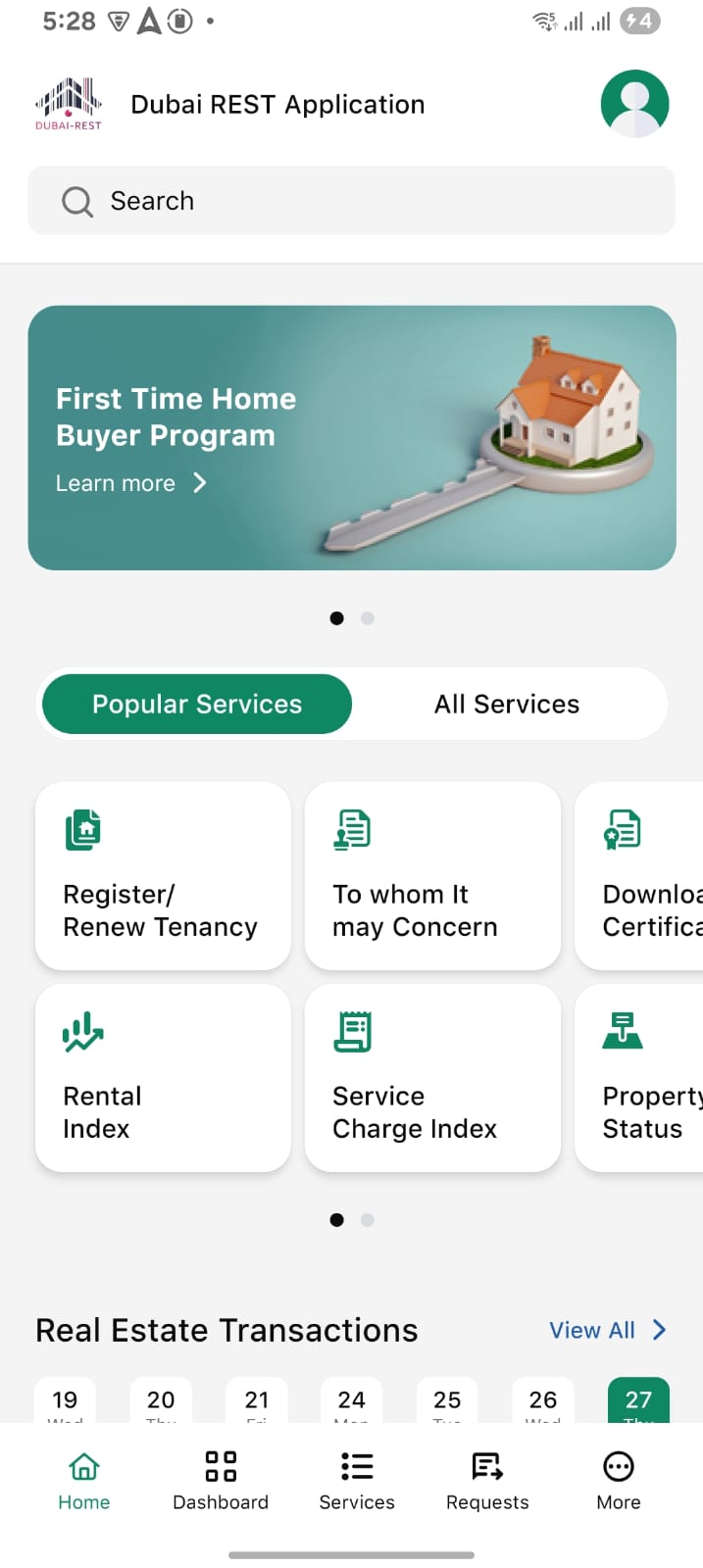
Dubai REST (Real Estate Self Transaction) is the official DLD application and is free on iOS and Android. You do not need to log in to verify a broker.
Step 3: Open the broker search function
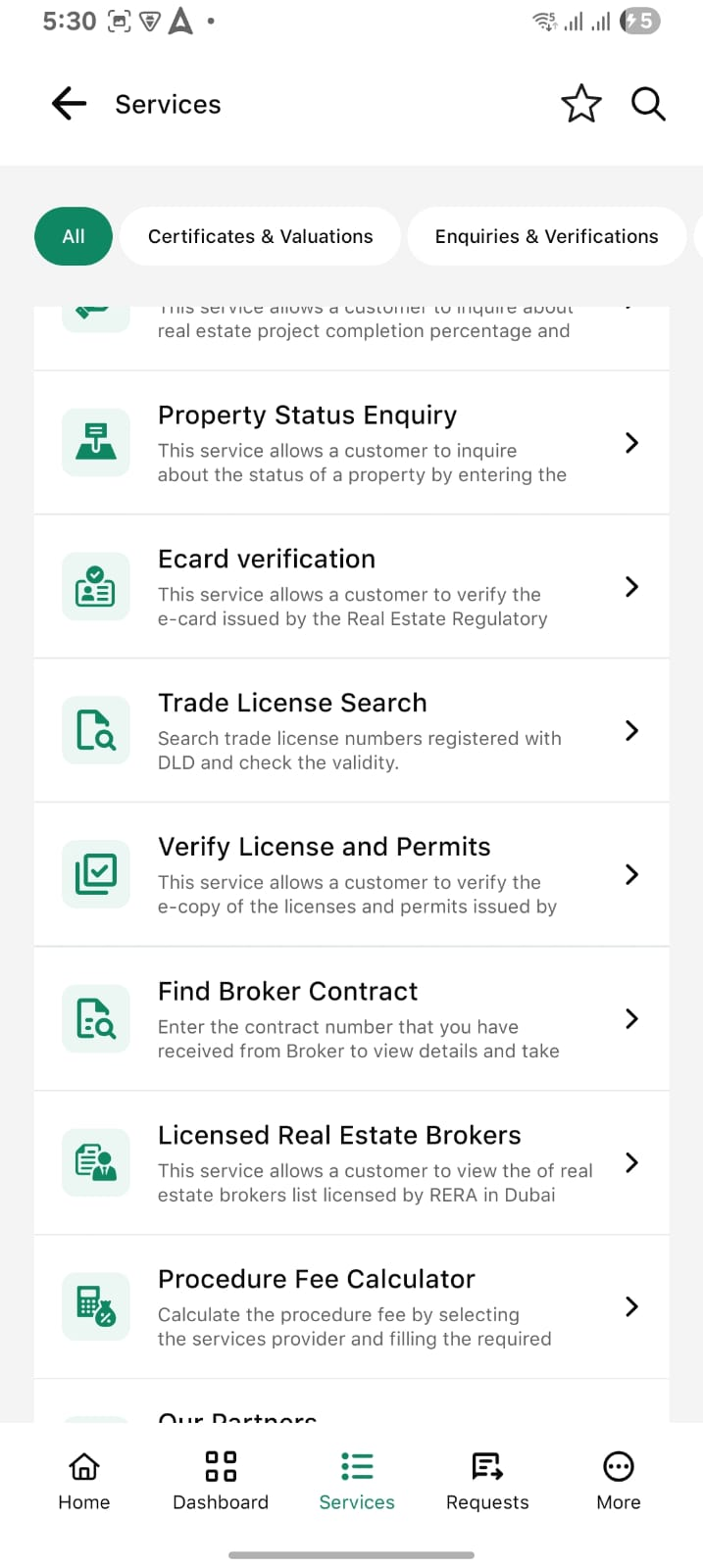
Inside the app, go to the Services, then drag down to the Licensed Real Estate Brokers menu.
Step 4: Search using the most precise identifier you have
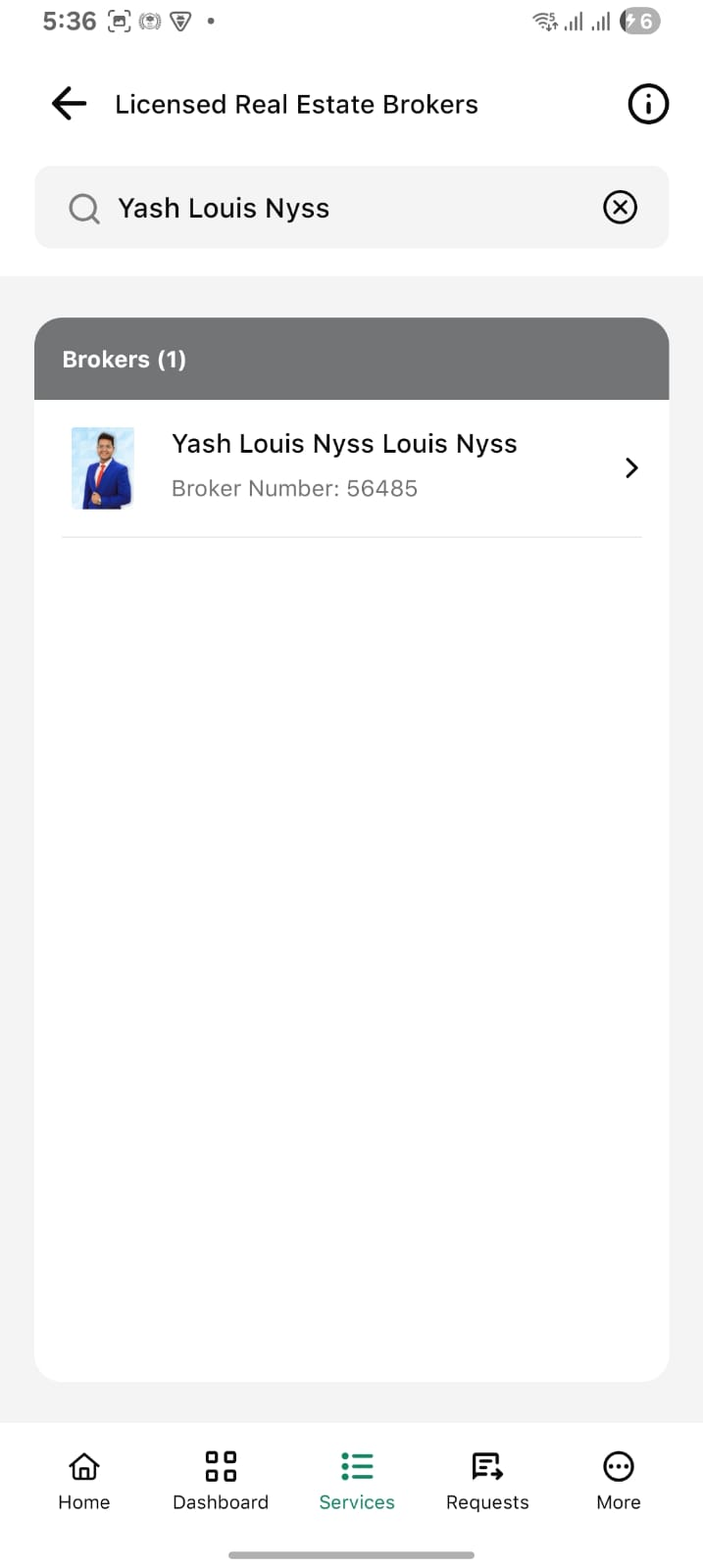
Search for the agent's full name, the BRN, the registered phone number, or the brokerage name. Entering the BRN gives you the most accurate result and removes any confusion between agents with similar names.
Step 5: Review the record that appears
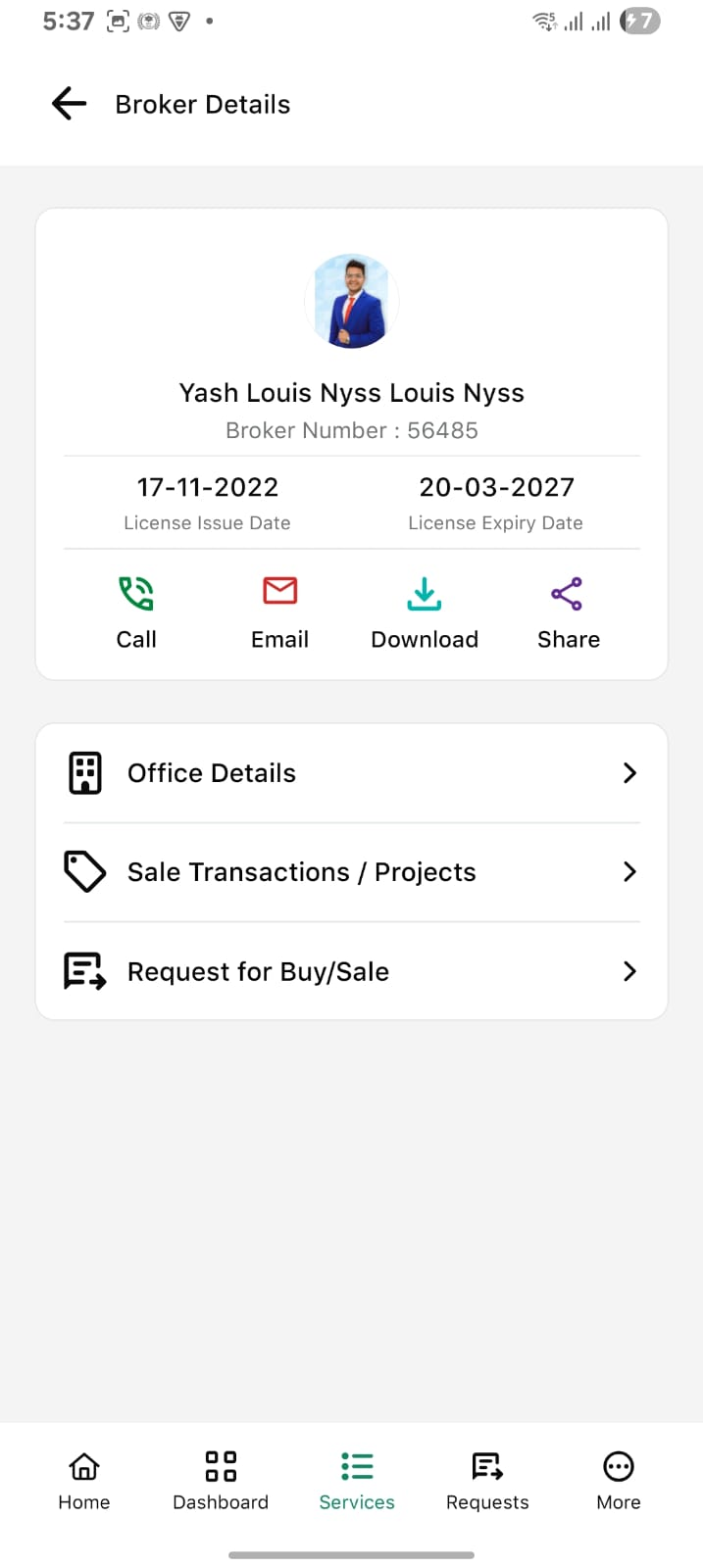
A valid record shows the agent's photograph, full legal name, BRN, affiliated brokerage, license status, and expiry date. Compare each field against what the agent told you verbally.
Step 6: Verify the brokerage separately
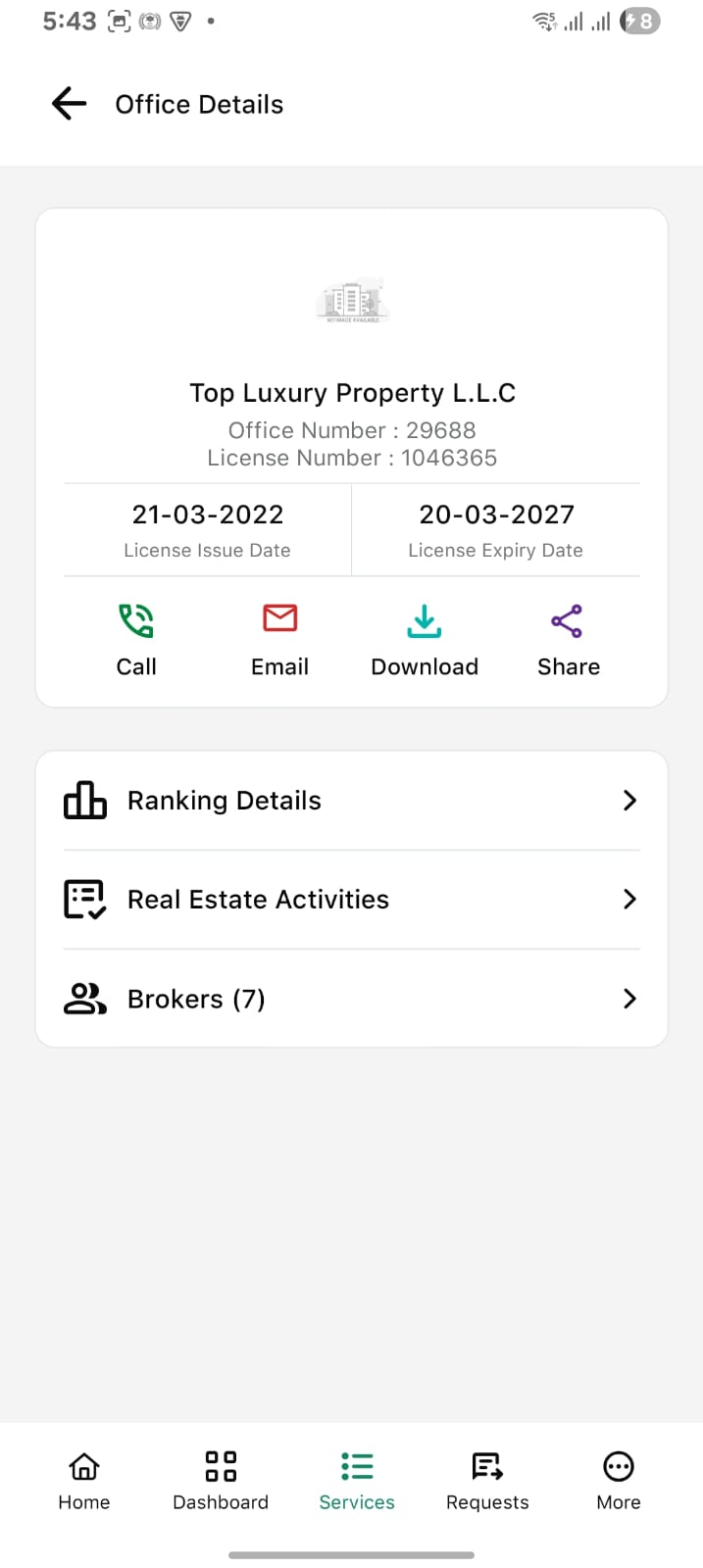
The same application confirms the company's ORN and registration status. The registered office address should match the address printed on business cards and correspondence.
Step 7: Check the advertisement permit
RERA requires every property advertisement, including portal listings, social media posts, brochures, and billboards, to display the agent's BRN and a valid advertising permit number issued through the Trakheesi system. Compliant listings usually carry a QR code or permit reference you can validate independently.
Step 8: Use another channel if anything looks inconsistent
The same check is available through the DLD website, the Dubai Brokers portal, and the DLD contact center on 800 4488.
How to Read the Result
- Active status with a matching brokerage. The agent is registered, and you can proceed.
- Expired or inactive status. That agent cannot lawfully broker your deal. Ask the firm for a registered colleague instead.
- Brokerage mismatch. The record shows a different employer from the one you were tcentreold. This usually reflects a recent move that has not been re-registered, so pause until the record is corrected.
- No record returned. The individual is not registered. Under Dubai law, unlicensed brokerage activity carries heavy fines, and a contract signed with an unlicensed intermediary can be challenged.
4. Seven Things to Look For When Choosing an Agent

1. Active registration
The Dubai REST check is your first filter and the one that allows no exceptions. Whatever documentation the agent hands you counts as a claim until the DLD record confirms it.
2. A track record in your specific community
Pricing in Dubai varies widely between communities and even between towers on the same project. An agent who closes regularly in Jumeirah Village Circle is not automatically the right adviser for Palm Jumeirah. Ask for recent transaction examples in your target community, named down to the building or sub-community.
3. Experience in price segment and asset type
Off-plan, ready resale, luxury villas and commercial leasing each involve different price analysis, financing structures, and negotiation. Check whatever the real estate professional specialization in that segment is.
4. Pricing supported by transaction data
A capable agent backs a valuation with recorded DLD sale prices for comparable units. Asking prices reflect what sellers hope for. Recorded transactions reflect what the market paid.
5. Written, transparent fee terms
The commission percentage, VAT treatment, payment trigger, and scope of services should appear in the signed agreement before the start. Any charge missing from that agreement should not reach you later.
6. Process discipline and responsiveness
Dubai transactions run to tight deadlines, particularly when a mortgage, an NOC, and a trustee appointment all need sequencing. Look for an agent who confirms next steps in writing and gives you realistic timelines.
7. Independent, verifiable client feedback
Reviews on major property portals, Google, and professional networks carry more weight than testimonials. Repeated themes across several sources tell you more than any single rating.
5. Questions to Ask Before Hiring a Real Estate Agent
Before any engagement, ask these questions
On Credentials
- What is your BRN, and which brokerage holds the ORN?
- When does your broker card expire?
- Is the brokerage VAT-registered, and what is its Tax Registration Number (TRN)?
- What is the Trakheesi permit number for this listing?
On Experience
- How many transactions have you completed in this community over the past twelve months?
- Which buildings or sub-communities do you transact in most often?
- Do you mainly handle off-plan, resale, or leasing business?
- Can you send me recent comparable sale prices recorded with the DLD?
On Representation
- Will you act for me alone, or do you also act for the other side in this deal?
- Which form will govern our relationship, Form A or Form B?
- What is the notice period if I want to end the agreement, and does that require Form U?
- If the property is listed by another brokerage, will you sign a Form I agent-to-agent agreement?
On Fees
- What is the total commission, as a percentage and as an amount in dirhams?
- Is VAT charged on top, and will I receive a valid tax invoice?
- At what point does commission become payable, and what happens if the deal does not complete?
- Which additional costs fall to me, including the DLD transfer fee, trustee fee, NOC, and mortgage registration?
On Process
- What is the expected timeline from offer acceptance to title transfer?
- Who prepares Form F, and when will I see the draft?
- How will my deposit be held, and to which registered account will it be transferred?
- What checks will you run on the seller's title deed and on any mortgage still outstanding against the property?
6. Red Flags to Avoid While Hiring a Real Estate Agent in Dubai

- Refusal or delay in giving you a BRN.
- An advertisement missing a Trakheesi reference or an agent BRN points to non-compliant marketing.
- Licensed brokerages invoice through company channels and issue receipts. If anyone asks payment in the personal account is a big red flag.
- Claims that an offer expires within hours or that several buyers are committing right now exist to stop you from doing your homework.
- Reluctance to put terms in writing. Verbal assurances about commission, exclusivity, or repairs carry little weight in a dispute.
- Credentials that do not match the DLD record.
- No affiliation with a registered brokerage. Independent operation without a BRN and an employing firm is unlawful.
- Prices presented without supporting evidence. A valuation offered without comparable DLD data cannot be tested for accuracy.
- Deposits are requested before Form F is drafted. The memorandum of understanding defines the terms your deposit is securing.
- Administration charges, marketing levies, or newly mandatory services absent from the original agreement deserve to be challenged.
7. Real Estate Agent Fees and Commission in Dubai
The commission in Dubai follows market convention. RERA regulates the paperwork and the dispute process, while the percentage itself stays negotiable between you and the brokerage.
Standard Commission by Transaction Type
|
Transaction type |
Typical commission |
Who customarily pays |
VAT |
|
Resale (ready) property purchase |
2% of the sale price |
The buyer, to the buyer's agent |
5% on the commission |
|
Resale property sale (listing) |
2% of the sale price, negotiable |
The seller, where a listing agent is appointed |
5% on the commission |
|
Off-plan purchase from a developer |
0% to the buyer |
The developer pays the brokerage directly |
Not applicable to the buyer |
|
Residential lease |
5% of the annual rent |
The tenant |
5% on the commission |
|
Commercial sale or lease |
Variable, depending on deal size |
Negotiated between the parties |
5% on the commission |
Worked Example: AED 2,000,000 Resale Purchase
- Agent commission at 2%: AED 40,000
- VAT at 5% on the commission: AED 2,000
- Total payable to the brokerage: AED 42,000, an effective 2.1% of the purchase price
Additional Costs to Budget For
|
Cost item |
Typical amount |
Notes |
|
DLD transfer fee |
4% of the purchase price |
Payable at transfer and occasionally split by agreement |
|
DLD administration fee |
Approximately AED 580 |
Fixed administrative charge |
|
Trustee office fee |
Approximately AED 2,100 to AED 4,200 plus VAT |
Scales with property value |
|
Developer NOC fee |
Approximately AED 500 to AED 5,000 |
Set by the developer rather than by the DLD |
|
Mortgage registration |
0.25% of the loan amount plus a fixed fee |
Applies to financed purchases only |
Total acquisition costs on a resale purchase commonly land between 6% and 8% above the purchase price once commission, DLD fees, and disbursements are added together.
What to Confirm Before You Sign
-
The rate is not mandated
No regulation fixes commission at 2%, although most established brokerages treat it as their standard. You can negotiate, though it is worth weighing what that does to the service you receive.
-
VAT applies to the commission, not to the property price
A brokerage charging VAT must be VAT-registered and must issue you a valid tax invoice showing its TRN.
-
Written agreements exist for a reason
Commission terms belong in Form A if you are selling and Form B if you are buying. Commission disputes rank among the most frequent complaints RERA handles, and undocumented arrangements are hard to enforce.
-
Off-plan is not cost-free overall
Developer-paid commission removes your brokerage fee, yet DLD registration and administrative charges still apply.
8. Buyer's Agent vs. Seller's Agent: Which Do You Need?
|
Consideration |
Buyer's agent |
Seller's agent (listing agent) |
|
Governing form |
Form B, the buyer representation agreement |
Form A, the marketing and listing agreement |
|
Primary objective |
Securing the property at the lowest achievable price and on favorable terms |
Achieving the highest achievable price within your timeframe |
|
Who pays the commission |
The buyer, on a resale transaction |
The seller, where a listing agent is separately engaged |
|
Main duties |
Property sourcing, comparable analysis, negotiation, mortgage and transfer coordination |
Valuation, marketing permits, viewing management, offer handling, NOC coordination |
|
Key limitation |
You carry the cost directly on resale purchases |
You may appoint a maximum of three brokers at once under Form A |
|
Best suited to |
Buyers unfamiliar with community pricing, and non-resident purchasers |
Owners who want broad market exposure and managed negotiation |
A few points to keep in view:
- Dual representation: A single agent acting for both sides has a built-in conflict of interest. Get the disclosure in writing, and check pricing independently if you go ahead.
- Form I transactions: Where your agent and the listing agent sit in different brokerages, a Form I agreement records the introduction and the commission split, commonly on a 50:50 basis.
- Termination: Form A and Form B are both ended through Form U, with a minimum of seven days' written notice and a stated reason. Going quiet does not end your obligation.
- Exclusivity: Exclusive listings often attract greater marketing spend from the brokerage, while non-exclusive arrangements widen exposure. Weigh both against your timeframe.
9. Key Takeaways
- Run the BRN and ORN check through Dubai REST before you do anything else.
- Community-level and price-segment experience predict your outcome far better than brand recognition does.
- A commission of 2% plus 5% VAT is market convention on resale transactions rather than a legal requirement.
- Every term that carries cost or obligation belongs in Form A or Form B before viewings begin.
- Move funds only to registered brokerage accounts or, on off-plan purchases, to the project's registered escrow account.